Symbols of Franco-American relations in Paris

A walk through Paris taking in the iconic sites associated with Americans in Paris, whilst also passing by some of the city’s famous landmarks.

The route can be followed in either direction.

Details

6354058
Creation:
Last update:
Last review:
  • Walking
    Activity: Walking
  • ↔
    Distance: 7.00 mi
  • ◔
    Average duration: 3h 20 
  • ▲
    Difficulty: Moderate

  • ⚐
    Back to start: No
  • ↗
    Ascent: + 108 ft
  • ↘
    Descent: - 49 ft

  • ▲
    Highest point: 197 ft
  • ▼
    Lowest point: 89 ft
  • ⚐ Country: France
  • ⚐ City: Paris (75000)
  • ⚑
    Start: N 48.84637° / E 2.333362°
  • ⚑
    End: N 48.868274° / E 2.293181°
  • ❏
    IGN map(s): Ref. 2314OT
  • Hour-by-hour weather

Photos

Description of the walk

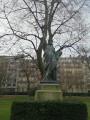
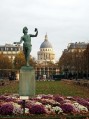
Starting from the Statue of Liberty in the Jardin du Luxembourg

(S) Head eastwards, passing between the Jeu de Paume (on the left) and the tennis courts (on the right). Turn left towards the central pond and walk round it on the right-hand side. Head towards the Senate building and walk round it on the right to exit via the gate at the junction of Rue de Vaugirard and Rue Rotrou. Take Rue Rotrou opposite and walk alongside the Odéon – Théâtre de l’Europe, emerging onto Place de l’Odéon.

(1) Follow Rue de l’Odéon to Boulevard Saint-Germain. Cross Boulevard Saint-Germain and take Rue de l’Ancienne Comédie (straight ahead). At the next junction, turn right into Rue Dauphine. Continue straight ahead to the Pont Neuf.

(2) Cross the bridge and walk past the statue of Henry IV. Immediately afterwards (i.e. without crossing the second branch of the Seine), turn right onto Quai de l’Horloge. Walk past the Palais de Justice and the Conciergerie, the Tour de l’Horloge, the Marché aux Fleurs and the Hôtel-Dieu. Then turn left onto the Pont d’Arcole.

On the other side, cross the Quai de Gesvres at the tricolour traffic lights, then cross the forecourt of the Hôtel de Ville. Continue straight on along Rue du Renard, passing the imposing Centre Georges Pompidou on your left. At the corner, turn left into Rue Rambuteau. At the next corner, turn left into Place Georges Pompidou.

(3) Continue straight on, passing the Stravinsky Fountain (with 16 sculptures set within the basin). Turn right, then left, to go round the Church of Saint-Merri. Follow Rue Saint-Martin and cross Rue Pernelle. Then turn right onto Rue de Rivoli and walk past the Tour Saint-Jacques.

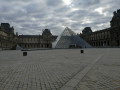
(4) At the corner of the Square de la Tour Saint-Jacques, turn left onto Boulevard de Sébastopol. Cross the Quai de Gesvres and follow it to the right. Continue along the Quai de la Mégisserie, the Quai du Louvre and the Quai François Mitterrand (a total of about 1 km). You’ll reach the Pont du Carrousel. Then turn right onto the square of the same name (with the Louvre Pyramid on your right).

(5) Before the roundabout, veer left and pass beneath the Arc du Triomphe du Carrousel. Then, walk straight through the Jardin des Tuileries to the Place de la Concorde. After the exit gate, turn right and cross the Rue de Rivoli at the traffic lights.

(6) Continue straight on along Rue Saint-Florentin. At number 2 is the Hôtel de Talleyrand (which served as the headquarters of the Marshall Plan between 1947 and 1952). Retrace your steps.

(6) Then turn right and walk along the square with it on your left. Pass in front of the Hôtel de la Marine. The Hôtel de Coislin was the site of the first alliance treaties signed between France and the United States on 6 February 1778, in which France recognised the independence of the United States and agreed to provide military support and ensure eternal peace between the two nations.
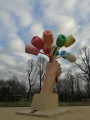
At the corner, turn left, cross the street and enter the Jardins des Champs-Élysées. Just before the famous avenue of the same name (Wallace Fountain), turn right. After about 300 metres, turn left and cross the Avenue des Champs-Élysées at the pedestrian crossing. Continue along Avenue Dutuit (passing behind the Petit Palais). You will emerge onto the Cours la Reine (on the left, Koons’s ‘Bouquet of Tulips’, which pays tribute to the attacks of 13 November 2015).

Follow Cours la Reine to the right. Cross Avenue Franklin Roosevelt and continue along Cours Albert1er. As you approach the Pont de l’Alma, go round Place de la Reine Astrid on the right. Cross Rue Jean Goujon, then Avenue Montaigne (Théâtre des Champs-Élysées, where Joséphine Baker, originally from the US, began her Parisian career).

(7) Follow the avenue to the left, going round the large junction on the left without crossing the Pont de l’Alma.

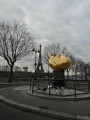
(8) Walk a few metres until you reach the Flame of Liberty, a gift to France from the United States in gratitude for the restoration of the Statue of Liberty completed in 1986 to mark its centenary. Retrace your steps.

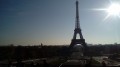
(8) Take the Pont de l’Alma to cross the Seine. Walk along the Quai Branly, crossing at the traffic lights, and head towards the Orthodox Cathedral of the Holy Trinity. Follow the Quai Branly to the right. Walk past the Musée du Quai Branly Jacques Chirac and continue to the Esplanade of the Eiffel Tower.

Alternatively, walk as far as the Pont de Grenelle, where you’ll find a scaled-down replica of the Statue of Liberty, donated by the American community in Paris (approximately 3 km there and back)

(9) Cross the Pont d’Iéna towards the Trocadéro Gardens.

(10) On the other side, go round the junction on the right and cross Avenue de New York and Avenue des Nations-Unies in turn. Continue through the gardens, then turn right to walk alongside the Paris Aquarium – Cinéaqua. Cross Avenue Albert de Mun, follow Avenue d’Iéna and walk alongside the Palais d’Iéna on your left.

(11) Go round the Place d’Iéna on the right (equestrian statue of George Washington) and cross Avenue du Président Wilson. Continue along Avenue d’Iéna. At the corner of Rue Freycinet, cross the avenue and emerge onto the Place des États-Unis, where you’ll find the Square Thomas Jefferson.

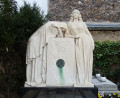
(12) Take a short detour to the right and back to reach the foot of the monument to the American volunteers (1917).

(12) Walk along the right-hand side of the square to reach the La Fayette-Washington Monument (E).

Waypoints

  1. S : mi 0 - alt. 138 ft - Jardin du Luxembourg
  2. 1 : mi 0.48 - alt. 135 ft - Place de l'Odéon
  3. 2 : mi 0.96 - alt. 95 ft - Pont Neuf
  4. 3 : mi 2.02 - alt. 108 ft - Centre Georges Pompidou
  5. 4 : mi 2.33 - alt. 118 ft - Tour Saint-Jacques
  6. 5 : mi 3.18 - alt. 112 ft - Louvre Pyramid - Arc de Triomphe du Carrousel
  7. 6 : mi 3.97 - alt. 108 ft - Place de la Concorde
  8. 7 : mi 5.22 - alt. 102 ft - Théâtre des Champs-Élysées
  9. 8 : mi 5.46 - alt. 115 ft - Flame of Liberty - Pont de l'Alma
  10. 9 : mi 6.05 - alt. 118 ft - Tour Eiffel
  11. 10 : mi 6.21 - alt. 108 ft - Trocédéro Gardens - Seine [la]
  12. 11 : mi 6.61 - alt. 154 ft - Equestrian statue of George Washington - Place d'IÉna
  13. 12 : mi 6.89 - alt. 180 ft - Monument aux Volontaires Américains
  14. E : mi 7 - alt. 197 ft - Statue of Lafayette and Washington - Square Thomas Jefferson

Notes

To get to the Jardin du Luxembourg
Bus 58, get off at Guynemer-Vavin; Bus 89, get off at Musée du Luxembourg; Metro line 12, get off at Notre-Dame-des-Champs; Metro line 4, get off at Saint-Placide; RER B, get off at Luxembourg

From Square Thomas Jefferson
Bus 22 & 30, Kléber – Paul Valéry stop; Metro line 6, Boissière stop; Metro line 9, Iéna stop

No particular difficulties; please wear comfortable shoes.

Worth a visit

The Luxembourg Gardens were created in 1612 at the request of Marie de Médicis to complement the Luxembourg Palace. They cover 23 hectares, 21 of which are open to the public and feature flowerbeds and sculptures

The Marché aux Fleurs has been located on the Île de la Cité since 1830. Partly covered and partly open-air, the market comprises several pavilions dating from the 1900s.

Paris City Hall has been the home of Paris’s municipal institutions since 1357. The building is in the Neo-Renaissance style and has been listed as a Historic Monument since 1975.

The Centre Georges Pompidou houses a museum of modern art, galleries for temporary exhibitions, theatres and cinemas, a library, IRCAM and the Brancusi workshop.

The Louvre Pyramid is a pyramid made of glass and metal, situated in the centre of the Cour Napoléon at the Louvre Museum in Paris. It houses the main entrance to the Louvre Museum.

The Grand Palais and Petit Palais were built for the 1900 World’s Fair, replacing the vast but uncomfortable Palais de l’Industrie. The Grand Palais has been listed as a Historic Monument since 2000.

The Théâtre des Champs-Élysées was built in 1913 in the Art Deco style. The building comprises three theatres (the Théâtre des Champs-Élysées, the Comédie des Champs-Élysées and the Studio des Champs-Élysées). It was listed as a Historic Monument in 1957.

The Flame of Liberty is a monument consisting of a life-size replica of the torch held by the Statue of Liberty at the entrance to New York Harbour and an unofficial memorial to Princess Diana.

The Cathedral of the Holy Trinity is an Orthodox cathedral topped by five bell towers covered in matt gold and an Orthodox cross.

The Quai Branly – Jacques Chirac Museum is a museum of African, Asian, Oceanic and American arts and civilisations.

The Eiffel Tower is a 300-metre-high iron tower built by Gustave Eiffel for the 1889 Paris World’s Fair.

The Palais d’Iéna is the headquarters of the Economic, Social and Environmental Council and the International Chamber of Commerce. It was listed as a Historic Monument in 1993 and registered as a Historic Monument in 2004.

The Equestrian Statue of George Washington was donated by a committee of American high-society women and unveiled in 1900.

Thomas Jefferson Square: The site of the square was originally occupied by the Chaillot reservoirs, which supplied water to the fountains on the right bank of the Seine and some of those on the left bank.

The Monument to the American Volunteers is a memorial to the American volunteers who served in the French army during theFirst World War.

Reviews and comments

4.7 / 5
Based on 2 reviews

Reliability of the description
5 / 5
Ease of following the route
5 / 5
Route interest
4 / 5
Rose7514
Rose7514

Overall rating : 4.7 / 5

Date of your route : Jan 29, 2026
Reliability of the description : ★★★★★ Very good
Ease of following the route : ★★★★★ Very good
Route interest : ★★★★☆ Good
Very busy route : Yes

The attraction is a walk through Paris.

Machine-translated

Echium
Echium

Overall rating : 4.7 / 5

Date of your route : Oct 05, 2025
Reliability of the description : ★★★★★ Very good
Ease of following the route : ★★★★★ Very good
Route interest : ★★★★☆ Good
Very busy route : Yes

We stopped the walk at the Concorde because there were too many people. . . It's true that it was a beautiful autumn day on Sunday. The theme wasn't very relevant, unless you took it to the extreme! We didn't see many traces of this Franco-American relationship, but the walk was very beautiful and the route took us through the most beautiful neighbourhoods of Paris. We had lunch in a very nice little restaurant near Beaubourg, so it was a great day for everyone!

Machine-translated

IamaHyFlyer
IamaHyFlyer
• Edited:

For Americans in Paris, this walking tour overlooks some absolutely crucial pieces of history: 56 Rue Jacob, the site where the Treaty of Paris was signed… where the USA gained its independence… which is pretty darn important in their history.

Machine-translated

Other walks in the area

For more walks, use our search engine .

The GPS track and description are the property of this route's author. Please do not copy them without permission.