A visit to Montparnasse Cemetery

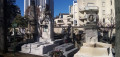
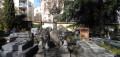
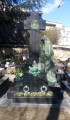
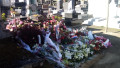
Less well-known and smaller than Père Lachaise Cemetery, Montparnasse Cemetery is the second largest cemetery within the city limits of Paris. It is the final resting place of many prominent figures, particularly from the worlds of the arts, publishing and politics. This route offers a stroll through this place of contemplation, discovering around fifty of these figures and several works of art scattered throughout the grounds.

Details

93876953
Creation:
Last update:
Last review:
  • Walking
    Activity: Walking
  • ↔
    Distance: 3.55 km
  • ◔
    Average duration: 1h 00 
  • ▲
    Difficulty: Easy

  • ⚐
    Back to start: No
  • ↗
    Ascent: + 7 m
  • ↘
    Descent: - 2 m

  • ▲
    Highest point: 63 m
  • ▼
    Lowest point: 54 m
  • ⚐ Country: France
  • ⚐ District: Paris (75000)
  • ⚑
    Start: N 48.841136° / E 2.325°
  • ⚑
    End: N 48.838458° / E 2.322751°
  • ❏
    IGN map(s): Ref. 2314OT
  • Hour-by-hour weather

Photos

Description of the walk

Start from Edgar Quinet metro station (line 6). Take the only exit onto Boulevard Edgar-Quinet.

Within the cemetery, the main avenues and paths are paved or tarmac-surfaced and are signposted. The route also takes secondary paths or trails, which are not signposted and may not appear on the base map.

In the description below, the names appearing on the graves may be highlighted for three different reasons:
1) Graves of
notable figures, in which case a lower-case letter in brackets refers to a short entry in the “Places to see” section, where names are listed in the order they appear on the route.
2) Particularly distinctive monuments.
3) Useful landmarks in the area.

(S) As you exit the metro station, turn left to cross Boulevard Quinet at the pedestrian crossing and follow it to the left. Walk along the cemetery wall on your right. After about 200 m, enter the cemetery through its main entrance.

Turn immediately left onto Avenue du Boulevard. Note the overgrown grave of Marguerite Duras on the left (a). At the end, turn right onto Avenue de l’Est. Note, on a large square slab of black marble on the right-hand side, a bird statue created by Nicky de Saint-Phalle. At the junction, turn left onto Avenue du Nord.

(1) Leave the western part of the cemetery, cross Rue Émile Richard and enter the eastern part. Turn right onto the avenue and note, on the left-hand side, the tomb of Charles Pigeon (b) and his wife Thérèse, depicted as recumbent figures on a monumental bed. Just after that, a tomb is adorned with two sculpted women. At the corner of Avenue Thierry, you arrive at the foot of the tomb of André Citroën (c) and his family.

Facing this grave, two grassy paths continue straight ahead: take the one on the right (do not turn right onto Avenue Thierry). Note, on the left, the simple grave of Joseph Kessel (e). Further on, pass between two monumental graves: that of the Wildenstein family on the right and that of the Jauro family on the left. Continue along a path to reach the grave of Alfred (e) and Lucie (f) Dreyfus, covered in pebbles. A little further on is the flower-covered grave of Félix Valloton (g). Continue along the path until you reach Avenue Thierry again.

(2) Follow the avenue to the right until you reach the grave of Auguste Bartholdi (h), on the right-hand side. On the left is the Wall of the Federates. Retrace your steps to the monuments (on the right-hand side) paying tribute to the Paris Fire Brigade, the Republican Guard and the soldiers of the 1870–1871 war.

(2) Continue straight ahead then turn right into Avenue du Midi. Leave the eastern part of the cemetery, cross Rue Émile Richard again and return to the eastern part. Shortly afterwards, turn right onto Avenue de l’Est. On the left, you will see a stele topped with a representation of a planet; this is the grave of the astronomer Urbain Le Verrier (i).

At the junction, turn right and immediately note, on the left, the grave of Stéphane Hessel (j). Then note, on the right-hand side, the grave of Bruno Cremer (k) with its humorous epitaph. Finally, arrive at the cenotaph of Charles Baudelaire (l). Retrace your steps back to the previous junction.

Continue straight ahead along Avenue Transversale. On the right, in the third row, you will see a grave whose slab is covered with oyster shells and topped by a glass bottle half-filled with a cloudy liquid. Still on the right, a little further on, is the grave of Samuel Beckett (m).

Here begins the first loop of the central part of the cemetery, in the form of a square following straight paths.

(3) At the junction, take a gravel path to the left, the Allée Chauveau-Lagarde. Go straight on and pass the grave of Mireille Darc (n) on the left, then that of Claude Chauveau-Lagarde (o) on the right. On the left, look for the grave of Charles Garnier (p) in the third row and that of François Coli (q) in the second. Next, on the right-hand side, note the grave of Claude Sautet (r) and, behind it, that of Alfred Mézières (s). At the next junction, look out for the Lichtig family grave (t) opposite, whose epitaph serves as a reminder that France can be a welcoming land.

Then turn right into a paved path (Allée Raffet). On the left-hand side, note the graves of Jacques Demy (u) and Agnès Varda (v), and the floral decorations that spill over onto the neighbouring shrubs. Roughly opposite, the grave of Jules Dalou (w).

At the foot of the mill (a remnant of the old farm on whose land the cemetery was established), turn right into Allée des Sergents de La Rochelle. Note a monumental sculpture on the right and, opposite, a truncated column inscribed with the names of the said sergeants (x). Shortly afterwards, on the right, you will find the grave of Georges (y) and Maryse (z) Wolinski.

(4) At the junction, turn right to quickly find, on the left-hand side, the grave of Philippe Noiret (aa), whose headstone is adorned with a small statue of a dog. Roughly opposite, note the grave of Jean Poiret (ab) and Caroline Cellier (ac). Return to the previous junction.

(4) Continue along the Allée des Sergents de La Rochelle and you will immediately see, on the left-hand side, the graves of Pierre Seghers (ad) and Marcel Bozzufi (ae).

At the next junction, turn right into Allée Lenoir. On the right-hand side, note the grave of the sculptor César (af), adorned with a miniature replica of his work *Le Centaure*. At the corner of the next junction, on the left-hand side, is the grave of Eugène Ionesco (ag).

Cross Avenue Principale and immediately on the left you will see the graves of Roland Petit (ah) and Zizi Jeanmaire (ai). Walk along a shaded, cobbled path and, just before the next junction, look out for the grave of Jean-Marc Reiser (aj) on the left, in the second row; his name is represented by the signature from his drawings, and his headstone features two aeroplane wings in reference to his passion for aviation.

Then return to Allée Chauveau Lagarde and follow it to the right. Shortly after the monument honouring a Parisian councillor, you will reach the junction where the first tour of the central section began.

Here begins a second loop of the central part of the cemetery, in the form of a circle following a path known as Allée Circulaire.

(3) Continue straight ahead and, after a statue of an angel, turn right onto Allée Circulaire. Note on the left a bust atop a stele: this is that of François Rude (ak). Cross Avenue Principale, walk a short distance, then turn right onto the path.

(4) Cross Avenue Transversale and, after a small obelisk, turn right into Allée Circulaire. Note, on the right-hand side, the grave of Émile Littré (al). Just before the next junction, note the grave of Honoré Champion (am) and its bas-relief. Cross the Avenue Principale and, after the Raspail family grave, turn right onto the path. Then, on the right-hand side, note the grave of Paul Belmondo (an).

This marks the end of the second circuit of the central section.

(3) Turn right onto Avenue Transversale, heading towards the prominent central monument. Note, in turn, on the left-hand side, the Jussieu family grave (ao), a fish-shaped sculpture, then the grave of Serge Gainsbourg (ap).

Go round the left side of the Monument to the Spirit of Eternal Sleep and you will immediately find the tomb of Jacques Chirac (aq). Take the first left and walk back up to the monument in tribute to those who died in the Civil Defence. Turn right, leaving the monument on your left, to find, behind it, the discreet tomb of Jean Carmet (ar).

Retrace your steps and continue round the central roundabout on the left. Take the second exit, the Avenue Principale. Cross the Allée Lenoir and continue straight on. On the left, the grave of Maryse Bastié (as) recalls her career as a pilot. Shortly afterwards, on the right, note the grave of Jean Seberg (at).

(5) At the junction immediately ahead, turn left onto Avenue du Nord. Immediately on the left, note the grave of Henri Langlois (au), evocative of the seventh art. A little further on, on the right, is the grave of Pierre Larousse (av). Then, on the left-hand side, note a statue of a cat created by Nicky de Saint-Phalle.

At the T-junction, turn left onto Avenue de l’Ouest. Shortly afterwards, note on the left, in the second row, the Beaudelaire family grave (l). Continue a little further along the avenue and, just after the Gérard family vault, turn left between the graves. First turn right then left around the Simonpaoli family grave to reach Lionel Jospin’s grave (aw).

Retrace your steps and continue along Avenue de l’Ouest. Shortly afterwards, follow a small path to the left to the grave of Christophe (ax). Retrace your steps and continue along Avenue de l’Ouest. At the next junction, note on the right a monument in honour of Jules Dumont-Durville (ay).

Continue south-west along Avenue de l’Ouest. Just before it ends, note the grave of Serge Reggiani on the left (az). Continue straight ahead and exit the cemetery. Then turn right twice to follow Avenue du Maine and you will soon reach Gaîté metro station (E).

To get back home:
By metro:
- Line 13: direct access.
- Line 6: follow Rue de la Gaîté to the right and, at the end, cross Boulevard Edgar Quinet to find the station of the same name on the right on the platform.
- Line 4: continue straight along Avenue du Maine, then cross Rue du Départ to reach Montparnasse station (also providing access to the Transilien’s Line N).

Waypoints

  1. S : km 0 - alt. 56 m - Edgar Quinet metro station
  2. 1 : km 0.55 - alt. 54 m - Crossing Rue Émile Richard
  3. 2 : km 0.86 - alt. 56 m - Avenue Thierry
  4. 3 : km 1.5 - alt. 58 m - Avenue Transversale x Allée Chauveau Lagarde
  5. 4 : km 1.79 - alt. 59 m - Av. Transversale x Allée Sergents de La Rochelle
  6. 5 : km 2.89 - alt. 55 m - Avenue Principale x Avenue du Nord
  7. E : km 3.55 - alt. 61 m - Gaîté metro station

Notes

A simple pair of trainers is sufficient for this short urban walk.

Inside the cemetery, water points are marked on the map and there are toilets on the left just past the main entrance on Boulevard Edgar Quinet. There are numerous bars and restaurants in the surrounding neighbourhood.

A detailed map is required (at the very least the one accompanying this description). It is recommended that you obtain the map provided by Paris City Hall, which indicates the locations of the graves of many notable figures.

Montparnasse Cemetery opening hours:
- Opening: between 8.00 am and 9.00 am depending on the day.
- Closing: from 6 November to 15 March, 5.30 pm; from 16 March to 5 November, 6.00 pm.
See detailed opening hours.

Need we remind you that a cemetery is a place of contemplation, and that discreet and respectful behaviour is required?...

Walk completed in two stages by the author, on 29 March and 6 April 2026.

Worth a visit

Some facts about the history of Montparnasse Cemetery:
Montparnasse Cemetery was established in July 1824 on the site of former farms, as evidenced by a mill that still stands today. At the time, it was situated outside the city walls of Paris. Rue Émile Richard, which cuts the cemetery in two, was built in 1890. Covering an area of 19 hectares, it is the second-largest cemetery in Paris, after Père Lachaise. It is the final resting place of many prominent figures, notably artists representing a wide variety of disciplines. In *La ballade des cimetières * (1961), Georges Brassens tells the story of a “well-dressed young man” who laments not having any graves to visit at the Montparnasse Cemetery,“a stone’s throw from [his] home”.

Graves of notable figures (non-exhaustive list) :
a - Marguerite Duras (1914–1996) Writer, playwright and film director.
b - Charles Pigeon (1838–1945) Entrepreneur, inventor of various types of lamps and petrol or spirit stoves.
c - André Citroën (1879–1935) Industrialist, pioneer of the automotive industry in France.
d - Joseph Kessel (1898-1979) Writer and reporter.
e - Alfred Dreyfus (1859–1935) Artillery officer, wrongly accused of spying for Germany and convicted of treason in 1894, against a backdrop of anti-Semitism. He was imprisoned in the Cayenne penal colony from 1895 to 1899. That year, his appeal hearing took place in Rennes and Alfred Dreyfus was once again convicted of treason. In September 1899, Émile Loubet, President of the Republic, pardoned Alfred Dreyfus, who filed an application for a retrial in November 1903. On 12 July 1906, Alfred Dreyfus’s innocence was recognised by the Court of Cassation and he was reinstated in the army. Retired in 1907, he was called up as a reserve officer throughout the First World War.
f - Lucie Dreyfus (1869–1945) Wifeof Alfred Dreyfus, she supported him unwaveringly and was extremely active in the fight for his rehabilitation.
g - Félix Vallotton (1865–1925) Painter, engraver, sculptor and novelist.
h - Auguste Bartholdi (1834–1904) Sculptor, best known for designing the Statue of Liberty, erected in New York (1886), and the Lion of Belfort (1880).
i - Urbain Le Verrier (1811–1877) Mathematician and astronomer, he is regarded as the founder of modern meteorology. In 1848, he revealed the existence of the planet Neptune through calculation alone; it was observed shortly afterwards.
j - Stéphane Hessel (1917–2013) Diplomat, writer and political activist. His 2010 manifesto, *Time for Outrage!*, reached a global audience.
k - Bruno Cremer (1929–2010) Theatre, film and television actor, best known for his portrayal of Inspector Maigret.
l - Charles Baudelaire (1821–1867) Poet, author of a prolific body of work, including *Les Fleurs du Mal*, and art critic.
m - Samuel Beckett (1906–1989) Irish writer, poet and playwright, who wrote in both English and French, and was awarded the Nobel Prize in Literature in 1969.
n - Mireille Darc (1938–2017) Actress, director and singer.
o - Claude Chauveau-Lagarde (1756–1841) A lawyer who, during the French Revolution, defended Charlotte Corday and Queen Marie Antoinette.
p - Charles Garnier (1825–1898) Architect responsible, amongst other things, for the Paris Opera House, construction of which began in August 1861 and which was inaugurated in January 1875.
q - François Coli (1881–1927) Aviator, who went missing alongside Charles Nungesser (1892–1927) whilst attempting to cross the North Atlantic by plane (the two are, incidentally, often associated in the streets or buildings named after them).
r - Claude Sautet (1924–2000) Screenwriter and film director.
s - Alfred Mézières (1826–1915) Writer, historian, journalist and politician.
t - Lucie (1912–1999) and Renée (1921–2007) Lichtig, a script supervisor and film editor respectively, who worked together on several films.
u - Jacques Demy (1931–1990) Director, screenwriter, dialogue writer and lyricist.
v - Agnès Varda (1928–2019) Filmmaker, photographer and visual artist.
w - Jules Dalou (1838–1903) A sculptor to whom we owe, amongst other works, *Le triomphe de la République*, a monument erected in 1889 in the centre of the Place de la Nation in Paris.
x - The Four Sergeants of La Rochelle: Jean-François Bories, Charles Goubin, Jean-Joseph Pomier and Marius-Claude Raoulx, accused of plotting against the monarchy and guillotined for this in 1822.
y - Georges Wolinski (1934–2015) Cartoonist, comic book author and journalist. He was among the victims of the attack on Charlie Hebdo on 7 January 2015.
z - Maryse Wolinski (1943–2021) Journalist and novelist.
aa - Philippe Noiret (1930–2006) Actor generally regarded as one of the greatest in French cinema.
ab - Jean Poiret (1926–1992) Comedian, actor, stage director and film director.
ac - Caroline Cellier (1945–2020) Actress.
ad - Pierre Seghers (1906–1987) Publisher, notably the founder, in 1944, of the Poètes d’aujourd’hui collection.
ae - Marcel Bozzufi (1929–1988) Actor, most often in supporting roles, and director.
af - César Baldaccini, known as César (1921–1998) Prolific sculptor, working mainly in metal, famous for his ‘compressions’, including the French film award that bears his name.
ag - Eugène Ionesco (1909–1994) Romanian-French playwright and writer.
ah - Roland Petit (1924–2011) Choreographer and dancer.
ai - Zizi Jeanmaire (1924–2020) Ballet dancer, revue star and singer.
aj - Jean-Marc Reiser (1941-1983) Cartoonist and comic book author.
ak - François Rude (1784–1855) Sculptor responsible, amongst other works, for *The Departure of the Volunteers of 1792*, a bas-relief adorning the Arc de Triomphe del’Étoilein Paris.
al - Émilie Littré (1801–1881) Lexicographer, philosopher and politician, remembered for his dictionary commonly known as Le Littré.
am - Honoré Champion (1846–1913) Bookseller and publisher.
an - Paul Belmondo (1898–1982) Sculptor.
ao - The Jussieu family (17th–19th centuries) Botanists and naturalists
ap - Serge Gainsbourg (1928–1991) Singer-songwriter, painter and writer.
aq - Jacques Chirac (1932–2019) Politician, Mayor of Paris (1977–1995), Prime Minister (1974–1976 and 1986–1988) and President of the Republic (1995–2007).
ar - Jean Carmet (1920–1994) Actor and screenwriter.
as - Maryse Bastié (1898–1952) An aviator, she obtained her pilot’s licence in 1925 and was the first woman to hold aviation records. In 1936, she flew solo across the South Atlantic. From September 1939 to May 1940, she served in the war as a volunteer in the Air Force.
at - Jean Seberg (1938–1979) American actress, muse of the French New Wave and activist against racial segregation.
au - Henri Langlois (1914–1977) Founder of the Cinémathèque Française.
av - Pierre Larousse (1817–1875) Encyclopaedist, lexicographer and publisher, author of the Grand Dictionnaire universel du XIXe Siècle, whose work lives on through the Petit Larousse.
aw - Lionel Jospin (1937-2026) Politician, Prime Minister (1997-2002).
ax - Daniel Bevilacqua, known as Christophe (1945–2020) Singer, film buff and jukebox collector.
ay - Jules Dumont-Durville (1790–1842) Naval officer and explorer. In 1940, he was one of the first humans to set foot on Antarctica and discovered Adélie Land.
az - Serge Reggiani (1922–2004) French actor and singer of Italian origin.

Sources: Paris City Hall and Wikipedia. See also a list of notable figures buried at Montparnasse Cemetery.

Other walks in the area

For more walks, use our search engine .

The GPS track and description are the property of this route's author. Please do not copy them without permission.