Country:
 City:
City:


Start: Kirn town centre
(S) Before we begin the official Soonwaldsteig trail, we will take a detour of about two kilometres to Kyrburg Castle. We follow Nahegasse towards Steinweg, turn left onto the L182 and immediately turn right again.
(1) Turn left onto "Auf der Kyrburg" to reach the castle.
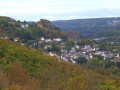
(2) On a long ridge between the Nahe and Hahnenbach valleys, you will come across the ruined medieval walls, which were first mentioned in documents in 1128. Kyrburg Castle was the ancestral seat of the Wildgrafen family, who dominated the Nahe region in the early Middle Ages. In 1734, it was blown up under French occupation. Today, Kyrburg Castle is owned by the town of Kirn, is its landmark and offers an outstanding view of the Nahe and Hahnenbach valleys.
From the castle, we head back towards Kirn market square and follow the signs for the Soonwaldsteig trail. We turn left into Embdengasse, cross the Hahnenbach stream and turn left. At the end of the street "An der Mühle", we turn right and then immediately left again.
(3) Then we turn right again and pass Alisa Park. We follow the road behind it to the left and now head into the hillside at the northern end of the town.
(4) Across meadows and along the edge of the forest, the trail continues uphill to the Oberhauser Felsen, the "Kirner Dolomites". This is a natural rock reef that was used in the Middle Ages to build the Stock im Hane, Stein and Kallenfels castles into the rugged quartzite rock, which today are collectively known as the "Steinkallenfels".
(5) Clearly visible, extremely spectacular but unfortunately inaccessible, the keep of the former Kallenfels Castle rises up in the middle of the village of Kallenfels on an exposed rock spur.
Take the Burgweg and Schloßstraße, which you then leave to the right, and continue through Kallenfels. Then enter the coppice and follow a forest path.
(6) This path leads to the "Three Castles Trail", which now joins the Soonwaldsteig trail to the left. A wider forest path leads towards Wartenstein Castle.
(7) The castle was built in 1357 as a fortress. In the exhibition "Erlebniswelt Wald und Natur" (Forest and Nature Experience), which is free of charge at Wartenstein Castle, visitors can learn about the diverse landscape of the Soonwald forest and the extraction of oak bark, which tanners needed to make leather.
The panoramic views from the castle courtyard down into the Hahnenbach Valley, one of the Soonwald's breakthrough valleys, and back to the quartzite rocks of Steinkallenfels are also well worth mentioning.
From Wartenstein Castle, the Soonwaldsteig trail descends steeply into the valley via stairways.
(8) Then we pass the village of Hahnenbach and turn off here onto "In der Au" and then onto Neue Straße. We leave the village again via Fasanenweg and then turn left and continue along the edge of the village for a while.
(9) Then we climb up a rocky, almost alpine path to the "Talblick" viewpoint. Here, a bench has been placed to allow visitors to enjoy the magnificent views down into the Hahnenbach Valley.
From this viewpoint, the route leads into the idyllic Steinbach Valley.
(10) We cross the Steinbach and follow the path to the left into the Hahnenbach valley.
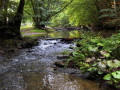
(11) At the bottom of the valley, cross the L 182 and walk into the wet meadows of the Hahnenbach stream on the western side of the valley. Only rarely directly alongside the stream, but always within earshot of the water, the Soonwaldsteig trail follows the Hahnenbach stream for a while. But soon after, the trail climbs uphill again and into the forest.
(12) After a series of ups and downs, narrow forest paths lead us to the tiny hamlet of Rudolfshaus. A paved farm track that follows the Hahnenbach stream leads from here directly to the former Reinhardsmühle mill, now the Forellenhof restaurant, which is about 600 metres away and the destination of the first stage of the hike.
(13) Deviating from this simple and tempting route, the Soonwaldsteig climbs steeply up the slope once again, passes a viewpoint on the hilltop and then descends steeply into the Hahnenbach valley and the Hotel Forellenhof. This is where the first stage of the Soonwaldsteig ends (E).
 Visorando Member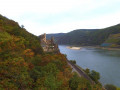
 Difficult