Berlin neighbourhoods: around the Oranienburger Tor

This route alternates between busy streets, including the famous Friedrichstraße, and much quieter streets. It is an opportunity to walk in the footsteps of Berlin's former Jewish community, one of the largest in Europe before the Nazi period.

Details

408047
Creation:
Last update:
Last review:
  • Walking
    Activity: Walking
  • ↔
    Distance: 5.09 km
  • ◔
    Average duration: 1h 30 
  • ▲
    Difficulty: Easy

  • ⚐
    Back to start: No
  • ↗
    Ascent: + 12 m
  • ↘
    Descent: - 12 m

  • ▲
    Highest point: 48 m
  • ▼
    Lowest point: 30 m
  • ⚐ Country: Germany
  • ⚐ City: Berlin 
  • ⚑
    Start: N 52.52027° / E 13.388282°
  • ⚑
    End: N 52.522685° / E 13.402337°
  • Hour-by-hour weather

Photos

Description of the walk

In the following description, the names of streets and main sites are written in German, i.e. as they appear on site, and in italics. The letter ß, specific to the German alphabet, is pronounced like a double s in English. See place names in the "Practical information" section.

Start: Friedrichstraße Station.

Access:
- S-Bahn - Lines 1, 2, 25, 5, 7 and 75.
- Underground - Line 6.
- Tram - Lines M1 and 12.

(S) From the station, take one of the Friedrichstraße exits (Ausgang). Follow this street north, cross the Reichtagufer and cross the Spree on the Weidendammer Brücke. Turn left immediately after the bridge and follow the river along Schiffbauerdamm. Pass Bertold-Brecht-Platz on your right and turn right at the next intersection onto Albrechtstraße. Ignore Marienstraße on your left.

(1) At the next intersection (monumental bunker opposite on the right), cross Reinhardtstraße and continue straight ahead. Then turn left into Schumannstraße. Pass the Deutsches Theater and continue along the pastel-coloured buildings on the right. At the next intersection (statue of Albrecht Von Graefe), turn right onto Luisenstraße. Keep the Charité Hospital (large brick complex) on your left and continue straight ahead. Cross Robert-Koch-Platz and, in its extension, Platz vor dem Neuen Tor. This will take you to a wide avenue, Invalidenstraße.

(2) Follow the avenue to the left, cross the Spree and you will reach the entrance to the Hamburger Bahnhof Museum on the right.

(3) Retrace your steps.

(2) Continue along Invalidenstraße and walk alongside the Museum für Naturkunde on your left. At the next intersection ( U-Bahn station), turn right onto Chausseestraße. At number 125, note the Brecht Haus. Immediately after, leave the street and turn right onto a small alley leading to two cemeteries (Dorotheenstadtisch and Französicher). When you reach a small square (information board), turn left at an acute angle and enter the Französischer Friedhof. Cross the cemetery diagonally to the right and take the exit that leads back to Chausseestraße. Follow this avenue again on the right.

(4) At the next intersection (traffic lights), cross Chausseestraße to the left and then Torstraße to the right. Continue along Chausseestraße and, at the next intersection, turn left into Oranienburger Straße. Ignore a street on the left and note an imposing building on the right, which was undergoing major renovation work in November 2016 (former artists' loft or squat). Ignore Auguststraße, pass the Oranienburger Straße S-Bahn station (on the left, a monumental former central post office building) and you will arrive at the Neue Synagoge.

(5) Continue along Oranienburger Straße and take the first left, Krausnickstraße. At the end of the street, turn right into Große Hamburger Straße. Walk along the old Jewish cemetery on your left and you will come to Oranienburger Straße, which you should follow to the left. At the crossroads, turn right and cross Große Präsidentenstraße. Stroll through Hackescher Markt via Neue Promenade and immediately head for the S-Bahn station (E).

To return home:
- S-Bahn - Lines 5, 7 and 75.
- Underground - Line 6.
- Tram - Lines M1, M4, M5, M6 and M8.

Waypoints

  1. S : km 0 - alt. 36 m - Friedrichstraße Station
  2. 1 : km 0.76 - alt. 38 m - Albrechtstraße x Reinhardtstraße
  3. 2 : km 1.77 - alt. 41 m - Invalidenstraße
  4. 3 : km 2.19 - alt. 36 m - Hamburger Bahnhof Museum für Gegenwart
  5. 4 : km 3.53 - alt. 40 m - Chausseestraße x Torstraße
  6. 5 : km 4.17 - alt. 43 m - Neue Synagoge
  7. E : km 5.08 - alt. 40 m - Hackescher Markt Station

Notes

Place names:
- The word most commonly used to refer to a street in a city is Straße (street), regardless of its length or width. This word is most often combined with the name of the street, as in Friedrichstraße. It can also appear separately, with hyphens, as in Rosa-Luxemburg-Straße, or without, as in Spandauer Straße.
- Other words for finding your way around: Allee (avenue, boulevard), Damm (quay), Gasse (alley), Weg (path), Platz (square), Markt (market place), Brücke (bridge), Bahnhof (station ).
- Buildings: Kirche (church), Dom or Kathedrale (cathedral), Synagoge (synagogue), Moschee (mosque), Museum (museum), Schloß (castle), Haus (house).

Public transport:
Public transport is very well developed and very convenient when visiting Berlin (and no doubt when living there too). There are four types of public transport:
- S-Bahn (suburban train)
- U-Bahn (underground)
- Straßenbahn (tram, only in former East Berlin)
- Bus (bus)
Tickets are valid for any of these modes of transport and must be validated. Tickets can be purchased on board from ticket machines. Tickets valid for 1, 2 or 3 days can also be purchased on board, as well as online and printed at home. For more information, visit the City of Berlin website.

Traffic:
- Given the space and urban planning, car traffic, which can be heavy in some places, rarely gives the impression of being as dense as in a large city in France.
- Berliners strictly obey green/red traffic lights for pedestrians and do not appreciate it when others do not do the same. However, there are many crossings without traffic lights or pedestrian crossings.
- Pavements are sometimes shared between pedestrians and cyclists, although this is not always clearly marked.

Equipment:
- Low-cut sports or hiking shoes are preferable to city shoes.
- From November to March, it is generally cold in Berlin and can be extremely cold. During this period, do not skimp on warm clothing.

Times, resources and alternatives:
- The times indicated are walking times, not including the many stops and visits that can be made. Depending on the number of visits and their duration, the time for this walk can vary from a few hours to a full day.
- The route alternates between busy areas and quieter areas. Given the characteristics of Berlin's urban planning, even in busy areas, there is plenty of space.
- Appropriate dress and behaviour are required in churches (see signs at the entrance). No visits to churches during services.
- There are bars and restaurants along the route where you can stop for refreshments or a meal. The toilets in these establishments are for customers only. There are also a few public toilets (payable).
- The itinerary can of course be varied depending on the sites you wish to visit or your inspiration, provided you have a detailed map (see below). It can be extended with the "Berlin neighbourhoods: Scheunenviertel and Prenzlauger Berg" walk, which starts at Hackescher Markt Station.

Maps:
It is essential to bring a detailed map with the names of the streets in German (at least the one accompanying this description). City maps can be purchased on site at the main tourist sites. They can also be obtained in France from specialist bookshops (for example, IGN offers a handy 1:15,000 map).

Hike completed by the author on 12 November 2016.

Worth a visit

This walk is part of a series of walking routes dedicated to Berlin, none of which claim to be exhaustive in terms of places to see or visit. In addition to the city's unique urban planning, characterised above all by its spaciousness, the following sites are worth mentioning:
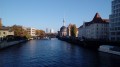
- Weidendammer Brücke shortly after (S). Nice view of the River Spree and Museum Island.
- Bunker (1). This imposing concrete building, erected in 1943, housed the NKVD (Soviet political police) after the war. Of dubious aesthetic value but apparently indestructible, it has now been converted into a theatre.
- Hamburger Bahnhof Museum für Gegenwart (3). Museum of modern art housed in a disused railway station.
- Museum für Naturkunde, between (2) and (4): natural history museum.
- Brecht Haus, formerly (4). House where Bertold Brecht (1886-1956) and his wife Hélène Weigel (1900-1971) lived from 1953, now converted into a museum.
- Dorotheenstadtisch and Französicher cemeteries, front (4). Open from 8 a.m. to 5 p.m. from November to February, and from 8 a.m. to 8 p.m. from March to October. Proper behaviour is required (see the sign at the entrance).
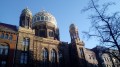
- Neue Synagoge (5). Built between 1859 and 1866, it was vandalised by the Nazis in November 1938 during Kristallnacht. Damaged by Allied bombing in 1943, it was restored in 1988. Visits are charged every day except Saturday.
- Old Jewish cemetery along Große Hamburger Straße, before (E).
- Hackescher Markt (E), a lively square.

Reviews and comments

Other walks in the area

For more walks, use our search engine .

The GPS track and description are the property of this route's author. Please do not copy them without permission.