Memories of the Berlin Wall: from the East Side Gallery to Potsdamer Platz

Erected in 1961 and demolished in 1989, the Berlin Wall was a symbol of the Cold War. The route mainly follows the former course of the wall, the longest section of which remains in place and is now decorated with paintings by various artists. An urban walk that is both historical and commemorative.

Details

407187
Creation:
Last update:
Last review:
  • Walking
    Activity: Walking
  • ↔
    Distance: 6.77 km
  • ◔
    Average duration: 2h 05 
  • ▲
    Difficulty: Easy

  • ⚐
    Back to start: No
  • ↗
    Ascent: + 50 m
  • ↘
    Descent: - 48 m

  • ▲
    Highest point: 53 m
  • ▼
    Lowest point: 26 m
  • ⚐ Country: Germany
  • ⚐ City: Berlin 
  • ⚑
    Start: N 52.506709° / E 13.449721°
  • ⚑
    End: N 52.509416° / E 13.376829°
  • Hour-by-hour weather

Photos

Description of the walk

In the following description, the names of streets and main sites are written in German, i.e. as they appear on site, and in italics. The letter ß, specific to the German alphabet, is pronounced like a double s in English. See the place names in the "Practical information" section.

Start: Warschauer Straße Station.

Access:
- S-Bahn - Lines 5, 7 and 75.
- Underground - Line 1.
- Tram - Lines M1 and 12.

On this route, particularly from (3), there are small signs marked "Berliner Mauerweg" below the street signs.

(S) When you leave the station (both the S-Bahn and U-Bahn stations), turn left and walk down Warschauer Straße on the left-hand side. When you reach the U-Bahn station, cross the road at the traffic lights and continue down the road on the right-hand side. At the bottom of the hill, cross Mühlenstraße and you will see the old wall on your right (before continuing on your route, don't hesitate to walk back a few metres to get a view of the Oberbaumbrücke).

(1) Then turn right and follow Mühlenstraße, keeping the old wall on your left. At the very beginning and then after about 500 metres, you can cross to the other side of the wall, towards the banks of the River Spree, but these are dead ends (moreover, only the part of the wall facing the street is painted). After passing a tall white building on the left (no. 60), cross to the river side and follow the wall (painted here) on your right (you can also continue on the street side). After about 250 metres, you will find a passage to the street on your right (the wall ends here).

(2) Continue west-northwest on Mühlenstraße and walk along the Energieforum Berlin (large brick building) on your left.

(3) At the next intersection (traffic lights), turn left and take the Schillingbrücke bridge to cross the Spree. Stay on the left-hand pavement and, when the street splits into two branches, follow the left-hand one, Benthaniendamm. Cross Köpenickerstraße and continue along Benthaniendamm, which curves to the right, passing a public garden below on the right and a church on the left. Cross Adalbertstraße and you will reach a T-junction.

Then turn left onto Leuschnerdamm to go around a pond surrounded by a garden below on the right. At the next intersection, turn right onto Waldemarbrücke, which crosses the garden, and continue straight ahead onto Waldemarstraße. At the next fork, turn left onto Luckauerstraße and leave Alfred-Döblin Platz on your left (information sign).

(4) At the next intersection, turn right onto Sebastianstraße (information sign on the right-hand pavement). Cross Prinzenstraße and continue along Sebastianstraße, which turns right and becomes a pedestrian street (map on the left). Walk between the buildings (which are separated by a wall!) and, when you reach No. 21A on the right, turn left and follow Alexandrinenstraße. At the next intersection, turn right onto Stallschreiberstraße (a cobbled alleyway starting at the foot of a building, No. 49).

(5) At the end, turn left onto Alte Jacobstraße, then immediately right onto Kommandantenstraße. Ignore a street on the right and, at the end of Kommandantenstraße, turn left onto Axel-Springer-Straße (a wide avenue). Then take the second street on the right, Zimmerstraße, which starts at the foot of a sculpture incorporating remains of the wall, at the foot of a glass building on the left. Follow Zimmerstraße straight ahead, crossing several perpendicular streets until you reach Checkpoint Charlie at the intersection with Friedrichstraße (there are numerous information signs).

(6) Continue straight ahead, still on Zimmerstraße, and cross Wilhelmstraße.

(7) Then turn left and right to enter the Topography of Terror esplanade. Cross this open-air memorial located on the remains of the Gestapo headquarters (information panels). Exit on the opposite side, turn right and then left and follow Niederkirchenerstraße between the Martin Gropius Bau on the left and the former Prussian Parliament on the right (information sign). At the end of the street, turn right onto Stresemannstraße. Follow this avenue to its end, Potsdamer Platz(E).

To return home:
- S-Bahn - Lines 1, 2 and 25.
- Underground - Line 2.

Waypoints

  1. S : km 0 - alt. 33 m - Warschauer Straße Station
  2. 1 : km 0.52 - alt. 32 m - Start of the East Side Gallery - Mur de Berlin
  3. 2 : km 1.62 - alt. 37 m - End of the East Side Gallery
  4. 3 : km 1.97 - alt. 34 m - Schillingbrücke
  5. 4 : km 3.58 - alt. 40 m - Alfred-Döblin Platz
  6. 5 : km 4.5 - alt. 38 m - Alte Jacobstraße
  7. 6 : km 5.67 - alt. 39 m - Check Point Charlie
  8. 7 : km 5.99 - alt. 39 m - Wilhelmstraße - Topography of Terror
  9. E : km 6.77 - alt. 35 m - Potsdamer Platz

Notes

Place names:
- The word most commonly used to refer to a street in a city is Straße (street), regardless of its length or width. This word is most often combined with the name of the street, as in Friedrichstraße. It can also appear separately, with hyphens, as in Rosa-Luxemburg-Straße, or without, as in Spandauer Straße.
- Other words for finding your way around: Allee (avenue, boulevard), Damm (quay), Gasse (alley), Weg (path), Platz (square), Markt (market place), Brücke (bridge), Bahnhof (station ).
- Buildings: Kirche (church), Dom or Kathedrale (cathedral), Synagoge (synagogue), Moschee (mosque), Museum (museum), Schloß (castle), Haus (house).

Public transport:
Public transport is very well developed and very convenient when visiting Berlin (and no doubt when living there too). There are four types of public transport:
- S-Bahn (suburban train)
- U-Bahn (underground)
- Straßenbahn (tram, only in former East Berlin)
- Bus (bus)
Tickets are valid for any of these modes of transport and must be validated. Tickets can be purchased on board from ticket machines. Tickets valid for 1, 2 or 3 days can also be purchased on board, as well as online and printed at home. For more details, visit the City of Berlin website.

Traffic:
- Given the space and urban planning, car traffic, which can be heavy in some places, rarely gives the impression of being as dense as in a large city in France.
- Berliners strictly obey green/red traffic lights for pedestrians and do not appreciate it when others do not do the same. However, there are many crossings without traffic lights or pedestrian crossings.
- Pavements are sometimes shared between pedestrians and cyclists, although this is not always clearly marked.

Equipment:
- Low-cut sports or hiking shoes are preferable to city shoes.
- From November to March, it is generally cold in Berlin and can be extremely cold. During this period, don't skimp on warm clothing.

Times, resources and alternatives:
- The times indicated are walking times, not including the many stops and visits that can be made. Depending on the number of visits and their duration, the time for this walk can vary from a few hours to a full day.
- The route alternates between busy areas and quieter areas. Given the characteristics of Berlin's urban planning, even in busy areas, there is plenty of space.
- Appropriate dress and behaviour are required in churches (see signs at the entrance). No visits to churches during services.
- There are bars and restaurants along the route where you can stop for refreshments or a meal. The toilets in these establishments are for customers only. There are also a few public toilets (payable).
- The itinerary can of course be varied depending on the sites you wish to visit or your inspiration, provided you have a detailed map (see below).

Maps:
It is essential to have a detailed map with the names of the streets in German (at least the one accompanying this description). City maps can be purchased on site at the main tourist sites. They can also be obtained in France from specialist bookshops (for example, IGN offers a handy 1:15,000 map).

Hike completed by the author on 11 November 2016.

Worth a visit

This walk is part of a series of walking routes dedicated to Berlin, none of which claim to be exhaustive in terms of places to see or visit. In addition to the city's unique urban planning, characterised above all by space, the following sites are worth mentioning:
- Oberbaumbrücke (1885) (1). This bridge over the Spree was one of the checkpoints between West Berlin and East Berlin.
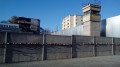
- East Side Gallery, between (1) and (2). This is the longest section of the wall still standing (1.3 km) and, after 1989, it was painted by various artists.
- Checkpoint Charlie (6). On Friedrichstraße, this is undoubtedly the most famous border crossing between East and West. There are numerous information panels at this intersection, and no fewer than three museums dedicated to the Wall, varying in size and admission price.
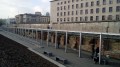
- Topography of Terror (7). Moving remains of the Gestapo headquarters, with several information panels. Remains of the wall along the street.
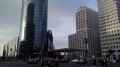
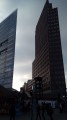
- Potsdamer Platz (E), surrounded by numerous buildings.

Reviews and comments

Other walks in the area

For more walks, use our search engine .

The GPS track and description are the property of this route's author. Please do not copy them without permission.