The historic centre of Berlin

Berlin, a city with unique urban planning, presents here its most historic buildings, including the Reichstag and the Brandenburg Gate, as well as several memorial sites. The central station, at the start, and Alexanderplatz, at the finish, showcase beautiful examples of modern architecture.

Details

407094
Creation:
Last update:
Last review:
  • Walking
    Activity: Walking
  • ↔
    Distance: 6.84 km
  • ◔
    Average duration: 2h 10 
  • ▲
    Difficulty: Easy

  • ⚐
    Back to start: No
  • ↗
    Ascent: + 79 m
  • ↘
    Descent: - 53 m

  • ▲
    Highest point: 60 m
  • ▼
    Lowest point: 18 m
  • ⚐ Country: Germany
  • ⚐ City: Berlin 
  • ⚑
    Start: N 52.524652° / E 13.369874°
  • ⚑
    End: N 52.521569° / E 13.411273°
  • Hour-by-hour weather

Photos

Description of the walk

In the following description, the names of roads and main sites are written in German, i.e. as they appear on site, and in italics. The letter ß, specific to the German alphabet, is pronounced like a double s in English. See the place names in the "Practical information" section.

Starting point: Hauptbahnhof (central station).

Access:
- S-Bahn - Lines 5, 7 and 75.
- U-Bahn - Line 55.
- Regional and international trains.

(S) From the station, take the "Washingtonplatz" exit (Ausgang). Cross the esplanade and then Rahel-Hirsch-Straße. Then cross the Spree on a footbridge for pedestrians and bicycles, heading towards the Reichstag. Note two very large buildings in the distance: on the left, the Paul-Löbe-Haus and, on the right, the Chancellery, recognisable by its large round glass window. After the footbridge, ignore the narrow alleyway perpendicular to it and, at the fork immediately after, take the wide gravel path on the left, leaving the Swiss Embassy on your right (recognisable by its flag). Walk along the Paul Löbe Haus on your left and pass under its impressive overhanging roof. Cross Paul-Löbe-Allee and you will arrive at Republiplatz, a large lawn facing the Reichstag.

(1) Cross the lawn with the Reichstag on your left (visitors' entrance on the other side of the square). Then cross Scheidemannstraße and turn left into Simsonweg, a wide, tree-lined, partly cobbled lane. Ignore the alley on your right and walk along the memorial to the gypsies deported and executed during the Nazi period on your left. Cross the boulevard at the traffic lights and you will reach Platz des 18.März, at the foot of the Brandenburg Gate.

(2) Pass under the gate and walk around Pariser Platz (French Embassy on the left, US Embassy on the right). Pass under the gate again.

(2) Follow the boulevard to the left (Erbertstraße) and walk along the US Embassy on your left. Then turn left into Behrenstraße and walk along the Holocaust Memorial on your right (you can also wander among the many grey stone blocks). Then turn right into Cora-Berliner-Straße and walk to the entrance of the memorial crypt.

Continue in the same direction and, at the next intersection, turn left onto Hannah-Arendt-Straße. Cross Wilhelmstraße and continue along Französische Straße. Cross Mauerstraße, pass under an arch connecting two buildings and cross Glinkastraße.

(3) At the next intersection, turn right onto Friedrichstraße, preferably on the left-hand side (numbers 78 and above). Cross Jägerstraße and walk along the Friedrichstadt Passage (shopping arcade) on your left. Then turn left onto Taubenstraße. At the end, continue straight ahead onto Gendarmenmarkt. Opposite the entrance to the Deutscher Dom on your right, turn left, pass the Konzerthaus and continue to the entrance to the Französischer Dom.

Go around the church on the right and continue along Markgrafenstraße. Cross Französische Straße and turn right at the end of the street. Then turn left, leaving St. Hedwigs-Kathedrale on your right. Cross a square, walking alongside the Humboldt University Law Faculty. You will come to a very wide avenue, Unter den Linden. To cross it, either turn left and walk past the equestrian statue of Frederick II (as shown on the map; be careful, there are no traffic lights here), or turn right and cross at the traffic lights.

(4) Then turn right, walk along the Humboldt University building on your left and note the Opera House on the opposite side of the avenue. Next, walk along the Neue Wache, a small temple with columns. Cross a street and walk along the Deutsches Historisches Museum. Pass the Schloß Brücke to cross the Spree. Turn slightly left off the avenue and take the lawn of the Lustgarten to head towards the entrance to the Berliner Dom, located on the right-hand side of its façade (note the former People's Palace on the other side of the avenue, which was undergoing reconstruction in November 2016).

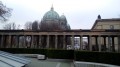
(5) Turn left towards the centre of the lawn, pass a small pond (not always filled with water) and head for the large granite basin in front of the entrance to the Altes Museum. Go around the museum on the right and follow Am Lustgarten on the left. At the end, turn left and immediately right under the arcades towards the Alte National Galerie (you are now on Museum Island). At the entrance to the Neues Museum, turn right and walk past the Alte National Galerie, which towers above you on your left. Continue straight ahead, walk past a golden statue of a horseman and you will come to the arcades overlooking the Spree. Turn right under the arcades and leave Museum Island by taking the Friedrichsbrücke bridge over the Spree on your left.

(6) At the end of the bridge, turn right, go down to the quay and follow the river on your right (the cathedral is clearly visible on the opposite bank). Pass the DDR Museum and go under the Liebknechtbrücke through a small tunnel. Go up a few steps and turn left towards the Marx and Engels monument. Go around the monument on the right and follow the path on the left, which curves to the right (towards the brick belfry of Berlin City Hall). Turn left again to come out onto Spandauer Straße. Follow the street on the right until you reach the traffic lights (Berlin City Hall is on the corner opposite on the left).

(7) At the traffic lights, turn left into Rathaustraße (Town Hall Street). At the next crossroads, turn left towards Nikolaikirche (signposted 100 metres ahead). Ignore a passage on the left and you will come to a square opposite the church (with a well topped by a bear, the emblem of Berlin). Start walking around the church on the right (counterclockwise) and keep the Museum Knoblauchhaus and then the Gedenkbibliothek on your right. Opposite No. 29, turn left and then left again at the end into Propstraße. Before reaching the front of the church, turn right, keeping the restaurant Zum Nußbaum on your left. At the next fork, turn right. At the end of the street, turn left onto Spandauer Straße and continue to the intersection you came from.

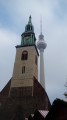
(7) At the traffic lights, cross Spandauer Straße to the right and then Rathaustraße to the left. Follow Spandauer Straße until you reach the point where you came from the Marx and Engels monument. Leave the street and turn right towards the Neptune Fountain, which stands in the middle of a large square. Continue diagonally to the left until you reach the façade of St. Marienkirche. Go around the church on the right. Leave the stairs leading to the Menschen Museum on your right and take a passageway, leaving the restaurant "Alex" on your left. Pass under the Fernsturm on your right. Continue to the right. You will come to a square and, on the other side of the street, you will reach Alexanderplatz station (E).

To return home:
- S-Bahn - Lines 5, 7 and 75.
- U-Bahn - Line 5.
- Tram - Lines M2, M4, M5 and M6.

Waypoints

  1. S : km 0 - alt. 18 m - Hauptbahnhof
  2. 1 : km 0.76 - alt. 31 m - Platz der Republik (Reichtag)
  3. 2 : km 1.17 - alt. 36 m - Bradenburger Tor (Porte de Brandebourg)
  4. 3 : km 2.57 - alt. 41 m - Friedrichstraße
  5. 4 : km 3.66 - alt. 40 m - Unter den Linden
  6. 5 : km 4.22 - alt. 52 m - Berlin Cathedral
  7. 6 : km 4.82 - alt. 30 m - Friedrichsbrücke
  8. 7 : km 5.46 - alt. 38 m - Spandauer Straße x Rathaustraße
  9. E : km 6.84 - alt. 40 m - Alexanderplatz Station

Notes

Place names:
- The word most commonly used to refer to a street in a city is Straße (street), regardless of its length or width. This word is most often combined with the name of the street, as in Friedrichstraße. It can also appear separately, with hyphens, as in Rosa-Luxemburg-Straße, or without, as in Spandauer Straße.
- Other words for finding your way around: Allee (avenue, boulevard), Damm (quay), Gasse (alley), Weg (path), Platz (square), Markt (market place), Brücke (bridge), Bahnhof (station ).
- Buildings: Kirche (church), Dom or Kathedrale (cathedral), Synagoge (synagogue), Moschee (mosque), Museum (museum), Schloß (castle), Haus (house).

Public transport:
Public transport is very well developed and very convenient when visiting Berlin (and no doubt when living there too). There are four types of public transport:
- S-Bahn (suburban train)
- U-Bahn (underground)
- Straßenbahn (tram, only in former East Berlin)
- Bus (bus)
Tickets are valid for any of these modes of transport and must be validated. Tickets can be purchased on board from ticket machines. Tickets valid for 1, 2 or 3 days can also be purchased on board, as well as online and printed at home. For further information, visit the City of Berlin website.

Traffic:
- Given the space and urban planning, car traffic, which can be heavy in some places, rarely gives the impression of being as dense as in a large city in France.
- Berliners strictly obey green/red traffic lights for pedestrians and do not appreciate it when others do not do the same. However, there are many crossings without traffic lights or pedestrian crossings.
- Pavements are sometimes shared between pedestrians and cyclists, although this is not always clearly marked.

Equipment:
- Low-cut sports or hiking shoes are preferable to city shoes.
- From November to March, it is generally cold in Berlin and can be extremely cold. During this period, do not skimp on warm clothing.

Times, resources and alternatives:
- The times indicated are walking times, not including the many stops and visits that can be made. Depending on the number of visits and their duration, the time for this walk can vary from a few hours to a full day.
- The route alternates between busy areas and quieter areas. Given the characteristics of Berlin's urban planning, even in busy areas, there is plenty of space.
- Appropriate dress and behaviour are required in churches (see signs at the entrance). No visits to churches during services.
- There are bars and restaurants along the way where you can stop for refreshments or a meal. The toilets in these establishments are for customers only. There are also a few public toilets (payable).
- The itinerary can of course be varied depending on the sites you wish to visit or your inspiration, provided you have a detailed map (see below). In particular, you can extend this tour with a visit to Alexanderplatz, located on the other side of the station.

Maps:
It is essential to have a detailed map with the names of the streets in German (at least the one accompanying this description). City maps can be purchased on site at the main tourist sites. They can also be obtained in the UK from specialist bookshops (for example, IGN offers a handy 1:15,000 map).

This hike has been completed five times by the author, with various variations, the first on 18 June 2003 and the last on 11 November 2016.

Worth a visit

This walk is part of a series of walking routes dedicated to Berlin, none of which claim to be exhaustive in terms of places to see or visit. In addition to the city's unique urban planning, characterised first and foremost by space, the following sites are worth mentioning:
- Hauptbahnhof (S): Berlin's central station, it is the largest railway station in Europe in terms of size. Rebuilt between 1993 and 2006, it is covered by a huge glass roof.
- Paul-Löbe-Haus (now the Parliament Library), formerly (1). Paul Löbe (1875-1967), a member of the SPD, was President of the Reichstag from 1920 to 1924 and from 1925 to 1932.
- Reichstag (1). This is the seat of the German parliament, which was burned down by the Nazis in 1933 and where Soviet soldiers raised the red flag on 2 May 1945. This event was captured in a propaganda photo that was seen around the world. The glass dome that now tops the building offers a superb view of the city (free admission from 8 a.m. to 10 p.m., reservations required).
- Brandenburger Tor (2). Built in 1791, this monument is undoubtedly the most iconic in Berlin.
- Holocaust Memorial, between (2) and (3). Above ground, there is a vast space lined with grey steles of various sizes. Underground, there is a Holocaust information centre (open every day except Monday, from 10 a.m. to 5 p.m. from October to March and 6 p.m. from April to September).
- Deutscher Dom (18th century) and Französicher Dom (17th-18th centuries), between (3) and (4). The French church recalls the importance of the Huguenot community that emigrated to Berlin following the revocation of the Edict of Nantes by Louis XIV in 1685 (a major political error!).
- Unter den Linden (4). Its name means "Under the Linden Trees" and it is one of Berlin's main avenues.
- Neue Wache, after (4). The building, erected in 1818, has been a memorial to the victims of war and tyranny since 1993. It houses the sculpture "Mother and Dead Son" by Käthe Kollwitz (1867-1945), whose son died at the age of 18 in the war in 1914.
- Berlin Cathedral (1894-1905) (5).
- Numerous museums on Museum Island, between (5) and (6). Allow at least 1.5 to 2 hours to visit one of these museums.
- Monument to Marx and Engels, between (6) and (7).
- Nikolaiviertel (7). Reconstruction of what was supposed to be the medieval heart of the city, which was destroyed during the war and rebuilt at the end of the 20th century. Nikolaikirche: admission fee (€5 in November 2016), open daily from 10 a.m. to 6 p.m., free admission on the first Wednesday of the month.
- St. Marienkirche, between (7) and (E). Free admission.
- Alexanderplatz Tower (1965-1969) (E). 250 metres high, it can be seen from far away. It is open to the public (admission fee).

Reviews and comments

Other walks in the area

For more walks, use our search engine .

The GPS track and description are the property of this route's author. Please do not copy them without permission.