Country:

 City:
City:


Access. Head towards Le Perthus on the D900. 1 km before Le Perthus, just after a cemetery and before crossing the River Rome (La Roma), turn left onto the D71 towards "l'Albère". Pass under the motorway and continue uphill on this road.
Please note that the road is narrow. Arrive at the hamlet. Continue for 50 m and park in the car park on the right below the road, in a field reserved for this purpose.
Yellow markings
(S/E) From the car park, go back up the D71, which has very little traffic, and follow it to the right, south-east for about 700 m until you reach a clearing on the left with a signpost.
(1) Leave the road and turn left, climbing up a grassy track. Follow this track as it winds upwards.
This climb is not regularly maintained.
(2) At the eighth bend, in a right-hand turn: there is a yellow cross opposite on the left-hand side of this track. Do not continue along the track. Turn left onto a barely visible path (yellow markings at the end of March 2024). Further on, the path climbs steeply to the right (yellow markings at the end of March 2024). Higher up, in open terrain with low vegetation, you will come to a fork. Leave the track that descends to the right at altitude 694. Continue climbing (cairn March 2024). Continue left, heading due north for 100 m. Pay attention.
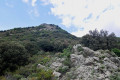
(3) Leave the track(yellow markings at the end of March 2024). Climb steeply to the right through the forest. There are old yellow markings and cairns. There are red markings and old blue markings, but follow the yellow markings (repainted in places in March 2024). Climb through the forest, north-east, towards the Col de Sant Joan. The arrival at the Coll de Sant Joan is completely clear at the end of March 2024.
Just before the pass, first turn right then left to come out onto a large area with a track. Directional signpost.
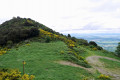
(4) Turn right onto a ridge path through the broom.
The destination can be seen to the east at the edge of the forest, 100 m higher up.
Continue along this good path, which is well marked on the ground. As soon as you enter the forest, climb to the right towards Puig d'Orella (Pic d'Aureille) and enjoy the 360° view. Then descend towards the access path, continue to the right for 150 m and you will reach a fork with an information panel and a signpost.
(5) Turn left heading due north, descending through the broom and entering the forest. The path is marked and well signposted on the ground. Join a track in a clearing at Roc del Grèvol. Directional signpost.
No markings
(6) Head completely left into the forest, along the track, heading south-west. The path is almost flat.
As you leave the forest, the landscape opens up and you can see the Chapelle de Sant Cristau perched to the west. You will come back to the Coll de Sant Joan, which you passed earlier.
Yellow markings
(4) On the left, as you pass a new shooting range (March 2024), find a marked path that climbs to the ridge above the forest track.
The path is in perfect condition and clear (March 2024). Further on, rejoin the track in a large open area at Coll del Baladre.
(7) On the left, find the continuation of the marked path that climbs to the ridge above the forest track.
Caution: At altitude 970, there is often a flock of sheep and their non-aggressive sheepdog.
Follow the new yellow markings and descend to the left to join another path that comes from Saint-Jean de l'Albère at Coll de la Font.
(8) Below, on the right, on the track, flows the Sant Cristau fountain. There is a sheepdog in summer.
Continue right/north-west along the path. You will arrive at a confusing area where the signage and signs are surprising and inaccurate.
Leave the path that descends to the right towards Montesquieu and the fountain.
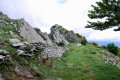
The path turns south-west to go around the massif. The area is steep. Follow the markings carefully.
You will arrive below the Chapel of Sant Cristau (Saint Christopher) with the ruins of the watchtower and a cross on your right.
(9) At this point, you will be treated to a beautiful view. The chapel, which is now little more than a name, can be used as a shelter.
It is often windy there. Close the door properly, otherwise sheep will invade the building. Thank you for the next visitors.
Head slightly to the right behind the chapel and find a small, steep path, marked on the ground and well signposted, which descends towards a stony track. Follow it to the right for a little over 100 m.
- Descend completely to the left along a good path that is very well marked on the ground and perfectly signposted.
Reach a terraced area, man-made with two old vaulted cavities at Coll de la Branca.
(10) Leave the track at the hairpin bend to the right (altitude 915 m). Continue opposite, north-east, along a very steep, clean and well-marked path (March 2024) which descends north-east to the vast Coll de Llinàs.
(11) In this vast flat area, continue 50 m due north-east to find another strange signpost. Turn left and descend steeply into the forest. You will arrive at a small rocky area.
(12) Do not descend to the right, heading due south towards the yellow cross.
- Stay on the 700 m contour line, heading south-east. Further on, the path climbs steeply. You will arrive at a clearing (a kind of pass) with an incomprehensible signpost.
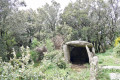
- Descend opposite, heading due east, and you will reach a clearing where the Na Cristiana dolmen is located at the edge of a track. There is another strange signpost here.
(13) Continue right along the track for 20 m and then turn left onto a steep path that descends into the forest.
Be careful: the path is steep, rutted and slippery after rain.
You will come to a small stream and join the D71. There is little traffic. There is another strange signpost here too.
(14) Continue left on the road, staying on the right-hand side. There are beautiful, tall cork oaks on both sides of the road. This will take you to the car park (S/E).



 Visorando Member

 Easy
Easy 
 Difficult