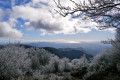
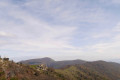
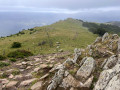
The Fort de Bellegarde and the Panissars site from Le Perthus

An easy hike from Le Perthus offering views of the Spanish valley towards La Jonquera. Part of the route follows the border and takes you past military buildings from yesteryear (fort and redoubt) as well as the Roman site of Panissars, including the remains of the Via Domitia.

Details

11023144
Creation:
Last update:
Last review:
  • Walking
    Activity: Walking
  • ↔
    Distance: 13.90 km
  • ◔
    Average duration: 5h 20 
  • ▲
    Difficulty: Moderate

  • ⚐
    Back to start: Yes
  • ↗
    Ascent: + 472 m
  • ↘
    Descent: - 473 m

  • ▲
    Highest point: 577 m
  • ▼
    Lowest point: 226 m

Description of the walk

To get to Le Perthus, take the D900. From Avenue de France, turn right at the gendarmerie brigade to go up towards car park no. 2, which is a pay-and-display car park. You can also continue along Rue du Fort (towards Fort de Bellegarde) to park outside the town, on the left-hand side of the road where there is a sufficiently spacious esplanade (parking for 4 to 5 vehicles). You can start from above car park no. 2.

(S/E) From the upper part of the car park, look for a building and enter the cork oak undergrowth to climb south-east to join theGR® 10trail and Rue du Fort well after leaving the town. Cross this road carefully, as there is a car park on the other side.

(1) You can start from this car park. Walk up the road towards the fort for a few metres before turning left to follow a yellow-marked path that winds through the vegetation, overlooking the road on your right until you reach a large grassy platform next to the road. Cross this road carefully to climb a fairly steep grassy path opposite (pylon with electricity meter). You will arrive at a gate in the fort near an old drawbridge.

(2) Enter the fort enclosure to observe the horizon to the north and east from the first line of fortifications. Depending on the season, it may be possible to visit the fort. Retrace your steps to return to the first gate, then continue straight ahead to a line of defences. At the end, leave the fort grounds to observe the south-western horizon again. Walk back down along the road and, further on, turn left towards the Panissars site and the 17th-century military cemetery. Beautiful view of the Spanish border. Arrive below at the old cemetery, also known as Col de Panissars.

(3) Climb the path towards the redoubt, clearly visible, via theGR®10. There are beautiful views from the redoubt over the Fort de Bellegarde, located higher up, as well as over Spain. Walk around it before continuing along theGR® to the Roman site of Panissars, through the cork oak trees. You will arrive at the remains of the buildings. Turn right to find traces of the Roman road connecting France to Spain imprinted in the rock. Climb the border hill to look out over the ruins.

(4) Go behind the ruins to return to theGR®10. Turn right. The trail winds its way uphill, continuing along the border. Looking back, you will see partial views of the fort and Le Perthus. The trail eventually descends before arriving at Coll del Priorat, near a water cistern.

(5) From the stony track known as the military road, climb steadily opposite, still following theGR®10, until you reach a fork much further on, where the track splits in two. Leave the military road and turn right.

(6) Descend this track, which crosses the Còrrec del Prat dels Pomers at its first circular bend to the right. Follow it continuously downhill towards Cortal Mirapeix and then Riunoguers. Stroll through the few streets of this hamlet.

(7) Retrace your steps to return to the cement cycle path you arrived on, continuing along it and keeping to the left as you leave the village (Mas Llong communal path). Follow it all the way to Mas Las Carbonères.

(8) Turn left at the second crossroads, staying on the cycle path. Continue along it until you reach the next junction with a yellow sign indicating Les Cluses. Turn left in this direction.

(9) Continue straight ahead along this path until you reach a large crossroads marked by a hunting hut. Then turn right.

(10) Follow the stone path that winds its way down the mountain, crossing streams as it goes. Without ever leaving it, return to the outskirts of Le Perthus. You will arrive at a large car park on the left, reserved primarily for coaches.

(11) From the junction with Rue du Mas Rimbau, turn right towards the town centre. Follow this road on the right-hand pavement. After passing a shaded boules court, turn immediately right to reach car park no. 2 (first possible starting point).

(12) Cross this car park, heading towards the edge of the cork oak forest, and join the (S/E).

Waypoints

  1. S/E : km 0 - alt. 300 m - Car park no. 2 - Hauteurs du Perthus
  2. 1 : km 0.36 - alt. 341 m - Road closure at the fort - car park at another departure point
  3. 2 : km 0.85 - alt. 408 m - Fort de Bellegarde
  4. 3 : km 1.91 - alt. 325 m - Cimetière militaire (Col de Panissars)
  5. 4 : km 2.24 - alt. 336 m - Ruines romaines de Panissars
  6. 5 : km 3.87 - alt. 458 m - Coll del Priorat - Puig del Priorat
  7. 6 : km 5.29 - alt. 577 m - Turn right towards Riunoguers.
  8. 7 : km 7.54 - alt. 336 m - Hamlet of Riunoguers
  9. 8 : km 9.43 - alt. 337 m - Las Carbonères hamlet
  10. 9 : km 9.97 - alt. 348 m - DFCI road
  11. 10 : km 10.51 - alt. 325 m - DFCI firebreak junction
  12. 11 : km 13.61 - alt. 298 m - Entrance to Le Perthus
  13. 12 : km 13.82 - alt. 299 m - After shaded playground
  14. S/E : km 13.9 - alt. 300 m - Car park no. 2 - Hauteurs du Perthus

Notes

(S/E) Car park no. 2 (paying) - Car park (1) free access.

(2) Visit to Fort de Bellegarde: fee applies - price in summer 2021: €4 for self-guided tour - €5 for guided tour.

(3) and (4) Redoute and Roman Ruins of Panissars, picnic area nearby (no facilities).

(6) At the northern exit of Riunoguers, along the D13c, picnic facilities available (shaded area).

(8) Mas Las Carbonères, picnic area available (unimproved site).

Walking sticks may be useful in rainy weather, on ascents and descents.

Worth a visit

(A/D) The village of Le Perthus was first mentioned at the beginning of the 14th century. In the Middle Ages, it was owned by the Counts of Roussillon and Empúries. It is a border village between France and Spain. It is located at an altitude of 271 metres on the pass of the same name. The originality of Le Perthus (in Catalan: El Portús) lies in the fact that the border demarcation in 1659, in the Treaty of the Pyrenees, allowed it to be formed on both French and Spanish territory. You only have to cross the street to change countries. From the point where Avenue de France slopes down towards the customs post, the right-hand side is French and the left-hand side is Spanish. This explains why the duty-free shops are on the left - the RN9 road itself is French and the kerb on the east side is Spanish.

(2) Fort de Bellegarde: Bellegarde Hill (423 m) overlooks the Perthus (271 m) and Panissars (335 m) passes, the lowest in the Pyrenees mountain range. Located in the centre of the vast depression formed by these two passes, Bellegarde has played a major strategic role over the centuries.
It is likely that a signal tower was the first military structure built at the top of this hill. Indeed, the Catalan word "guarda" is a place name evoking the famous towers from which signals were sent according to an established code: fire at night and smoke during the day. This was how the population and the castle of the Kings of Majorca in Perpignan, which centralised the towers of Madeloc, La Massana and Saint-Christophe, were alerted. The first mention of a medieval fort in Bellegarde dates back only to 1324. It refers to a salary paid to the servants of the castle of "Bellaguàrdia". In 1462, Louis XI occupied the fort before it was returned to the Kingdom of Catalonia-Aragon in 1493. In 1659, it became the property of the King of France. It was occupied by 17 men in 1666 because it was considered outdated and incapable of withstanding a siege. After 1675, it became a strategic location following a change in thinking. Vauban designed the new fortified castle between 1670 and 1688, which could accommodate 1,200 men, 150 horses and powerful artillery. He had a well dug 63 metres deep and 5.85 metres in diameter with an average water level of 27 to 30 metres (750 to 850 m³). Occupied by the Spanish in 1793, it was recaptured in 1794 by General Dugommier. It never played a military role again.

(3) Panissars Pass and its border marker nmr 569. Behind the cemetery is a sign with a map of the Girona region. Military cemetery with some graves dating back to the 17th century.

(4) Roman ruins of Panissars with the Via Domitia on the French side and the Via Augusta on the Spanish side. The imprints of the wheels of the chariots of the time engraved in the rock are clearly visible. Presence of border marker nmr 567, which overlooks the ruins. Commemorative plaque: "To Emperor Caesar Flavius Valerius Constantine (306 - 310 AD)".
A place of passage since prehistoric times, Panissars has a very rich history. Between Via Domitia and Augusta, Pompey's trophy, it was crossed by various armies, including Punic, Roman, Barbarian, Muslim, Mallorcan, Aragonese, Spanish and French. The site has seen intense activity. Thanks to archaeological excavations undertaken since 1984, most of the events that took place there are now known to us.
We owe this road, one of the most important opened by the Romans from the Republic to the Empire, to General Cnaeus Domitius Ahenobarbus. The Via Domitia, or Domitian Way, linked the Alps to the Pyrenees, crossing the entire province of Narbonne, now southern France.
Work began in 118 BC. This route was initially used for military purposes, then for trade. Its design was ultimately very similar to our current roads. Marked out and punctuated by relay stations and inns, it was used by travellers on foot, on horseback or in carts. If we had to describe this road, we could say that it was the motorway of Antiquity. It is worth noting that the A9 motorway often runs alongside its route.
The Via Domitia ended at the Col de Panissars and the site of the Trophy of Pompey, before becoming the Via Augusta upon entering Hispania.
The pass was then called "Summum Pyrenaeum", a place name found on all Roman routes of the via known today.
The Trophy of Pompey is a monument built in 71 BC by the Roman general Pompey at the Col de Panissars. It commemorated Pompey's victory over General Sertorius on his return from his campaigns in Hispania.
Nine years of archaeological excavations conducted by Georges Castellvi for France and Josep Maria Nolla and Isabel Rodà for Spain confirmed that the foundations uncovered at the Col de Panissars correspond to the monument erected in 71 BC by the Roman general.
It should be noted that in 1285, the Panissars Pass was the scene of a bloody battle that would profoundly mark the kingdoms of France, Majorca and Aragon. It sealed the end of the Aragonese Crusade.

Always be cautious and plan ahead when you're outdoors. Visorando and the author of this route cannot be held responsible for any accidents occurring on this route.

The GR® and PR® markings are the intellectual property of the Fédération Française de Randonnée Pédestre.

Reviews and comments

4.8 / 5
Based on 12 reviews

Reliability of the description
5 / 5
Ease of following the route
4.8 / 5
Route interest
4.7 / 5
kerisa
kerisa
• Edited:

Overall rating : 5 / 5

Date of your route : Feb 18, 2026
Reliability of the description : ★★★★★ Very good
Ease of following the route : ★★★★★ Very good
Route interest : ★★★★★ Very good
Very busy route : No

A lovely walk with a fascinating insight into history,
Thank you very much

Machine-translated

mimi6645
mimi6645

Overall rating : 4.7 / 5

Date of your route : Nov 09, 2025
Reliability of the description : ★★★★★ Very good
Ease of following the route : ★★★★★ Very good
Route interest : ★★★★☆ Good
Very busy route : Yes

On a beautiful autumn day, 360-degree views from the fort.
Superb views of the Pyrenees and Canigou with the first snows.
Highly recommended for a peaceful day out.

Machine-translated

Myriam031972
Myriam031972

Overall rating : 4 / 5

Date of your route : Oct 11, 2025
Reliability of the description : Not used / Not applicable
Ease of following the route : ★★★★☆ Good
Route interest : ★★★★☆ Good
Very busy route : No

What a lovely surprise this route was, beautiful scenery, easy paths, a great time, thank you.

Machine-translated

Céline66
Céline66

Overall rating : 4.7 / 5

Date of your route : Apr 21, 2025
Reliability of the description : ★★★★★ Very good
Ease of following the route : ★★★★★ Very good
Route interest : ★★★★☆ Good
Very busy route : No

Very nice hike, but we did it on a day when the tramontane wind was blowing, and the site is very exposed to the wind!😅

Machine-translated

JLF1
JLF1

Overall rating : 5 / 5

Date of your route : Sep 24, 2024
Reliability of the description : ★★★★★ Very good
Ease of following the route : ★★★★★ Very good
Route interest : ★★★★★ Very good
Very busy route : No

The first part of this hike is very interesting in terms of historical heritage (fort, Roman ruins, boundary markers), and the second part remains interesting due to its route.

Machine-translated

Ludo72
Ludo72

Overall rating : 4.3 / 5

Date of your route : Sep 02, 2023
Reliability of the description : ★★★★★ Very good
Ease of following the route : ★★★★☆ Good
Route interest : ★★★★☆ Good
Very busy route : No

The main attraction of this hike is following the French-Spanish border from Le Perthus with its numbered border markers and discovering the Via Domitia, of which only a few remains can be found in the Pyrénées-Orientales.

This hike can also be enjoyed in hot weather as much of it is shaded.

Machine-translated

Lucky15
Lucky15

Overall rating : 5 / 5

Date of your route : May 22, 2023
Reliability of the description : ★★★★★ Very good
Ease of following the route : ★★★★★ Very good
Route interest : ★★★★★ Very good
Very busy route : No

A very pleasant short hike, combining history and geography to enhance the experience.
Discover beautiful landscapes and magnificent views.
I highly recommend it.

Machine-translated

jpp070259
jpp070259

Overall rating : 5 / 5

Date of your route : Apr 05, 2023
Reliability of the description : ★★★★★ Very good
Ease of following the route : ★★★★★ Very good
Route interest : ★★★★★ Very good
Very busy route : No

Very beautiful hikes, diverse landscapes, beautiful views of the Spanish valley. No difficulty.

Machine-translated

martine cls
martine cls

Overall rating : 5 / 5

Date of your route : Apr 12, 2022
Reliability of the description : ★★★★★ Very good
Ease of following the route : ★★★★★ Very good
Route interest : ★★★★★ Very good
Very busy route : Yes

A very interesting and varied hike, taking in Bellegarde Fort, the magnificent site of Panissars, and a variety of paths through cork oak forests. It took us 4 hours and 20 minutes without stops.
Definitely worth doing.

Machine-translated

VERO LA CATALANE
VERO LA CATALANE

Overall rating : 5 / 5

Date of your route : Jan 30, 2022
Reliability of the description : ★★★★★ Very good
Ease of following the route : ★★★★★ Very good
Route interest : ★★★★★ Very good
Very busy route : Yes

A very beautiful hike with lovely views and beautiful farmhouses.
And then the Roman site is very interesting, although the fort was closed.

Machine-translated

lecabos
lecabos

Overall rating : 5 / 5

Date of your route : Jan 26, 2022
Reliability of the description : ★★★★★ Very good
Ease of following the route : ★★★★★ Very good
Route interest : ★★★★★ Very good
Very busy route : No

Route completed on 25/01/2022. No difficulties. No people encountered except in Panissar and Fort de Bellegarde. Beautiful view of the snow-capped Canigou between the village of Riunogues and Les Carbonères. Recommended.

Machine-translated

Thierry lepneu
Thierry lepneu

Overall rating : 5 / 5

Date of your route : Jan 23, 2022
Reliability of the description : ★★★★★ Very good
Ease of following the route : ★★★★★ Very good
Route interest : ★★★★★ Very good
Very busy route : No

A very beautiful and fairly easy route, taking around 5 hours, with the magnificent village of Riunogues to discover, along with a fort and ruins at the start. And no one around except on the road to Jonquera.

Machine-translated

Other walks in the area

For more walks, use our search engine .

The GPS track and description are the property of this route's author. Please do not copy them without permission.