Country:

 City:
City:


From Le Boulou, follow the D900 towards Le Perthus. Just after the road sign marking the entrance to Le Perthus, turn left towards Saint-Jean de l’Albère and the Col de l’Ouillat via the D71.
Please note: the road, although in good condition, is winding and quite narrow. Drive with care.
When you reach the first junction, turn right onto the D71a. At the second junction, turn left, staying on the D71a, and you will soon find a lay-by on the left, after passing the turn-off for Sant-Martí (private cul-de-sac).
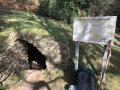
(S/E) Head down the D71a and turn left onto the D71c towards the hamlet of Saint-Martin de l’Albère (Sant Martí) and pass through it. Watch out for the dog. Do not attempt to park in this hamlet, which has declared itself private property; only mountain bikers and hikers are permitted to pass through.
Note: a brand new 3-wire fence, 3,300 m long, has been installed by Albera Pastur. Enhancing Cattle Resources in the Pyrenees-Mediterranean Cross-Border Massif. Information board.
Pass through two gates in this new fence. Take care at the ford.
(1) Turn right as you cross the ford. Continue for about twenty metres along the track. Look out for a path on the left that climbs into the forest. I have placed a cairn there. Old yellow markings visible on a rock.
Old yellow + red and white markings clearly visible all the way to Coll de Forcat.
Note: observed on 2 October 2022: these markings have been covered with fluorescent pink paint. Hunting car parks have been set up and painted. The old markings can be found much higher up.
(2) Leave the track. Head up to the left along a path through the forest. Cut across afirst track . Continue climbing. Join asecond track and follow it straight ahead, south-east. Join athird track, continuing straight ahead south-east.
(3) Leave the track and take a path to the left heading due east. Do not continue along the track towards the còrrec (ravine). Pass close to an old stone picnic table and the non-functioning Fontaine d'en Manel. The path turns south, passing a small còrrec where a trickle of water flows. Look out for and carefully follow the old markings still visible on the trees.
Join an old track which you must follow to the left, heading due east. Red and white Spanish GR® markings. Arrive at a small open area at Coll Forcat.
Observation 2 October 2022: signpost destroyed.
Note: if this area is overgrown with brambles, head back down and go round the area through the woods.
Yellow markings are very sparse.
(4) Do not cross the wooden barrier, but continue left, north-east, along a good path cut through brambles. The path is cleared and accessible (2 October 2022). Reach Coll Forcadell through the forest.
(5) Border ridge. Head northwards now, climbing up the border line. You will reach a beautiful, long stone wall built along the border. There is a stone table and benches.
(6) Note: head left into the forest, following the yellow markings and cairns. Do not try to walk alongside the wall. The path to follow runs more or less parallel to the wall on your right. Continue climbing.
Pass Puig Forcadell. Continue north-east with the border fence on your right. Pass Puig de les Calladetes. Continue climbing.
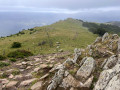
Arrive at Coll del Pal. Open area with small rocks on the right-hand side. Beautiful scenery on both the French and Spanish sides. Continue the fairly steep climb from this pass. Pass two firing posts built on the ridge line. Beautiful scenery in these open areas. Arrive in a grazing area where there is an antenna and an old prefabricated building on the left-hand side.
(7) Follow the grassy track north then north-east, skirting the Roc dels Tres Termes on the right.
Red and white markings ofthe GR®10.
(8) Turn right and head uphill along the GR®10. Reach the boundary fence. Climb, keeping it on your right.
Note: from this point, the walk can be shortened if necessary by heading left down the GR®10 towards Coll de l'Ullat.
(9) Large gate in the border fence. Do not go through it. Continue climbing along the GR®10 towards the large antenna on Puig Neulós (Pic du Néoulous), painted red and white.
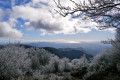
(10) A very beautiful spot, apart from the antennas. The view is 360°. The Tramontane often blows in gusts over these ridges, particularly at this spot *.
Head down towards the end of the access road to the facilities. Then turn left for about 40 m, and turn sharply right onto a track that goes round the building on the left. Look out for the red and white markings and follow them carefully. Do not try to go down into the beech forest straight away.
The track ends and a path runs alongside the top of the fence. Pass through a gap in the electric fence and head down a very steep slope into the forest, heading south-east.
Caution: the descent is along a gullied path often covered in leaves.
Continue towards a small building where the Fontaine de la Tanyareda spring is located. Follow the GR®10 above the track, still heading south-east.
Note: from here, you can turn back via the same route or take the road to (8).
(11) At Pla de la Tanyareda, head straight on to the entrance of the beech forest and find the Refuge de la Tanyareda (forest edge refuge) at the forest entrance.
(12) This basic shelter is in good condition, with no litter. Observations: 2 October 2022, 19 January 2023.
A lovely spot for a lunch break, a short climb up towards the fence on the ridge marking the border.
Turn back for 300 m, climbing slightly up to Pla de la Tanyereda.
Off the marked trail
(11) Leave the GR®10 and continue climbing towards the border fence, leaving the spring on your right below you. The gradient increases. Pass a few rock piles and arrive at a Spanish signpost made of wood and enamelled iron.
Coarse yellow markings and cairns on the Spanish side
(13) Note: the route is accurate and corresponds to the existing path.
Head left, generally due west. At the start, there are cairns that I reinforced during my visit. The route is clear, staying more or less on the slope below the border ridge on your right. Pass a cattle track that climbs to the ridge just before the snow well. A stone with old yellow markings is present on the correct path leading down to this nearby snow well.
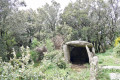
(14) You emerge into an open area. El Pou de Neu (the snow well) is on the left **.
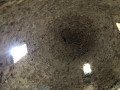
A magnificent structure in perfect condition. You can enter the tunnel that was used to haul out the ice.
Be careful, however, as at the end there is a gaping hole which is in fact the well. Reach the recently installed crossing over the electric fence on the border ridge.
Red and white markings of the GR®10
(9) Join the GR®10 after a few metres, and turn left, heading down the path you took on the way up.
(8) Continue straight ahead, following the GR®10 as it heads into the forest. Leave the access road to the antennas. You’ll reach an open area on the edge of the beech forest. Continue to the right, following the red and white markings. Descend rapidly through the beech forest, heading towards the road and a large open area at Coll de l’Ullat (Col de l’Ouillat).
(15) Turn left, passing the Chalet de l’Albères on your right ***.
Continue on the GR®10. Pass the dormitory buildings and, further on, a tin-roofed sheepfold. The path then descends through the beech forest. Continue down the GR®10 to Coll del Ras.
(16) Turn left as you approach the road and follow it along the top, running parallel to it.
Keep an eye out for the red and white markings and continue down a track to the ford.
(1) Leave the ford and the track on your left, continue straight ahead through Sant Martí and join the (S/E).



 Visorando Member

 Difficult
  Easy
Easy