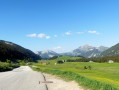
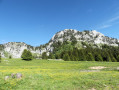
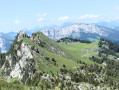
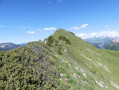
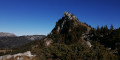
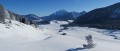
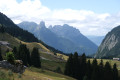
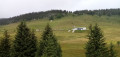
Pointe de Puvat and Pointe de Québlette from the Plateau des Glières

Starting from the Plateau des Glières, I suggest you explore the Montagne des Auges whilst taking in some very lovely views. The route reaches the Pointe de Puvat, then joins the Arête Dran before following a beautiful ridge line towards the Pointe de la Québlette. Please note that the route passes through a few exposed sections requiring a degree of caution: please read the ‘Practical Information’ section below.

Details

98377418
Creation:
Last update:
Last review:
  • Walking
    Activity: Walking
  • ↔
    Distance: 8.52 mi
  • ◔
    Average duration: 5h 50 
  • ▲
    Difficulty: Very difficult

  • ⚐
    Back to start: Yes
  • ↗
    Ascent: + 2,221 ft
  • ↘
    Descent: - 2,251 ft

  • ▲
    Highest point: 6,270 ft
  • ▼
    Lowest point: 4,616 ft

Photos

Description of the walk

The route starts at the Col des Glières near the memorial: plenty of parking spaces available.

Marked sections

(S/E) Take the path leading to the National Monument to the Resistance.

(1) Once you arrive at the site, you can spend a little time reading the numerous information boards. Continue along the route towards the Ancienne Scierie, turning left at the first nearby junction and then going straight on at the second. You’ll reach a crossroads.

Unmarked sections

(2) Ignore thefirst left, then, after crossing a very short wooden bridge, carry on straight ahead, leaving the signposted route. Head briefly to the right and continue until you reach the edge of a clearing.

(3) Look out for a faint path on your right where it begins and follow it to the junction with a track. Continue to the right along an uphill track for quite a while. Shortly after a downhill section, look out for the start of a narrow path on your left.

Marked sections

(4) Follow this and you’ll very quickly come to another path: continue leftwards, following the route uphill via a few hairpin bends. After reaching the hamlet of Plan du Loup Nord, carry on straight ahead towards Plan du Loup Sud.

(5) At the junction, turn left towards the Col de l’Ovine and follow a path uphill. The route runs almost level at the foot of the cliffs, then climbs steeply to reach the Col de l’Ovine.

(6) Follow a path to the left through terrain that gradually becomes rockier. A little further up, you’ll encounter a few steep sections, after which the summit comes into view straight ahead. Follow the path heading towards the left-hand side of the second rock outcrop (western sector) and stop briefly at the foot of a chimney on the right: climb this (it is relatively short) whilst remaining vigilant on this exposed section: see §Practical Information. Reach the Pointe de Puvat, crowned by its cross.

(7) After enjoying the stunning 360° view, retrace your steps, taking extra care on the descent to the Col de l’Ovine.

(6) Once back at the pass, head straight on for about 300 m.

(8) Turn slightly to the left and follow the path for a long stretch, with only a slight change in elevation.

Unmarked sections

(9) Once you reach the Chalet de l’Ovine, head right, using a bearing, across the mountain pasture for a few metres, then follow a clearly visible path to the left. A little further on, stop just before a descent near a small rocky section.

(10) Off the trail, head right across the mountain pasture; a little further up, join a narrow track, then follow this to the left until you reach a small flat area. Continue straight ahead off the trail up the grassy slope – the route is made easier by a series of narrow terraces – and head for a rocky outcrop corresponding to the Arête de Dran. Take a passage and make a short climb through rugged terrain until you reach a cairn. Then continue to the right towards a small pass , tackling a short exposed section: see § Practical Information. This will take you to the ridge line.

(11) Follow the ridge to the right until you reach a small boulder which you will need to climb over: this section is not very difficult but it is exposed. Continue along the ridge, which is not very wide and equally exposed at first (see § Practical Information), then follow the ridge for some time via faint track marks to reach the summit of the Pointe de Québlette, where the scenery is quite different from that of the Pointe de Puvat and Arête de Dran areas.

(12) Facing due north, continue along the path opposite in the direction of the descent; further down, the route follows a narrow track before rejoining the path taken on the way up.

(8) Follow this path to the left to return to the Col de l’Ovine.

Marked sections

(6) Follow the descending path to the left that you took earlier.

(5) At the junction, continue left onto the track.

(13) Just before the Chalet du Loup, turn off onto the path on the right towards Plan des Mouilles. After a short while, you’ll reach a vast mountain pasture. A little further down, follow a track to the right and you’ll come to a junction.

(14) Continue left onto a north-westerly-facing path, then begin a descent with a few maintained sections.

Unmarked sections

(15) Just before reaching the Glières mountain pasture, follow a path to the right: this runs along the edge of the forest before joining another path, which you should also follow to the right to rejoin the route from the outward leg.

Marked sections

(1) Pass the National Monument to the Resistance once more, then you’ll soon be back at the starting point (S/E).

Waypoints

  1. S/E : mi 0 - alt. 4,747 ft - Col des Glières - Mémorial des Glières
  2. 1 : mi 0.25 - alt. 4,708 ft - National Monument to the Resistance
  3. 2 : mi 0.7 - alt. 4,619 ft - Former Sawmill
  4. 3 : mi 0.85 - alt. 4,692 ft - Trail junction
  5. 4 : mi 1.58 - alt. 5,046 ft - Path junction
  6. 5 : mi 2.11 - alt. 5,518 ft - Map of Loup Sud
  7. 6 : mi 2.62 - alt. 5,837 ft - Col de l'Ovine (1786m)
  8. 7 : mi 2.91 - alt. 6,260 ft - Pointe de Puvat
  9. 8 : mi 3.43 - alt. 5,860 ft - Junction for the Pointe de la Québlette circular loop
  10. 9 : mi 3.99 - alt. 5,827 ft - Chalet de l’Ovine
  11. 10 : mi 4.39 - alt. 5,810 ft - Rocky section
  12. 11 : mi 4.6 - alt. 5,902 ft - Small pass – Dran Ridge
  13. 12 : mi 5.08 - alt. 6,270 ft - Pointe de Queblette
  14. 13 : mi 6.71 - alt. 5,282 ft - Chalet du Loup
  15. 14 : mi 7.46 - alt. 5,000 ft - Map of Les Mouilles
  16. 15 : mi 7.94 - alt. 4,682 ft - Path junction
  17. S/E : mi 8.52 - alt. 4,747 ft - Col des Glières - Mémorial des Glières

Notes

The route starts from the Col des Glières (viewable on Google Maps).

Good walking boots and walking poles are recommended.

Please take your rubbish away with you – nature will thank you for it.

Please note: there may be flocks of sheep and mountain dogs in the area around the Chalet de l’Ovinela; in this case, you’ll need to adjust your planned route (you can reach the Pointe de Québlette by retracing your steps and then taking a shortcut to join the path leading there).

This description does not cover the Arête de Dran area, and you may wish to continue on to Pointe de Dran via an even more rugged route: follow the path at the foot of the ridge before ascending to it. View the route by clicking on this link.

Below is a difficulty rating by section (the route is not uniform):
- Green: fairly straightforward walking with no significant elevation gain or difficulty.
- Blue: steeper slopes and/or greater elevation changes on a well-marked route.
- Orange: routes presenting some technical difficulties and/or poor route conditions (markings or visibility of the path).
- Red: a difficult route due to significant elevation changes that may require some climbing, in an environment presenting certain hazards.
- Black: a route on a fairly difficult trail and/or involving imminent dangers.
- White: routes through very challenging technical terrain requiring specific equipment.

From (S/E) to (1): Green difficulty
The route is very easy to follow, running along a very well-maintained path.
Marked with yellow arrows and signposts.

From (1) to (2): Green difficulty
The route continues without difficulty along a track suitable for vehicles.
Signposted with Yellow Arrows and signposts.

From (2) to (4): Blue difficulty
The route follows slopes that are generally moderate. The main difficulty is locating the start of a path just before a clearing (a GPS may be useful).
Unmarked section.

From (4) to (5): Blue difficulty
The main challenge is spotting the path (a GPS may be useful); if you miss the start, carry on for about 200 metres and then follow the signposted route. You will then follow a well-marked uphill path with few difficulties.
Markings: Yellow Arrows + signposts.

From (5) to (6): Blue difficulty
This section is not very difficult; at most, there is potential exposure to rockfalls at the foot of the cliffs and a short section that appears to have been carved out of the rock.
Yellow Arrow markings + signposts.

From (6 to (7): Orange difficulty
There are some challenging sections on the approach to Pointe de Puvat:initially, there are a few steep sections, particularly on a short stretch of sharp limestone pavement. After an easy stretch, the path ends at the foot of a chimney on the south-western side: climb this at Grade II with plenty of holds for both feet and hands. This section is not very difficult, but it is nonetheless exposed and you should remain vigilant (particularly on the descent on the way back).
Signpost at the start / no markings

From (6) to (9): Blue difficulty
A relatively easy path is followed for a good distance.
Markings: Yellow Arrows + signposts.

From (9) to (10): Blue difficulty
After the chalet, the route follows a bearing for a few metres before continuing to the left along a path. From there, the route continues with little difficulty; at most, you’ll need to watch out for other crossing tracks.
Unmarked section.

From (10) to (11): Orange difficulty
Just before a small rocky section and a descent, leave the path and climb straight up the slope, possibly angling slightly to make the gradient more gentle. Further up, follow a path to its final section at a small flat area: then continue straight ahead off-trail up a grassy slope via one of the narrow natural terraces, preferably the one situated just above. You will then reach a passage leading into a rocky, uneven section, followed by a short climb to the cairn. After veering to the right, take care on an exposed section on the right just before reaching the small pass.
Unmarked section.

From (11) to (12): Orange difficulty
Make your way up to the ridge as best you can, then continue to the foot of a small rocky escarpment: this isn’t particularly difficult but, as it is quite exposed on both the right and left, it requires caution: it can be tackled either directly or by briefly skirting its base to the left (west side) before climbing it diagonally. Continue along the ridge, which is not very wide and remains exposed for a few metres, then proceed along an easier section to the summit, where the main risk is the western section bordering the cliffs.
Unmarked section.

From (12) to (6): Blue difficulty
Continue along the route in the direction of descent without encountering any particular difficulties. At most, it should be noted that the route follows a less distinct track before rejoining the marked path.
Unmarked section.

From (6) to (5): Blue difficulty
Follow the route in the opposite direction to the outward leg, with minimal difficulty.
Markings: Yellow Arrows + signposts.

From (5) to (13): Green difficulty
The route follows a very easy track suitable for vehicles.
Marked with Yellow Arrows and signposts.

From (13) to (15): Blue difficulty
The route is relatively straightforward, following a series of paths. After Plan des Mouilles, some sections may be damp and muddy, hence the presence of footbridges.
Marked with Yellow Arrows and signposts.

From (15) to (1): Blue difficulty
The trail is easy to follow.
Unmarked section.

From (1) to (S/E): Green difficulty
It is easy to return to the starting point.
Unmarked section.

Other walks in the area

For more walks, use our search engine .

The GPS track and description are the property of this route's author. Please do not copy them without permission.