Discover more walks in this area with a description or the Visorando app here
(1) The Basilica of Saint-Martin d'Ainay is a former Romanesque abbey church. In 859, a Benedictine priory was founded on this site. Later, it was elevated to the rank of abbey and the abbey church was built and consecrated in 1107.
At the end of the 17th century, the monastery disappeared and the church became a parish church in 1780. During the Revolution, it was converted into a grain store, which saved it from destruction. It was elevated to the rank of minor basilica in 1905.
All architectural styles can be found in the Basilica of Ainay: pre-Romanesque in the Sainte-Blandine chapel, Romanesque for its entire main structure, the Saint-Michel chapel is Gothic, and the whole complex was restored and enlarged in the 19th century with Neo-Romanesque additions.
When the weather is hot, it is very pleasant to rest inside this beautiful and sober church.
Between (1) and (2) is the Church of Saint-Georges. The current building, in neo-Gothic style, was built by the architect Pierre Bossan (who also designed the Basilica of Fourvière) in 1844-1845.
(2) Saint-Jean Cathedral. Its precise title is Primatiale Saint-Jean-Baptiste-et-Saint-Étienne because the Archbishop of Lyon holds the title of Primate of Gaul.
Its construction spanned three centuries, from 1175 to 1480, at a time when Western architecture was shifting from Romanesque to Gothic. Three archbishops contributed to this project: Guichard de Pontigny planned and began the construction of a Romanesque church, Jean Belles-Mains began the transformation of the building into a Gothic structure, the technical aspects of which were not yet fully mastered, and finally Renaud de Forez transformed the project, thanks to advances in craftsmanship, to give the cathedral its current appearance.
Heavily damaged by the Wars of Religion in 1562, then by the Revolution and the siege of Lyon in 1793, the cathedral underwent several successive restorations in the 19th and 20th centuries.
The cathedral is rich in treasures, but I particularly like the astronomical clock. The first mention of an astronomical clock dates from a capitular act dated 23 November 1379. In the 15th century, the clock was referred to as "the clock with small bells". Two major restorations took place in the 17th and 18th centuries respectively. The mechanism installed during the second restoration was still in working order at the beginning of the 21st century. The clock was severely damaged during the French Revolution and was neglected for more than fifty years. It was not until 1894 that a proper restoration was carried out.
The current clock is 9.35 metres high and 2.2 metres wide. It chimes four times a day, at noon, then at two, three and four o'clock in the afternoon, setting in motion nineteen automatons: angels, a cockerel, a Swiss guard, a scene from the Annunciation, the Holy Spirit and, finally, God the Father giving his blessing.
The clock is used to predict the cathedral's jubilee, which takes place about once a century, when Corpus Christi falls on 24 June, the feast day of Saint John the Baptist, patron saint of the cathedral.
On the other side of Place Saint-Jean, on Rue Tramassac, a commemorative plaque recalls the Fourvière Catastrophe, also known as the Lyon-Saint-Jean Catastrophe. On the night of 12 to 13 November 1930, three successive landslides on a section of Fourvière hill caused the destruction of several buildings and the death of forty people.
(3) The Ancient Theatre of Lugdunum (the Roman name for Lyon) is one of the main Roman monuments visible in Lyon. Built during the reign of Augustus, it was enlarged at the end of the 1st century or the beginning of the 2nd century, and could then accommodate up to 10,000 spectators. Abandoned at the end of the Roman Empire, it was turned into a quarry and badly damaged, then completely buried in the Middle Ages and forgotten. It was discovered by chance at the end of the 19th century, then completely excavated and restored from 1933 onwards. On the same site are the Ancient Odeon, a small amphitheatre, and the Gallo-Roman Museum. Every summer since 1946, the entire site has hosted the "Nuits de Fourvière" shows.
Between (3) and (4) is the Hôtel de Fourvière. The former archives of the Hospices Civils de Lyon. This former Visitation Convent was built in 1854. It then became an archive. Since May 2016, it has been a beautiful hotel.
Between (4) and (5), the Loyasse Cemetery, created in 1807, is the oldest cemetery in Lyon. However, the terrain was not very suitable. The ground is so unstable that in 1810, the terrace wall collapsed. The impermeable nature of the soil even prevented the bodies from decomposing... In addition, the cemetery was very difficult to access as it was located on the outskirts of the city at the time and, moreover, at the top of a plateau overlooking the centre of Lyon by more than a hundred metres: the plateau could only be reached by steep stairs or considerable detours. The transport of bodies was nevertheless improved with the creation of the funicular railway between Saint-Paul and Fourvière in 1900, followed by the train between Fourvière and the cemetery. The cemetery is rich in effigies and busts representing local artists, painters, architects... and personalities, such as the mayors of Lyon, with portraits of Antoine Gailleton and Édouard Herriot near the cemetery entrance.
The Chemin du Viaduc, which connects the Loyasse Cemetery to the Basilica of Fourvière, is a pleasant walk along the route of the old railway line that used to carry funeral convoys.
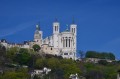
(5) Basilica of Notre-Dame de Fourvière. It was built on the site of the former Forum of Trajan, Forum vetus (the most likely etymological origin of the current name Fourvière). In the Middle Ages, a double cult dedicated to Saint Thomas of Canterbury and the Virgin Mary was established on this site. A chapel was built and, following a vow made in 1642 to ward off a plague epidemic in Lyon, an annual pilgrimage was established. In the 19th century, a statue of Mary was erected on the bell tower and a proposal to build a basilica was accepted, both to accommodate the increasing number of visitors and in gratitude for the protection of Lyon during the war of 1870. Its neo-Byzantine or Romano-Byzantine architecture, designed by Pierre Bossan, has earned it many admirers, but also some very harsh criticism. Personally, I like it.
You can take a break in the shade of the beautiful trees in the Jardins du Rosaire. You can get there by climbing the stairs from the esplanade.
Between (5) and (6), the people of Lyon like to say that the top of the Tour Métalique (telecom antenna) perched on the hill is higher than the top of the Eiffel Tower...
(6) Saint Paul's Church. It is a Romanesque and Gothic style building. The existence of the church has been documented since the 9th century. No remains from this period survive. The construction of the Romanesque parts, which can still be seen today, began in the second half of the 12th century and was completed in the 13th century. In the 15th and 16th centuries, the monument was modified by the addition of Gothic elements (reconstruction of the bell tower porch).
In the 19th century, after damage caused by the Revolution and lack of maintenance, major restoration work was undertaken in the 1840s. The last phase of restoration, in the years 1898-1904, removed the plaster that had covered the walls of the church since the 18th century.
The lantern tower has been listed as a historic monument since 1920.
Between (6) and (7) Notre-Dame-Saint-Vincent Church. Formerly the church of the Grands Augustins convent, the Church of St-Vincent, built in the 18th century in the neoclassical style, has a late 19th-century façade. Built between the buildings erected on the site of the convent, it is inspired by that of Saint-Nizier.
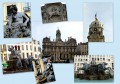
(7) Place des Terreaux. Between 1646 and 1651, Simon Maupin built the Town Hall on the eastern side of the square, which was rebuilt by Jules Hardouin-Mansart following the fire of 1674. Also in the 17th century, the nuns of Saint-Pierre had their convent rebuilt on the southern side, which became the Museum of Fine Arts in 1803.
In 1892, a fountain designed by Bartholdi was inaugurated in the centre of the square, opposite the Town Hall. It represents an allegory of the Garonne! Initially commissioned by the Bordeaux City Council in 1857, the sculpted group called "Char Triomphal de la Garonne" (Triumphal Chariot of the Garonne) represents the Garonne and its four tributaries flowing into the ocean, symbolised by a woman driving a quadriga. However, the City of Bordeaux abandoned the project. The fountain was presented at the 1889 World's Fair and was so successful that it was purchased in 1890 by the mayor of Lyon, Antoine Gailleton.
The square was redesigned in 1994 by Christian Drevet and Daniel Buren, featuring 69 water jets alternating orthogonally and bordered by 14 pillars.
Between (7) and (8) stands the Church of Saint-Nizier. According to tradition, a basilica was built in the 5th century to house the relics of the martyrs of Lyon, including those of Saint-Nizier. The church was rebuilt in the 9th century during the reign of Charlemagne. In the Middle Ages, it was the church of the bourgeois elite and remained so during the Renaissance.
The artistic heritage of Saint-Nizier was almost entirely dispersed or destroyed on at least two occasions: in 1562 by the Huguenot bands of Baron des Adrets, who pillaged the tombs of the bishops of Lyon, and then in the 18th century during the French Revolution.
Saint-Nizier has a distinctive silhouette with its two asymmetrical spires. The church is mainly built in the Flamboyant Gothic style. Most of the current building dates from the 15th century. The interior of the church is remarkable for the height and boldness of its vaults, the shape of the pillars that support them, the size of the building (one of the largest in Lyon), the light that fills it, and above all for a certain severity that characterises the entire structure.
(8) The Church of Saint Bonaventure was part of the Cordeliers Convent. It was built between 1325 and 1327 and faces south, which was rare at a time when Gothic churches faced east so that the apse would receive the light of the rising sun.
Unlike the Church of Saint-Nizier, which housed the Canonical Chapter, the Church of the Cordeliers became the seat of the brotherhoods, the most important of which built chapels there. The church was enlarged between 1471 and 1484 and was dedicated to Saint Bonaventure.
The church was used as a grain store after the French Revolution before being returned to worship around 1806 and given its current façade thanks to the initiative of Cardinal Joseph Fesch.
This church is much less famous and much less visited than Saint-Nizier, but also less cold, both literally and figuratively. It is very well integrated into the city centre, and there is always a steady stream of parishioners coming and going during the working day or while shopping. It is cool in summer and heated in winter.
(9) On Place Antonin Poncet stands the bell tower of the former Hôpital de la Charité. The hospital, built in 1622, was destroyed in 1934. Only the bell tower has been preserved.
A monument in tribute to the victims of the Armenian genocide is also located on the square. Made of aligned columns, it was inaugurated in 2006.
Between (9) and (E) stands the Church of Saint-François-de-Sales. It was built in 1803 in the neoclassical style.



 Country:
 City:
City:






 Visorando Member
 Moderate