Country:
 City:
City:


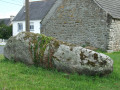
To reach the starting point, arriving via the D102 at Lesconil, after a roundabout, at a large boulder, turn left into Rue de La Fontaine, which continues as Rue Jules Ferry after a Stop sign. Cross the bridge over the Stêr and, shortly afterwards, take the hairpin bend into the first street, which leads to a small clay-surfaced car park near the Penn al Lann Protected Natural Area.
(S/E) With your back to the car park, turn right near the sign for the ‘Penn al Lann Protected Natural Area’ and follow the coastal path towards the bridge.
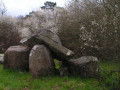
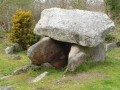
Yellow markings (sign for the dolmens)
(1) Cross at the pedestrian crossing and take the path opposite that follows the Ria du Stêr (information board on the re-estuarisation of the Stêr de Lesconil). Follow this ria up the slightly overhanging path between hedges of blackthorn. A few educational panels showcase the local flora and fauna.
On the opposite bank, you can see the Manoir de Kerlut, which is now used for receptions. Ignore a path on the right (which you’ll take on the way back) and continue along the ria until you reach a metal barrier indicating a signposted diversion (the dyke was in poor condition in August 2021).
(2) Turn right to join a short stretch of road towards the hamlet of Le Pors, then turn left onto a wide path that winds around some ponds. Enter the woods and rejoin thePR® after the damaged dyke.
(3) Continue along the ria, passing the sign for Chapelle de Plonivel on your right, and reach the Manoir de Kerhoas, a typical example of a 16th-century Cornish manor house (access permitted to the outer grounds, which feature picnic tables).
No signposting
Continue along the small road to the first junction.
(4) Turn right and follow this 30 km/h road to a crossroad (thePR® route on the IGN map is no longer up to date). Turn right to reach the Chapelle Saint-Brieuc de Plonivel (open to visitors in July and August). Note the two crosses in the enclosure, which are clearly not in their original positions.
(5) Retrace your steps and, at the junction, continue straight on towards Kerlouargat.
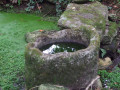
(6) At the bend in the road, look out for a wash house on the left that deserves a better fate and, 20 metres further on, still on the left, a half-buried fountain. Turn right onto the first road after the Kergroës sign. At the end, take the first turn left then right to reach Saint-Melaire. At the side of the road, on the right, note a pretty stone well.
(7) Turn left and continue along a stony path towards a house. Just before reaching it, turn left towards a meadow to see the remains of some walls, the ruins of Saint-Mélaire Chapel, which was the site of two pilgrimages until the Revolution of 1789, when it was abandoned. Many of its stones were used in the construction of the neighbouring houses.
Retrace your steps, pass the house and you will reach the Saint-Mélaire fountain and wash house. Note the presence of a perfectly round holy water font which, similarly, comes from the old chapel. Return to the junction.
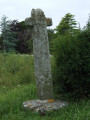
(7) Take a grassy path to the right of an imposing, cube-shaped modern house. Continue straight along this path, which veers to the right, to join the Kerdalaë Plonivel road and follow it to the left until you reach the crossroads where the 16th-century Kerdalaë cross stands on a two-tiered plinth. Also note a fallen menhir, which is said to have toppled during excavations in 1880.
(8) Turn right and you will soon spot, on your left, hidden amongst a flowerbed, a Gallic stele from the Second Iron Age. Continue along this small road to the four-way junction.
(9) Turn right and immediately look out for the small Kerescant cross on its circular base, on your left, set slightly back from the road, likely dating from the Middle Ages. Continue straight on to the next junction. Just before it, look out for another conical Gallic stele on your left, set in a hedge, which has retained its original position. Join the route you took on the way there.
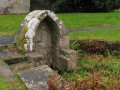
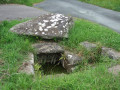
Turn left towards the chapel and, just before reaching it, take the small road on the left. At the roadside, look out for the rustic Plonivel fountain, where two large, roughly hewn stones form a pointed arch and cover the spring. Continue on and, opposite the Air France CCE Youth Holiday Centre, follow a path through the woods.
In the bend, note an original book box made from a fish crate. You’ll reach the Stêr estuary and follow the route back along the diversion that’s been put in place. Just at the end of the road in the hamlet of Le Pors, ignore the diversion sign telling you to turn right and carry straight on towards a footbridge.
Continue along the path you took on the way there until you reach the car park where you started (S/E).

 Visorando Member
 Moderate