Country:
 City:
City:


Park at Place de la Résistance, opposite the post office, at the entrance to Lesconil (signposted car park).
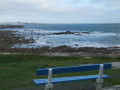
(S/E) Head towards the back of the car park, cross the road at the pedestrian crossing, pass to the right of the wine cellar (the former post office sorting office) and emerge opposite Ster Nibilic, a small inlet of the Ster estuary which served as the first shelter before the port was built from 1878 onwards.
Turn left onto the low wall where a menhir stands: Men Rouz, which once stood in the cove and has been incorporated into the base of the wall on the sea side. First turn left then right to enter Rue du Docteur Charcot, which continues, after a Stop sign, into Rue Marcel Cachin.
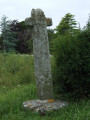
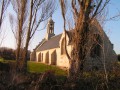
After the first house, turn left into the enclosure planted with Scots pines. Pass by a large wooden cross, set upon an old fluted stele. Head towards the Church of Notre-Dame de la Mer, originally the Chapel of Sainte-Anne, built in 1902 before becoming a parish church in 1934 (the church is open during the summer).
Walk round the building; note the tomb at its chancel of the parish’s first priest, who left his mark on the early days of this parish. Come out onto Rue Marcel Cachin and turn left, continuing to the junction with Rue Jules Ferry.
Turn right for a return trip across the causeway bridge over the Ster, built from 1967 onwards to link Lesconil to Loctudy (viewpoint over the Ster and the beaches).
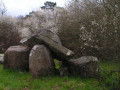
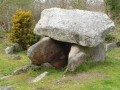
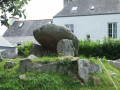
Retrace your steps and walk down Rue Jules Ferry to a roundabout. Just before the roundabout, look out for a dolmen on the left, on private land. On the right-hand side of the roundabout is the Pomp Loc’h fountain, fitted with an old hand pump. Head back up Rue de la Fontaine for about a hundred metres, until you reach a dead end on the left.
(1) Turn left into Impasse Méjou Kerlano, which leads onto the small Rue du Général de Gaulle. Follow this one-way street to reach Rue Jean Jaurès; cross at the pedestrian crossing to reach the former Protestant church, built in 1912 on the initiative of a Welsh pastor and transferred to the local council in 2007. Note the inscription at its base: Ti Doué, meaning ‘House of God’ in Breton.
Retrace your steps for about 20 metres to enter Impasse des Dentellières, a narrow passage between the houses, and continue along the path that crosses a green space. Turn right and continue straight on to the end of the street.
(3) Turn right to walk alongside the Dr Fleming State Primary School and continue along the street of the same name as the school. At the end, turn left and continue to a roundabout. At the roundabout, continue along Rue Paul Langevin to a green space with a children’s playground.
(3) Take this path and, at the end, turn right towards the dune. Walk around the semaphore tower, built between 1804 and 1806. Now disused, it serves as a venue for art exhibitions.
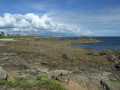
On the left, on private land, you can make out a high beacon built in 1930. Enter the Goudoul conservation area and head down towards the coastal path to join theGR®®34, which runs alongside the rock formation known as Goudoul, whose shapes spark the imagination.
Pass close to the Croix des Amoureux, a replica of the medieval cross that was destroyed in 1925. Continue along the path by the shore, where you’ll find an old wash house and a seaside fountain (Pors ar Feunteun). Shortly afterwards, on your left, you’ll notice a humorous display featuring a pebble named ‘Lesco Weather Forecast’. Pass the Beg ar Guelec rocks and arrive at Rue de la Corniche.
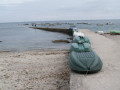
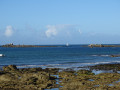
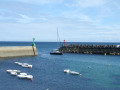
(4) Turn right into Rue du Môle and walk to the end to see the 125-metre-long breakwater, built between 1948 and 1951 to protect the harbour, a sight to behold during storms (access to the breakwater is prohibited). Retrace your steps and take the passage between the houses to walk along the shore and reach Pontuche slipway. Walk around the restaurant: Tara, la Cantine de Mer, and follow the quay past the harbour office. Note the two net fishermen still moored at the harbour, where recreational boating has taken over. Walk around the inner harbour, with the maritime cooperative on your left, and reach the fish auction building.
(5) Walk along the right-hand side of it until you reach a rock-filled area at the end of the quay. Continue along the path, go round the Men ar Groaz tower (the harbour entrance light) and pass close to the sailing centre.
(6) Turn right to walk along the top of the beach, coming out onto Rue Victor Hugo and following it to the right. This is the Quartier des Quatre Vents, with its small fishermen’s cottages. Turn right into a grassy square where information boards summarise the highlights of the walk. Go down the steps and head for the car park on the left (S/E).


 Visorando Member
 Moderate