Country:
 City:
City:


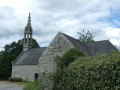
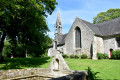
Access: In Scaër, from the Pont-Lédan roundabout, take the first exit (D6) and, at the bend, follow signs for the Glatfelter factory along a small road to the site of the Cascadec chapel. The signposted car park is 100m further on, on the right.
(S/E) Retrace your steps along the road until you reach a signpost on the left.
Yellow markings on signpost no. 5-6: be careful, as there is no Yellow Cross indicating the wrong direction. Keep a close eye out for the signposts in the wooded area.
At the signpost, enter the mixed deciduous and coniferous woodland via a path that winds upwards and reach a clearing near a group of houses (lodges). Note a restored bread oven. Follow a small road to the right for about a hundred metres.
(1) At the signpost, turn right to enter the woods, continue along a long straight stretch and turn left at the end. You will reach a new signpost.
Mountain bike signpost 1-21.
(2) Leave the yellow markings and follow the sign for VTT1-21 to the right, emerging near some houses. At the crossroads, turn left and continue along the small road.
Yellow signposting via signpost no. 5-6: be careful, there is no Yellow Cross indicating the wrong direction. Keep a close eye out for the signposts in the wooded area.
(3) Turn right to re-enter the woods. At the first three-way junction, take the left-hand path downhill, then further on, head back up to the right. Look out for the directional signposts, as in this coniferous woodland several paths criss-cross without any real landmarks. Overall, the route curves to join the road towards Bolazec.
(4) At the next signpost (a ‘no hunting’ sign on a tree and a horse riding route marker), turn left, then immediately left again and continue almost along the edge of the woods heading north-west to come out onto a small road near the village of Bolazec. Note that two yellow-marked routes diverge
Take the road on the right, which climbs, to cross the village. On the left, there is a view of the other side of the Isole valley.
(5) At the end of the road, enter the woods and continue along the path bordered by low stone walls. This heads north-east to reach a small road.
Cross it to enter the old hamlet of Neuziou, built on a granite hillside. “Note the old stones and the restoration work in progress. Take a short detour to the left to discover an old bread oven, somewhat hidden amongst the vegetation. Despite its location, it is open to the public.
Continue along the path beyond the hamlet to reach the D6. First turn left then right and take the small road opposite. You’ll come to a fork marked by two old wooden signs. Follow the sign for “menhir” to the right.
Yellow markings at marker post no. 5.
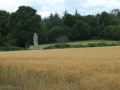
Continue along this small road, where the junction is marked as tricky, until you reach the sign for the menhir. Turn left and follow the path leading to this beautiful 8-metre menhir, ranked among the 10 tallest in France.
No markings.
(6) Retrace your steps (grassy area with a picnic table) and continue along the small road to the left, lined with horse pastures. At the three-way junction (sign for Miné Saint-Jean), take the sharp left-hand bend and follow this small road. Pass a group of houses where you will be greeted by a chorus of barking. Note the lovely view on the left of the menhir, which seems lost in the middle of the fields. Continue on to reach the hamlet of Saint-Jean and its16th–17th-century chapel.
Yellow markings at signpost no. 5.
(7) Retrace your steps for about a hundred metres and, at the signpost, turn right and follow the path which passes between a few old houses and then leads onto the access road to some houses. Continue down a lovely descent towards the Stop sign on the D6.
(8) After crossing this road, continue to the right along the path which climbs slightly. Note the granite outcrops in several places, then turn left at the next three-way junction and continue to a small road. Follow it to the right towards the hamlet of Kerbars.
(9) At the signpost, turn left to cross this hamlet (old stone buildings) and take the sunken path that descends towards the Isole valley. Veer slightly left at the road to take the path that leads down to the river.
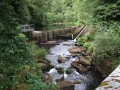
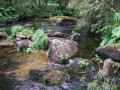
(10) Follow the river to the left. Note that there are several paths allowing you to adapt the route depending on the river level. On the opposite bank stands the Cascadec Mill, which was bought by the Bolloré family to power the paper mill built downstream in 1917. Near the footbridge, look out for large granite slabs that can serve as a little beach area. Continue to follow the Isole and its granite boulders (watch out for roots) until you reach the road. Follow it to the fork by the factory at the bridge.
Turn right onto the bridge to see the riverworks and the diversion channel leading to the paper mill. The chapel, built in 1926 by the Bolloré family and made available to factory staff and the parish clergy for several decades, was dismantled during the winter of 2019–2020.
Follow the road to the car park (S/E), located 100 metres away.



 Visorando Member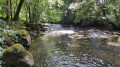
 Easy
Easy