Country:
 City:
City:


Park at the car-share area beside the D15
(S/E) Leave the car-sharing area on the left and turn right onto a grassy track overlooking a children’s playground on your left.
Signposted with yellow marker posts + the Coray and VTT30 logos at junctions.
Continue along Rue de la Gare, which merges into Chemin de la Ligne, the former “Rosporden–Plouescat” railway line, and reach the D50.
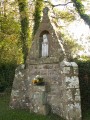
(1) At the crossroads, turn left; look out for a space laid out in 1995 to serve as a resting place for the procession: a statue of the Virgin Mary. Follow the road for about a hundred metres and turn right (signpost and sign for the motorhome site) onto the small road that descends gently towards a stream. Then head back up towards the hamlet of Kerherno on your left.
(2) On leaving the hamlet, at the signpost, turn right onto a wide stony track closed to motorised vehicles (a sign you’ll see regularly along the route). At the first crossroads, veer right and continue to the next one, where you’ll find two brand-new signs (April 2018).
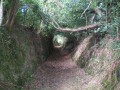
(3) Let the old route continue to the right and take the sunken track leading down to the left (signposted ‘Tro Kore’). This sunken track descends gently towards the ruined Kernaval farm. This section can be muddy in winter. Continue along the small road, past the imposing Crysland greenhouses. Pass under the high-voltage power line and continue along this small road, flanked by marshy areas.
(4) At the Stop sign, carefully cross the D36 to take the small road slightly to the left. As you pass, note the imposing old café with the fitting name ‘Café de la Gaité’. Head up towards the hamlet of Huelgarz and turn right onto the wide path at the exit.
Unmarked
(5) Despite the signpost indicating a left turn towards the meadows, head down the wide path on the right, which allows you to avoid a whole section that is impassable in winter. At the D36, turn right, keeping well to the wide grassy verge on the left, then turn left at the first road, signposted Carn Laër.
Signposted with blue-marked signposts + the Coray logo and VTT30 at junctions.
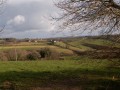
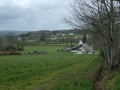
(6) When you reach the signpost again, turn right and begin a long climb along the small road to the houses, then along a path where the rock outcrops. This climb can be a little tricky in wet weather. Take a moment to look back and admire the panoramic view of the Montagnes Noires range. Continue along the edge of the woodland and then through fields until you reach a small road, which you cross. Carry on until you reach the junction with a second road.
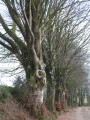
(7) Cross this road at the signpost, which now bears yellow and blue markings. Continue uphill along this track, which was the old route linking Coray to Châteauneuf-du-Faou. In places, you can see two levels: the lower one used by horses and carts, and the upper one by coachmen. Pass the hamlet of Kervihan and go under the high-voltage power line. This wide track is lined with old, hundred-year-old beech trees. Locally, this track towards Kerhuel is known as “Hent Carn Laër” (the thief’s cart track).
(8) Shortly after the hamlet of Kerhuel, reach the highest point in Coray, marked by a sign (Brec’horay 257m); pass a large mobile phone mast on your left, then an underground water tower, also on your left.
(9) Turn left to cross the Brec’horay housing estate and avoid the bend in the road where visibility is very poor. Return to the road and continue to the Stop sign.
Unmarked section
(10) Cross the D15 at the pedestrian crossing and continue along the road opposite, following the sign for MAPA du Pays GlazicK, then turn into the first street on the right. Pass the care home and then the post office. Cross the road to take the path between the church and the war memorial. After the steps, cross the Quimper road with care, then the coach park. Continue along Rue de Pors Clos, which turns left and leads straight to the car-sharing area (S/E).

 Visorando Member
 Easy
Easy