


Refine your search for walks in Oratoire de Notre-Dame-du-Moru
Oratoire de Notre-Dame-du-Moru walks


 La Croix au Maréchal circular from Mignovillard
 Visorando Member
 7.14 mi
 +610 ft
 -610 ft
 3h 50
3h 50
 Moderate
 Departure from Mignovillard (Jura)
Starting from the centre of Mignovillard, this circular route gradually takes you through farmland and then the wooded areas to the south-east of the village. It first reaches the Croix au Maréchal, an old stone cross standing alone amongst meadows and woods, situated at a former crossroads. The route continues towards the restored oratory of Notre-Dame-du-Moru, then crosses the Moru area, a reminder of a former hamlet of farmhouses that has now disappeared. The return journey takes you via La Pettouse, first overlooking and then skirting the limestone aggregate quarry. Rural landscapes, woodland and traces of local history give this circular walk a very distinctive character.
Walks near Oratoire de Notre-Dame-du-Moru
Chez Liadet - CAF Gros Morond Refuge
 12.78 mi
+1,998 ft
-1,266 ft
7h 35
12.78 mi
+1,998 ft
-1,266 ft
7h 35
 Difficult
Departure from Mouthe (Doubs)
Difficult
Departure from Mouthe (Doubs)
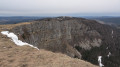
This third stage leads to Mont d'Or, from where the view stretches across the French and Swiss Alps. The route passes by the source of the Doubs, winds through forests and mountain pastures, and climbs to the summit of Mont d'Or before descending to the CAF refuge at Gros Morond.
From Foncine-le-Haut to Bellefontaine
 12.87 mi
+1,575 ft
-994 ft
7h 15
Difficult
Departure from Foncine-le-Haut (Jura)
12.87 mi
+1,575 ft
-994 ft
7h 15
Difficult
Departure from Foncine-le-Haut (Jura)
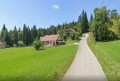
Thirteenth stage of the Échappée Jurassienne: discover the Jura Mountains on this stage between Haut-Jura and Haut-Doubs. Explore the cross-country ski trails of the Mont Noir massif, which are transformed into superb hiking trails in summer. Immerse yourself in a peaceful, unspoilt environment, where alpine flowers bloom alongside the woody scents of fir and spruce trees. Between the woods, valleys and ridges, enjoy the fresh air while admiring the picturesque landscapes.
This stage will also take you along the Bellefontaine and Mortes lakes, known for their peat bogs, which are home to remarkable flora and fauna.
Les Charbonnières - Col du Machairuz
 12.99 mi
+2,703 ft
-1,266 ft
8h 20
Difficult
Departure from Le Lieu (Vaud)
12.99 mi
+2,703 ft
-1,266 ft
8h 20
Difficult
Departure from Le Lieu (Vaud)
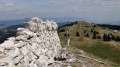
On this fifth stage, you will reach the highest point of the Swiss Jura and also of this 6-day route: Mont Tendre. This summit offers a splendid view of the canton of Vaud, Lake Geneva and the Alps.You’ll also see the numerous piles of stone gathered from fields stretching for kilometres. These are stone walls built to mark out plots of land or enclose areas for grazing livestock.
Le Pont - Ballaigues
 11.56 mi
+2,398 ft
-2,612 ft
7h 25
Difficult
Departure from Le Lieu (Vaud)
11.56 mi
+2,398 ft
-2,612 ft
7h 25
Difficult
Departure from Le Lieu (Vaud)
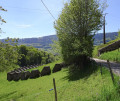
Stage 3: From Les Rousses to Lake Constance via the Jura ridges. From the beach at Lake Joux to Le Pont, you reach Vallorbe via the Dent de Vaulion (1,483 m) before following and crossing the River Orbe. Since the Middle Ages, Vallorbe has been an important centre for the iron industry thanks to its iron ore deposits and wood reserves. At the Vallorbe Iron and Railway Museum, you leave the town following the shore of Lake Day. The route then passes close to the Day Viaduct, a beautiful arch bridge built in 1925, before arriving at the Day Dam, which holds back the waters of the Orbe, and then Ballaigues, located on the southern slope of the knoll, above the course of the Orbe
From Chaux-des-Crotenay to Foncine-le-Haut
 12.62 mi
+1,998 ft
-1,765 ft
7h 35
Difficult
Departure from Chaux-des-Crotenay (Jura)
12.62 mi
+1,998 ft
-1,765 ft
7h 35
Difficult
Departure from Chaux-des-Crotenay (Jura)
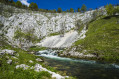
Twelfth stage of the Échappée Jurassienne. For this stage,prepare to be amazed by the wild and authentic beauty of the Jura as you let yourself be carried away by the water for a peaceful break, out of time.
Follow the tumultuous course of the Saine River through theLangouette Gorges, then discover the village of Les Planches-en-Montagne and the spectacular Malvaux Gorges, where the Saine has formed the Cascade du Bief de la Ruine, the largest waterfall in the department with a drop of 110 metres. The river then winds its way under the viaduct of the old tramway towards Foncine-le-Bas, offering breathtaking natural landscapes.
Finally, cross the Mont Bayard at an altitude of over 1,000 metres for a remarkable view of the surrounding mid-mountain landscape. End your day with a descent to the village of Foncine-le-Haut, ideal for a restful and rejuvenating night.
Vallorbe - Les Charbonnières: Lakes Joux and Brenet
 8.19 mi
+2,398 ft
-1,552 ft
5h 50
Moderate
Departure from Vallorbe (Vaud)
8.19 mi
+2,398 ft
-1,552 ft
5h 50
Moderate
Departure from Vallorbe (Vaud)
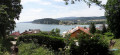
For this fourth stage, after a good hour's walk, you will reach the highest point of the day: the Dent de Vaulion. The lakes of Joux and Brenet will be at your feet. The water from these two lakes flows underground, shaping the karst cave of the Orbe, near Vallorbe. On a clear day, you can see up to eight lakes.