


Refine your search for walks in Nassogne
Nassogne walks


 Around Nassogne
 Visorando Member
 11.12 mi
 +1,286 ft
 -1,316 ft
 6h 15
6h 15
 Moderate
 Departure from Nassogne (Province de Luxembourg)
A lovely walk through the forests of the municipality of Nassogne. However, you mustn’t be put off by the steep gradients and muddy paths.
From Nassogne to Masbourg and Ambly
 9.09 mi
+1,394 ft
-1,424 ft
5h 25
Moderate
Departure from Nassogne (Province de Luxembourg)
9.09 mi
+1,394 ft
-1,424 ft
5h 25
Moderate
Departure from Nassogne (Province de Luxembourg)
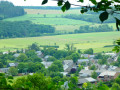
A pleasant hike through the hills and valleys of the Nassogne countryside and woods. It first takes you to the Chapel and Calvary of St-Léonard before descending towards the Masblette stream and the village of Masbourg. This is followed by a very steep climb up a very stony path on the agricultural plateau between Masbourg and Ambly. You may need a machete to approach Ambly, but the view on arrival is magnificent. The return to Nassogne is still a bit of a challenge for your calves, but you won't need a machete: the path is a little wider and properly cleared.
Ardennes walk in Nassogne
 9.97 mi
+1,473 ft
-1,447 ft
5h 50
Moderate
Departure from Nassogne (Province de Luxembourg)
9.97 mi
+1,473 ft
-1,447 ft
5h 50
Moderate
Departure from Nassogne (Province de Luxembourg)
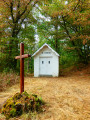
Here is a walk in Nassogne without running water, without the iconic Masblette, Diglette and other local tributaries of the Lomme.The walk is no less enjoyable for it! You’ll discover some lovely countryside scenery in a hilly setting, along with woodland sections featuring a variety of tree species typical of the region. The icing on the cake: there’s a giant sequoia in the small park surrounding the pond at the foot of Nassogne’s water tower.The Chapel of Saint-Léonard, the site itself and the Way of the Cross leading to it are a wonderful discovery. An information board there recounts the history – or perhaps, more likely, a version fuelled by the legend – of the hermit and his brother.
On the way to the Fourneau Saint-Michel
 6.70 mi
+928 ft
-928 ft
3h 55
Moderate
Departure from Nassogne (Province de Luxembourg)
6.70 mi
+928 ft
-928 ft
3h 55
Moderate
Departure from Nassogne (Province de Luxembourg)
Starting from Masbourg, the forest trails will take you halfway to the Fourneau Saint-Michel, an estate comprising the open-air museum of rural life in Wallonia and the Iron Museum, with a return trip through the heights of the Masblette valley.
Circuit in the Saint-Hubert forest starting from Fourneau Saint-Michel
8.67 mi
+814 ft
-814 ft
4h 40
 Easy
Departure from Saint-Hubert (Belgique) (Province de Luxembourg)
Easy
Departure from Saint-Hubert (Belgique) (Province de Luxembourg)
This is a very easy route through one of Belgium's largest deciduous forests, on comfortable gravel paths and a little tarmac, but very secluded, completely away from 'civilisation'. It passes by the Étang de Bilaude bird observatory, which is superb in its moorland setting. In several places, beautiful benches carved from tree trunks invite you to rest and contemplate.
Between Lomme and Masblette
12.02 mi
+1,663 ft
-1,663 ft
7h 00
Moderate
Departure from Nassogne (Province de Luxembourg)
A walk through the rolling Ardennes countryside around two rivers that are emblematic of the region.
The Masblette is a tributary of the Lomme (also spelled L'Homme in some sources). Their confluence is located between the villages of Lesterny and Masbourg, south of Forrières.
Notre-Dame des Pauvres Chapel and Pont des Cloyes
 6.05 mi
+656 ft
-650 ft
3h 20
Moderate
Departure from Tellin (Province de Luxembourg)
6.05 mi
+656 ft
-650 ft
3h 20
Moderate
Departure from Tellin (Province de Luxembourg)
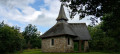
Discover the Notre-Dame des Pauvres Chapel, whose stained-glass windows, dedicated to the Virgin Mary, allow light to penetrate under the arch sheltering the Virgin of Banneux. Beforehand, cross the Pont des Cloyes, a prime spot for observing herons, mallards, kingfishers and other birds of the Lomme.
From the Linçon Valley to the Masblette Valley
 6.77 mi
+850 ft
-840 ft
3h 50
Moderate
Departure from Tellin (Province de Luxembourg)
6.77 mi
+850 ft
-840 ft
3h 50
Moderate
Departure from Tellin (Province de Luxembourg)
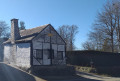
Walk in the Land of the Awenne Clog Makers. This slightly hilly route, mostly through forest, will take you past the Notre-Dame de Lourdes cave and the Ri Bellerose stream to the heights of the Prairies de Gimbes ridge, passing by the open views at a place called La Justice.
Walk to the sources of the Hédrée from Lignières
 8.98 mi
+830 ft
-843 ft
4h 50
Moderate
Departure from Marche-en-Famenne (Province de Luxembourg)
8.98 mi
+830 ft
-843 ft
4h 50
Moderate
Departure from Marche-en-Famenne (Province de Luxembourg)
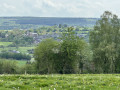
The Hédrée river forms in the marshy area of the forest on the outskirts of Marche-en-Famenne between the villages of Gênes (Rendeux) and Bande (Nassogne).The route crosses this rushing stream at the ford on the path shortly after kilometre 2 and then follows one of its tributaries, whose bed runs alongside the path for just under the next kilometre.This is not the only wet spot on the walk: you often have to take a path through the undergrowth instead of the road until you reach the junction with Rue des Fagnes at kilometre 4.4.After a well-deserved break, it's back to the same thing for about 2 kilometres after crossing the national road.The last 4 kilometres are much drier.A short stop on the bridge at the bottom of Grimbièmont allows you to see how much the waters of the Hédrée have swollen over the first few kilometres of its course.In autumn, the circular offers not only the beautiful colours of nature but also an incredible diversity of mushrooms.
Circular route within the future Nassonia National Park starting from Sapin Fî
 14.03 mi
+1,312 ft
-1,306 ft
7h 35
14.03 mi
+1,312 ft
-1,306 ft
7h 35
 Difficult
Departure from Saint-Hubert (Belgique) (Province de Luxembourg)
Difficult
Departure from Saint-Hubert (Belgique) (Province de Luxembourg)
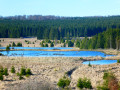
This circular walk follows the wide forest tracks through part of the future Nassonia National Park and the Deux-Ourthes Nature Park.Starting from the Sapin Fî car park, the walk first heads towards the Rouge Poncé birch forest and its boardwalks, then towards the Wallonia Log Park before branching off towards Mochamps, the Fagnes de Priesse observation tower and the Croix des Russes.After a long descent into the Rabani valley, the walk crosses the Masblette, the iconic river of Fourneau-Saint-Michel, via a small footbridge following the destruction of the two-arched stone bridge during the floods of summer 2021.On the return journey, the route climbs slowly but surely, following the Palogne stream back up to Sapin Fî.
On the heights of the Lomme, starting from Bure
 12.01 mi
+1,198 ft
-1,198 ft
6h 35
Difficult
Departure from Tellin (Province de Luxembourg)
12.01 mi
+1,198 ft
-1,198 ft
6h 35
Difficult
Departure from Tellin (Province de Luxembourg)
Starting from the Chapel of Notre-Dame de la Salette, the walk begins in the countryside before entering the woodland, quickly reaching the Lomme stream, which it follows upstream for over 4 km to the provincial fish farm at Mirwart.The ponds stretch out one after the other along the course of the Marsault or Marsolle stream to the former site of the Marsolle blast furnace, which operated from 1536 to 1568 on behalf of the Lord of Mirwart.The route then zigzags through the forest for around 9 kilometres to reach the rural heights of Bure and return to the starting point.
Between Ardenne and Famenne
 11.15 mi
+1,276 ft
-1,273 ft
6h 15
Moderate
Departure from Tellin (Province de Luxembourg)
11.15 mi
+1,276 ft
-1,273 ft
6h 15
Moderate
Departure from Tellin (Province de Luxembourg)
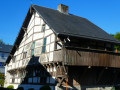
Part countryside, part woodland, the walk offers lovely views across the slopes of the Lomme Valley and its surroundings.Of particular note are the Notre-Dame de Haurt Chapel and the nearby disused quarry (a protected site), the Clusure viewpoint, the Maison Espagnole, the Château de Burlin estate, the beautifully renovated farmhouse on Rue Belair, and the Notre-Dame des Pauvres Chapel – to name but a few of the walk’s highlights.
Passing through La Basseille
 5.27 mi
+673 ft
-673 ft
3h 00
Easy
Departure from Tenneville (Province de Luxembourg)
5.27 mi
+673 ft
-673 ft
3h 00
Easy
Departure from Tenneville (Province de Luxembourg)
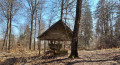
Set off to explore the River La Basseille, a tributary of the Ourthe which rises in Saint-Hubert. The river, whose banks form a Nature Reserve, flows exclusively through the Forest of Freyr for around 10 km.
Please note: there are two sections that are more difficult to follow; a GPX track is recommended.
Towards La Hédrée and La Wamme, setting off from Waha
 11.45 mi
+1,112 ft
-1,086 ft
6h 15
Moderate
Departure from Marche-en-Famenne (Province de Luxembourg)
11.45 mi
+1,112 ft
-1,086 ft
6h 15
Moderate
Departure from Marche-en-Famenne (Province de Luxembourg)
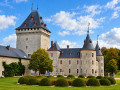
From Waha church, the walk begins by heading due east before climbing up through the countryside and then into woodland. After passing through the very pretty Bois de Waha, the route returns to open countryside as far as Harsin, offering beautiful panoramic views over the Hédrée and Wamme valleys. The walk then takes you to explore the Prés de la Wamme and the splendid Château Jemeppe in Hargimont, before gently winding its way back up to the hills of Waha.
Geological trail in the Fond des Vaulx nature reserve
 2.48 mi
+151 ft
-151 ft
1h 15
Easy
Departure from Marche-en-Famenne (Province de Luxembourg)
2.48 mi
+151 ft
-151 ft
1h 15
Easy
Departure from Marche-en-Famenne (Province de Luxembourg)
The Fond des Vaulx is part of the Famenne-Ardenne Geopark, the first UNESCO Global Geopark in Belgium.
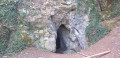
A stone's throw from the town centre, this small, steep-sided valley offers a landscape that contrasts with the expanse of the Marche plain. It is home to several caves, chantoirs and holes, including the Trotti-aux-Fosses chasm, which is unique in Belgium and remarkable for its collapse chasm morphology.
Countryside between Marche-en-Famenne and Verdenne
 5.15 mi
+289 ft
-292 ft
2h 35
Easy
Departure from Marche-en-Famenne (Province de Luxembourg)
5.15 mi
+289 ft
-292 ft
2h 35
Easy
Departure from Marche-en-Famenne (Province de Luxembourg)
This route takes you to the village of Verdenne, on the plateau to the east of Marche-en-Famenne.
Discover the essentials of Mirwart
 4.41 mi
+505 ft
-486 ft
2h 30
Easy
Departure from Saint-Hubert (Belgique) (Province de Luxembourg)
4.41 mi
+505 ft
-486 ft
2h 30
Easy
Departure from Saint-Hubert (Belgique) (Province de Luxembourg)
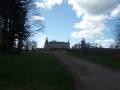
Glacière, ponds, arboretum, Croix des Bûcherons: circular around Mirwart Castle.
The grand tour of Mirwart
 9.92 mi
+1,086 ft
-1,056 ft
5h 30
Moderate
Departure from Saint-Hubert (Belgique) (Province de Luxembourg)
9.92 mi
+1,086 ft
-1,056 ft
5h 30
Moderate
Departure from Saint-Hubert (Belgique) (Province de Luxembourg)
Glacière, ponds, arboretum, Croix des Bûcherons, but also Croix des Morts, La Lomme, Rocher de Marie Gobaille. Let's set off on the grand tour of Mirwart.
In the woods of Arville
 9.45 mi
+823 ft
-827 ft
5h 05
Moderate
Departure from Saint-Hubert (Belgique) (Province de Luxembourg)
9.45 mi
+823 ft
-827 ft
5h 05
Moderate
Departure from Saint-Hubert (Belgique) (Province de Luxembourg)
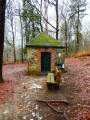
From the small car park at the back of the Arville barbecue area (at the end of Rue de la Supinette), the walk heads through the countryside towards the Lozet Biai pond. At Le Paradis, the route enters the woods and remains there almost all the way to the finish.Wide paths or narrow tracks, stony, muddy, grassy and even a bit soggy in places, are the main features of this route. Only 600 metres of tarmac at the start and a 200-metre break about a third of the way along the route allow you to keep your boots reasonably dry… you can wipe your boots clean when crossing a few small fords further on, but recent forestry work will almost certainly quickly undo any cleaning efforts.Apart from the ever-present forest, walkers pass by the Halifax memorial as well as the Notre-Dame de Bon-Secours Chapel, also known as the Chapelle du Cheny du Mont, where there is a bench.On the way back, there’s a lovely view on the horizon of the outskirts of Arville.
A woodland walk to Mirwart Castle
 9.87 mi
+876 ft
-896 ft
5h 20
Moderate
Departure from Saint-Hubert (Belgique) (Province de Luxembourg)
9.87 mi
+876 ft
-896 ft
5h 20
Moderate
Departure from Saint-Hubert (Belgique) (Province de Luxembourg)
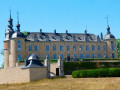
Set off to explore the vast forest of Saint-Hubert from Mirwart, taking a more open route through the rural hills of Arville. On the return journey, the route follows the meandering course of the River Lomme and its numerous passages under the railway line before climbing up the avenue leading to Mirwart Castle, which was splendidly renovated at the start ofthe 21st centuryand transformed into a hotel, restaurant and venue for receptions, seminars and outdoor events.
Eaux & Forêts in Mirwart
 12.48 mi
+1,398 ft
-1,398 ft
6h 55
Difficult
Departure from Saint-Hubert (Belgique) (Province de Luxembourg)
12.48 mi
+1,398 ft
-1,398 ft
6h 55
Difficult
Departure from Saint-Hubert (Belgique) (Province de Luxembourg)
Eaux & Forêts (Water & Forests): older people will certainly remember this former name of the Wallonia public service Direction Nature et Forêt (Nature and Forestry Department). The former name perfectly reflects the intrinsic characteristics of this long hike starting from the provincial estate of Mirwart, which takes you on a journey of discovery along the Lomme, the Parfond Ry and a few other nameless streams. Nothing but forest and aquatic bliss... especially when the rivers and streams are in flood! That said, the paths and trails in this region of the Belgian Ardennes are in much better condition in the middle of winter after heavy rains than in other regions such as Limburg or the Pays des Collines, to name but two. Of course, the ruts dug by forestry machinery during various felling or clearing operations do not always help to keep the paths in good condition for hiking.
Hike without description to be followed with the Visorando app.
Broom walk from Waharday
 9.93 mi
+965 ft
-981 ft
5h 25
Moderate
Departure from Rendeux (Province de Luxembourg)
9.93 mi
+965 ft
-981 ft
5h 25
Moderate
Departure from Rendeux (Province de Luxembourg)
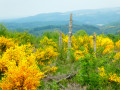
The deforested hillsides in the Waharday, Chéoux and Hodister area have been repopulated with various species of shrubs, notably broom, which has taken root there in their thousands.When they flower in May, they light up the whole area with their characteristic magnificent yellow colour.The icing on the cake is that the numerous meadows are also illuminated in yellow by buttercups.A real feast for the eyes.