Country:

 City:
City:


Once in Ferrals-les-Montagnes, park in the car park on the edge of the D12: this car park is located at the entrance to the village or at the exit, depending on the direction of arrival. There is an information board about hikes in the area.
Yellow + blue PR® markings
(S/E) Head towards the village, passing in front of the inn and then the town hall/school. At a beautiful isolated tree bearing the double markings, leave the road and turn left into a cement alleyway (Rue du Lavoir). Come out onto a tarmac road and continue straight ahead to cross the bridge.
(1) Turn right onto a gravel path that climbs gently and eventually rejoins the road you left earlier. Follow it to the right until you reach a crossroads (road sign "Camp de Périès") and turn left towards a clearly visible fire hydrant.
(2) Walk to the tank to admire its painted decoration, retrace your steps, then take the path on the right.
Yellow PR® markings
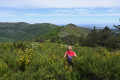
Keep right at a faint three-way junction in the path and, after a steady climb, emerge from the undergrowth. The view opens up on the right, particularly over the Corbières and the Ariège Pyrenees. Pass a hunting post and you will reach a three-way junction in the path.
(3) Continue straight ahead. Cross a fence, leave a path on the right at the edge of the forest and reach a flat area, where another completely rusted fire tank marks a crossroads.
(4) Keep going. Cross a second fence and begin the steady, demanding climb up the south-eastern slope of Mont Cayroux.
No markings
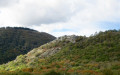
(5) Temporarily leave the markings to climb straight up despite the yellow cross. You will soon reach a flat area with a small isolated tree. Continue straight ahead for a few dozen metres until you find a faint grassy trail and follow it to the left to quickly reach the summit, which is recognisable by its scree.
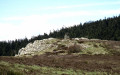
(6) Enjoy the 360° panorama. Despite its modest altitude, this summit offers an exceptional view encompassing the Montagne Noire, the Corbières, the Ariège Pyrenees and even, if the weather permits, the Mediterranean Sea. Turn back.
Yellow PR® markings
(5) Turn left, then go through a metal gate. Keep to the right at the fork just after the gate and continue for about 300 metres. At the three-way junction, which is not very clear on the ground, keep left and join a tarmac road. Just opposite, a second cistern, beautifully decorated with a sea theme, makes you forget the horrible breeze block construction you passed just before.
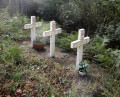
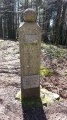
(7) Turn left and follow this very quiet road. Pass the crosses commemorating the death of four inhabitants of the hamlet of Serières who were killed by the occupying forces on 15 June 1944 and continue to a path on the left.
(8) Leave the road and take this path, following the signposts. Return to the road after a steep descent, continue straight ahead, pass another fire hydrant with a darker design and arrive at the Col de Serières on the D12.A memorial stone commemorates the events mentioned above.
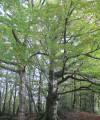
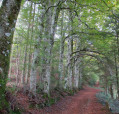
(9) Cross carefully and follow the tarmac road opposite to a private property. At the end of a majestic row of beech trees, leave this property on your left and turn right onto a wide path through a beautiful, dense wood. Go through two hairpin bends.
No markings
(10) When you reach the third bend, go straight ahead before negotiating the bend, despite the yellow cross. Follow this beautiful forgotten path, where your footsteps sink into the thick carpet of dead leaves, until you rejoin the path you left further down.
Yellow PR® markings
Continue to the right.
(11) Turn left at the hairpin bend onto the path, which begins a steep climb before levelling out onto the plateau. Go through a metal gate and continue across the meadows, alternating between gentle ascents and descents. The wide grassy ridge offers views of the Pyrenees and Pic de Nore, which dominates the north-west, all along the way.
(12) Go through a final fence and descend a gentle slope to the next junction marked by another fire hydrant, whose decoration has unfortunately been almost completely erased.
(13) Turn left, continue straight ahead at the fork about a hundred metres further on and enter the forest. You will come to another fork where a grassy track joins from the left. Take the track opposite and descend steeply to rejoin the track you crossed earlier. Turn right and join the D920.
(14) Turn left and proceed with extreme caution for about 20 metres: this section is between two bends with no visibility. Cross over and turn right onto a tarmac road (road sign "Peyroubayle"). At the entrance to the property, leave the tarmac road and continue straight ahead on a beautiful stony path.
(15) Note the magnificent and imposing beech tree, which is not listed, located in the left-hand bend, pass a short concrete section, and continue downhill. The path heads south, then becomes tarmac before joining the D12 at the car park (S/E).





 Visorando Member
 Difficult
 Tourist office
 Easy
Easy