Refine your search for walks in Moncey
Moncey walks


 Architecture and heritage starting from Moncey
 Visorando Member
 6.23 mi
 +515 ft
 -522 ft
 3h 20
3h 20
 Moderate
 Departure from Moncey (Doubs)
This walk allows you to discover:
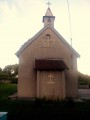
- Moncey Castle, former property of Marshal Moncey, who was Marshal of the Empire under Napoleon,
- the restored old centre of the village of Moncey, its old railway station and its greenway, which follows the old railway line,
- and a walk through the forest in the mountains, then across the village of Venise, with the option of walking around the lagoon to discover its flora and fauna.
From the abbey to the châteaux, starting from Cirey-les-Bellevaux
 Tourist office
 13.92 mi
+837 ft
-860 ft
7h 10
13.92 mi
+837 ft
-860 ft
7h 10
 Difficult
Departure from Cirey (Haute-Saône)
Difficult
Departure from Cirey (Haute-Saône)
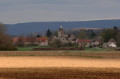
This circular route starts at the town hall in Cirey-les-Bellevaux. Enjoy your walk along the Ognon as you pass numerous landmarks: the château, the Saint-Justin Chapel and the Malgéard Mill.
The Fort de la Dame Blanche
 5.32 mi
+1,227 ft
-1,204 ft
3h 30
Moderate
Departure from Vieilley (Doubs)
5.32 mi
+1,227 ft
-1,204 ft
3h 30
Moderate
Departure from Vieilley (Doubs)
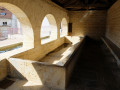
From the town hall in Vieilley and its beautiful wash house fountain, you will climb towards the line of ledges overlooking the Ognon valley to reach the Fort de la Dame Blanche viewpoint over the Vosges, hopefully without encountering that unsettling woman who haunts these places after dark. Then, from the old fortifications, you’ll descend via a wild path towards the valley.
Meadows, river and castle between Buthiers and Perrouse
 4.99 mi
+315 ft
-312 ft
2h 35
4.99 mi
+315 ft
-312 ft
2h 35
 Easy
Departure from Perrouse (Haute-Saône)
Easy
Departure from Perrouse (Haute-Saône)
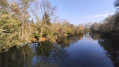
Viewpoint, castle, wash houses, banks of the Ognon, nature reserve pond: discover Perrouse and Buthiers.
In the footsteps of the White Lady
 7.67 mi
+1,316 ft
-1,319 ft
4h 40
Moderate
Departure from Bonnay (Doubs)
7.67 mi
+1,316 ft
-1,319 ft
4h 40
Moderate
Departure from Bonnay (Doubs)
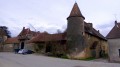
From Bonnay church, you will climb up to this beautiful line of cornices overlooking the Ognon valley to reach the Fort de la Dame Blanche viewpoint over the Vosges, following in the footsteps of the disturbing woman who haunts these places after dark. Then, from the ancient fortifications, you will descend via a wild path towards the valley and its villages with their beautiful fountains, returning to Bonnay and its castle via the old Tacot road.
Circular route around Braillans-Est
 3.31 mi
+125 ft
-125 ft
1h 40
Easy
Departure from Braillans (Doubs)
3.31 mi
+125 ft
-125 ft
1h 40
Easy
Departure from Braillans (Doubs)
A short walk east of Braillans, through its game-rich woods and past the memorial stone honouring the memory of Honoré Gressenbucher, known as Nono, who died for France at Les Combottes in 1944.
From the train to the chasms
 8.80 mi
+446 ft
-476 ft
4h 25
Moderate
Departure from Rioz (Haute-Saône)
8.80 mi
+446 ft
-476 ft
4h 25
Moderate
Departure from Rioz (Haute-Saône)
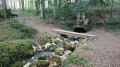
Following in the footsteps of our ancestors, let's walk through the countryside to the chasms of the Bois de la Hye, known as the "Bois des Roches".
Passage impossible in (10), see notices
Through the woodland to the River Ognon at Voray-sur-l’Ognon
9.67 mi
+548 ft
-548 ft
4h 55
Moderate
Departure from Voray-sur-l'Ognon (Haute-Saône)
This circular route starts from Voray, Place de l’Église. You can also enjoy the water sports on offer along the banks of the Ognon (canoeing and kayaking, swimming).
 The butterfly in Voray-sur-l’Ognon
 25.30 mi
+1,493 ft
-1,486 ft
4 hrs
Moderate
Departure from Voray-sur-l'Ognon (Haute-Saône)
25.30 mi
+1,493 ft
-1,486 ft
4 hrs
Moderate
Departure from Voray-sur-l'Ognon (Haute-Saône)
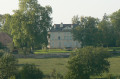
This route forms a circular route shaped like a butterfly. It starts at the church in Voray and passes through the villages of Buthiers, Villers-le-Temple, Breurey, Boult, Montarlot-les-Rioz, La Lotière and Boulot.Discover the cultural heritage of the Haute-Saône region with the castles of Buthiers, Boult and Boulot.
The Grand Châfo in Voray-sur-l'Ognon
 2.79 mi
+102 ft
-102 ft
1h 20
Easy
Departure from Voray-sur-l'Ognon (Haute-Saône)
2.79 mi
+102 ft
-102 ft
1h 20
Easy
Departure from Voray-sur-l'Ognon (Haute-Saône)
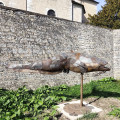
The Fisherman of the Grand Châfo: thrills and adventures along the Ognon!
This is an educational trail. In Voray-sur-L’Ognon, a legend has long been told… That of the Grand Châfo, a monstrous catfish lurking in the river, capable of snatching perch and pike in an instant!Join Désiré, a brave fisherman, in his incredible battle against this legendary monster, and discover a world where courage, mystery and laughter come together by the water’s edge.Take your children along the trail and experience, together, this thrilling adventure, full of twists and turns and magic, in the heart of nature!
Circular Thise through the Coutelot and Ban woods
7.61 mi
+597 ft
-594 ft
4h 00
Moderate
Departure from Thise (Doubs)
On the outskirts of Besançon, this entirely woodland hike will take you from the outskirts of Thise to the summit of the Côte de Marchaux via the aptly named Sentier des Dolines, then along various roads and tracks to reach the highest point of the route. The return journey along the ridge line and then along some lovely paths presents no difficulty.
The Chapel of Montoille and the Rocks of Château-Loriot
 7.20 mi
+1,512 ft
-1,486 ft
4h 40
Moderate
Departure from Vaire-le-Petit (Doubs)
7.20 mi
+1,512 ft
-1,486 ft
4h 40
Moderate
Departure from Vaire-le-Petit (Doubs)
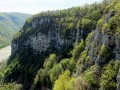
A gentle forest walk to the Montoille viewpoint overlooking Deluz and its old paper mill. You'll no doubt find yourself whistling as you climb the beautifully named Impasse de Chantemerle, but you'll soon need to catch your breath for the strenuous climb to the Grotte de sous Roche and the Château-Loriot viewpoint over the Doubs valley and the Vosges mountains, which will reward you for your efforts. A peaceful, wooded return journey, framed by the mossy rocks of a superb sinkhole.
Aigremont Mountain
 7.06 mi
+1,867 ft
-1,867 ft
4h 50
Moderate
Departure from Deluz (Doubs)
7.06 mi
+1,867 ft
-1,867 ft
4h 50
Moderate
Departure from Deluz (Doubs)
Aigremont overlooks the Doubs valley. Once crowned by a small fortified castle, legend has it that on these ruins, a shepherd intrigued by the behaviour of his flock—which was drawn to a patch of evergreen grass—discovered a statue of the Virgin Mary. Carried down to the village, it mysteriously returned to its rock, where a chapel was built. You will reach it by following magnificent jagged ledges, discovering from these heights the Jura mountains and, on a clear day, Mont Blanc.
Fort de la Dame Blanche, starting from Les Grandes Baraques
 4.37 mi
+840 ft
-840 ft
2h 45
Easy
Departure from Besançon (Doubs)
4.37 mi
+840 ft
-840 ft
2h 45
Easy
Departure from Besançon (Doubs)
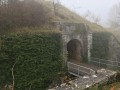
An easy forest walk leading to the Fort de la Dame Blanche from the Grandes Baraques car park. From the fort, the view over the Ognon Valley is splendid.
The Acacia Fountain
 4.02 mi
+351 ft
-351 ft
2h 10
Easy
Departure from Besançon (Doubs)
4.02 mi
+351 ft
-351 ft
2h 10
Easy
Departure from Besançon (Doubs)
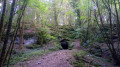
A short, cool, shaded walk to discover the Fontaine des Acacias, one of the only water sources in the Chailluz Forest, carved out at the foot of a small cirque of mossy rocks in a wild sinkhole. Return via the floral trail to another sinkhole: the Creux Vivier.
La Dame Blanche
 5.95 mi
+1,047 ft
-1,060 ft
3h 40
Easy
Departure from Besançon (Doubs)
5.95 mi
+1,047 ft
-1,060 ft
3h 40
Easy
Departure from Besançon (Doubs)
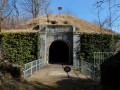
This is a forest walk in the Chailluz Forest, whose name comes from "chaille", a rock similar to flint, which our ancestors used to make arrowheads. You will climb up to the beautiful line of cornices overlooking the Ognon valley to reach the Fort de la Dame Blanche viewpoint over the Vosges mountains. And as you will no doubt be doing this walk on a beautiful sunny day, you are unlikely to encounter the disturbing lady who haunts these places after dark.
Walk to Notre Dame de la Libération
 0.51 mi
+26 ft
-26 ft
0h 15
Easy
Departure from Thise (Doubs)
0.51 mi
+26 ft
-26 ft
0h 15
Easy
Departure from Thise (Doubs)
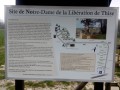
A very lovely, fairly short walk suitable for everyone, on the hills above the small village of Thise, east of Besançon. Minimal elevation gain, stony path.
The Bois de la Cototte in Roche-lez-Beaupré
 5.55 mi
+725 ft
-705 ft
3h 10
Moderate
Departure from Roche-lez-Beaupré (Doubs)
5.55 mi
+725 ft
-705 ft
3h 10
Moderate
Departure from Roche-lez-Beaupré (Doubs)
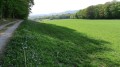
A short walk, almost entirely through the forest, very pleasant, very close to Besançon but offering a complete change of scenery and plenty of variety.
La Roche Blanche
 9.37 mi
+1,138 ft
-1,142 ft
5h 20
Moderate
Departure from Vaire-Arcier (Doubs)
9.37 mi
+1,138 ft
-1,142 ft
5h 20
Moderate
Departure from Vaire-Arcier (Doubs)
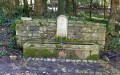
From the sumptuous Château de Vaire-le-Grand, the whim and ruin of Jean-Antoine Boisot, son of a close friend of King Louis XIV, you will climb towards La Roche Blanche. This is an unsecured viewpoint (caution!) over the Doubs valley. You will be taken by surprise by the rustic fountain of Les Tilleuls and descend via the beautiful sunken path lined with wild garlic at La Vacherie. You will then return along the riverbank, in the shade of the Rochers du Château Loriot, to discover the old paper mill.
The Rufille Trail in Thise
 8.96 mi
+873 ft
-869 ft
4h 55
Moderate
Departure from Thise (Doubs)
8.96 mi
+873 ft
-869 ft
4h 55
Moderate
Departure from Thise (Doubs)
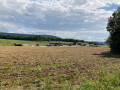
The town of Thise and the March'en Thise Association have marked out four paths in the Bois de Thise to showcase different aspects of the woods, including the one described here: the Sentier Noir, known as the Sentier de Rufille.
The Dolines Trail
 5.96 mi
+807 ft
-804 ft
3h 25
Easy
Departure from Thise (Doubs)
5.96 mi
+807 ft
-804 ft
3h 25
Easy
Departure from Thise (Doubs)
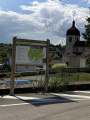
The municipality of Thise and the March'en Thise Association have mapped out four trails in the Bois de Thise to showcase different aspects of this woodland, including the one described here: the 10 km red trail, known as the Sentier des Dolines.
Route around Thise-Est and Beaupré Castle
 3.88 mi
+246 ft
-243 ft
2h 00
Easy
Departure from Thise (Doubs)
3.88 mi
+246 ft
-243 ft
2h 00
Easy
Departure from Thise (Doubs)
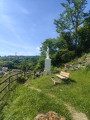
Views of Beaupré Castle along an easy, picturesque route east of Thise.
Alternative routes available. Wildlife and birdwatching.
Picnic, sports and play area. Boules court. Second car park halfway along the route.
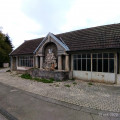
A trail featuring stones and unusual or remarkable trees in Thise
 1.66 mi
+289 ft
-285 ft
1h 00
Easy
Departure from Thise (Doubs)
1.66 mi
+289 ft
-285 ft
1h 00
Easy
Departure from Thise (Doubs)
A short walking route through the forest and along paths on the northern hills immediately surrounding Thise.
Numerous possible variations.
The Chanois and Dame Blanche viewpoints
 5.27 mi
+899 ft
-883 ft
3h 10
Easy
Departure from Tallenay (Doubs)
5.27 mi
+899 ft
-883 ft
3h 10
Easy
Departure from Tallenay (Doubs)
You’ll climb towards the wild viewpoint of Le Chanois on the rocks of La Dame Blanche, following in the footsteps of this eerie woman who haunts these places after dark, passing the ruins of an old mountain hut along the way, Then, following a beautiful ridge line overlooking the Ognon valley, you’ll reach the Fort de la Dame Blanche viewpoint overlooking the Vosges. From the ancient fortifications, you’ll descend towards Tallenay along paths overlooking a picturesque forest slope, ending with the peaceful Sentier du Facteur, which will lead you to a forest boundary marker dating from the time of Louis XV.
The Acacia Fountain
 8.66 mi
+571 ft
-564 ft
4h 30
Moderate
Departure from Besançon (Doubs)
8.66 mi
+571 ft
-564 ft
4h 30
Moderate
Departure from Besançon (Doubs)
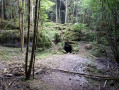
A pleasant walk in the shade of the trees in the Chailluz forest, passing by the Fontaine des Acacias (a forest water source carved into the side of a sinkhole). An easy route through the coniferous woodland.
The Sous Roche Cave
 4.63 mi
+1,181 ft
-1,165 ft
3h 10
Moderate
Departure from Deluz (Doubs)
4.63 mi
+1,181 ft
-1,165 ft
3h 10
Moderate
Departure from Deluz (Doubs)
Forest walk to the viewpoint of the Chapelle de Montoille sur Deluz and the Doubs valley, peaceful today but still echoing with the industrious sounds of the old mines and paper mills of yesteryear, to the Rochers du Château Loriot viewpoint, and finally down to the Grotte de sous Roche and the village.
The Rocks of Château Loriot, the Chapel of Aigremont
 8.20 mi
+1,955 ft
-1,955 ft
5h 30
Moderate
Departure from Deluz (Doubs)
8.20 mi
+1,955 ft
-1,955 ft
5h 30
Moderate
Departure from Deluz (Doubs)
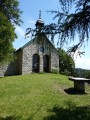
This is a challenging hike offering three viewpoints over the Doubs valley and its meanders, the Val de Roulans, the Jura mountains and, on a clear day, Mont Blanc. You will visit the two villages in the valley, Laissey and Deluz, which are peaceful today but still echo with the industrious sounds of the old mines and paper mills, and enjoy their genuine and simple riches: here a naive war memorial, there an ancient forgotten cul-de-four oven or an old wash house.
Le Vieux Tilleul and Fort de la Dame Blanche as seen from Les Petites Baraques
8.83 mi
+1,430 ft
-1,457 ft
5h 20
Moderate
Departure from Besançon (Doubs)
On the outskirts of Besançon, starting from Les Petites Baraques (Chailluz Forest), theGR® de Pays Ceinture de Besançon trail takes you up to the ridge, which you then follow for nearly 6 km, from Le Vieux Tilleul above the Prè Brenot industrial estate to the Fort de la Dame Blanche viewpoint above Bonnay. The return route takes you through the Chailluz Forest, allowing you to walk alongside its wildlife reserve.
Le Roulanais
6.57 mi
+558 ft
-554 ft
3h 30
Moderate
Departure from Roulans (Doubs)
An easy family walk. The Roulanais route alternates between villages, small roads, paths through the undergrowth and forest tracks.
Notre Dame d'Aigremont
 4.51 mi
+1,391 ft
-1,378 ft
3h 15
Moderate
Departure from Roulans (Doubs)
4.51 mi
+1,391 ft
-1,378 ft
3h 15
Moderate
Departure from Roulans (Doubs)
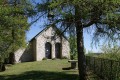
Walk to the Chapel of Aigremont in Roulans and the viewpoint overlooking the Doubs on the Laissey side.
The Arcier Springs
 5.41 mi
+1,234 ft
-1,240 ft
3h 35
Moderate
Departure from Vaire-Arcier (Doubs)
5.41 mi
+1,234 ft
-1,240 ft
3h 35
Moderate
Departure from Vaire-Arcier (Doubs)
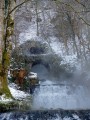
At the gates of Besançon, the waters of the Arcier springs, naturally filtered by the Saône marshes, have supplied the city since the distant Gallo-Roman era. From their green and rocky settings, the babbling waters, gushing from all sides, will restore your bucolic spirit. You will then climb, at a more military pace, to the ruins of the Épesses battery, built in 1878.
Arcier Springs Circular Trail
 1.49 mi
+558 ft
-535 ft
1h 10
Easy
Departure from Vaire-Arcier (Doubs)
1.49 mi
+558 ft
-535 ft
1h 10
Easy
Departure from Vaire-Arcier (Doubs)
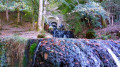
A short but challenging walk to discover the Arcier springs that have supplied the city of Besançon since the distant Gallo-Roman era. A gentle warm-up, accompanied by the music of gushing water. Then a lovely climb up the slopes of the Grand Bois, still accompanied by the murmur of the water.
The Fontaine aux Soldats and the Chanois viewpoint
 5.40 mi
+906 ft
-899 ft
3h 15
Easy
Departure from Châtillon-le-Duc (Doubs)
5.40 mi
+906 ft
-899 ft
3h 15
Easy
Departure from Châtillon-le-Duc (Doubs)
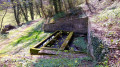
From the secluded Fontaine aux Soldats, you’ll climb towards a wild viewpoint overlooking the rocks of the Dame Blanche, passing the ruins of an old mountain hut along the way, following in the footsteps of that eerie woman who haunts these places after dark. You’ll then descend towards a powder magazine and the Fort de Châtillon via peaceful forest paths.
From Fort Châtillon to the Dame Blanche
 6.75 mi
+1,076 ft
-1,076 ft
4h 05
Moderate
Departure from Châtillon-le-Duc (Doubs)
6.75 mi
+1,076 ft
-1,076 ft
4h 05
Moderate
Departure from Châtillon-le-Duc (Doubs)
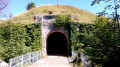
From Châtillon church, you will climb to a wild viewpoint on the rocks of the Dame Blanche, encountering the ruins of an old caborde (stone shelter) along the way. Then, along a beautiful line of cornices overlooking the Ognon valley, you will reach the Fort de la Dame Blanche viewpoint over the Vosges mountains, following in the footsteps of the disturbing woman who haunts these places after dark. From the old fortifications, you will descend towards Châtillon along peaceful forest paths.
The Arcier springs with return via the heights of Chalèze
4.32 mi
+768 ft
-748 ft
2h 40
Moderate
Departure from Vaire-Arcier (Doubs)
Near Besançon, discover the beautiful hamlet of Arcier and its water sources, which contribute significantly to the water supply of Besançon and the valley overlooking them, and return via the heights of Chalèze and La Canaie via the Côte de Joux.
Sources d'Arcier and Vaire-le-Grand
 8.54 mi
+794 ft
-794 ft
4h 35
Moderate
Departure from Chalèze (Doubs)
8.54 mi
+794 ft
-794 ft
4h 35
Moderate
Departure from Chalèze (Doubs)
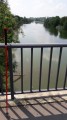
Hike starting in the village, then through the Chalèze woods to reach the Arcier springs. The return journey is along the Doubs river via the cycle path.
Between forges and castles from Loulans
10.91 mi
+476 ft
-472 ft
5h 25
Moderate
Departure from Loulans-Verchamp (Haute-Saône)
A winding path through the forest reveals the peaceful waters of the Ognon and the Linotte. The rustling of the leaves will accompany you on your walk, whilst the clearings offer peaceful resting spots. The golden reflections on the water complete this enchanting natural scene.
Mont Souvance
 4.91 mi
+1,480 ft
-1,486 ft
3h 35
Moderate
Departure from Laissey (Doubs)
4.91 mi
+1,480 ft
-1,486 ft
3h 35
Moderate
Departure from Laissey (Doubs)
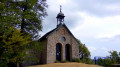
A challenging climb to Pic d'Aigremont and Mont Souvance, overlooking the Doubs Valley and visible from Besançon and Baume-les-Dames, observation points already used by the Romans. The discovery of various small objects from the Bronze Age at the summit of Mont Souvance, where the cross stands, indicates occupation since the Bronze Age.
The Château de Vaite viewpoint
 4.58 mi
+1,033 ft
-1,033 ft
3h 00
Easy
Departure from Champlive (Doubs)
4.58 mi
+1,033 ft
-1,033 ft
3h 00
Easy
Departure from Champlive (Doubs)
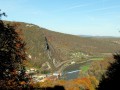
A rocky outcrop, a Bronze Age residence in Franche-Comté; a feudal castle destroyed during the Revolution for fear that it would become a hideout for bandits; views of the Doubs valley; a pretty waterfall created by human hands in a bright and airy woodland setting.
Chailluz Forest - La Dame Blanche
8.39 mi
+1,043 ft
-1,024 ft
4h 45
Moderate
Departure from Besançon (Doubs)
Walk in the Chailluz Forest and climb up to the Dame Blanche viewpoint.