Country:
 City:
City:


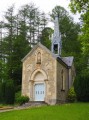
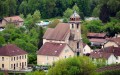
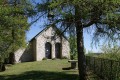
Parking on Rue des Papeteries on the right-hand side of the Church of Saint-Martin, built in 1736 by architect J.P. Galezot, with its Comtois imperial dome covered with glazed tiles. Yellow-blue markings. On the church square, you can see an ancient calvary.
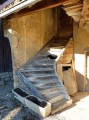
(S/E) Set off along Rue de l'Église, despite the yellow and blue cross. At the "Give Way" sign, turn right into Rue Du Breuil, passing under the railway bridge. Then go straight on along the dead-end road. At the top of the street, turn left towards the cemetery, passing in front of an old workers' house.
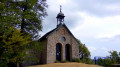
At No. 37, turn right onto what appears to be a private road. The grassy hiking trail starts to the right of the house. At the top, it joins a stone path at a signpost. Follow it to the left (towards Vaire-le-Petit). About 50 metres further up, at the new signpost, climb up to the chapel via the small path on the right.
(1) On the forecourt, there are benches from which to admire the view of the valley. Facing the chapel, turn right onto the nearest gravel path below the building. At the departmental road, continue left, following the dry stone wall, and quickly at the fork, go up to the right onto the well-graveled path.
(2) At the top, at the crossroads at the foot of a large tree bearing a sign saying "Parking de chasse" (hunting car park) and the number 15 engraved in red, turn right onto the forest path. You will soon come to a fork. Turn left, leaving the marked trail for a few moments. At the next fork (triangular), at the foot of a large tree, continue straight ahead (right-hand path). The path improves and becomes a beautiful trail.
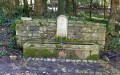
(3) When you reach a wider forest track, turn left, walking alongside an old mossy pile of stone gathered from fields (dry stone walls). Soon, at the foot of a large tree with a signpost, climb up to the right.
When you reach the departmental road, climb up to the left for about 50 metres and then immediately turn right into the woods via a beautiful stone path. Soon, at a fork, continue straight ahead and stay on this path until you reach the cliffs. As you approach the cliffs, the path becomes a trail.
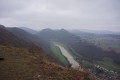
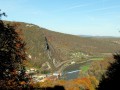
(4) At the signpost, turn left, walking along beautiful indented cornices towards Laissey. A hundred metres further on, look out for the small "Belvédère" sign on the right, slightly off the path, which invites you to descend a path on the right towards the Rochers du Château Loriot, which dominate the Doubs valley from their height of 491 metres. Be careful! It is easy to walk past without seeing it. I have built a small cairn to mark it. Feel free to leave your stone there to make it more obvious. Carefully descend towards the Château Loriot viewpoint. In the distance, you can see the village of Laissey. Turn back to find the "Route des Belvédères" signpost.
(4) Descend to the left towards Deluz, continuing along the ledges.
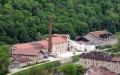
(5) At the second "Attention Falaises" sign, you will find the Grotte de sous Roche cave and a wild viewpoint over the valley. Be extremely careful. Do not try to reach the cave, as it is impossible. Continue on to the pastures, enjoying the view of the old forges topped by the Roche Blanche.
There is one last fork in the path, at a signpost. Continue downhill to the left until you reach the village. At the bottom of the beautifully named Impasse Chantemerle, turn right, passing in front of the town hall and wash house, and continue straight ahead. Then turn left into Rue des Papeteries to return to the church (S/E).
 Regarding the Château Loriot viewpoint, THVELOTTE informs us that "access to the viewpoint is prohibited due to the risk of rock falls. However, you can still get close and enjoy the beautiful view of the Doubs and the village of Laissey."



 Visorando Member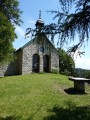

 Easy
Easy