Country:

 City:
City:


Access:
- By bus, take the number 19 service running between Castellane and Madrague de Montredon (via Avenue du Prado) and alight at the terminus at Madrague de Montredon. For those running late, return via the night bus number 583, running between Madrague de Montredon and Canebière Bourse.
- By car, from the Prado beaches, head towards Callelongue then park at the foot of Mont Rose.
(S/E) Cross the road, Chemin des Goudes, to reach the hiking trailheads at Parc Adrienne Delavigne.
Markings: Blue (trail no. 1), Brown (trail no. 1), Black (trail no. 1) andGR®®98/GR®®51
The Black route is also known as the “President’s Trail” (Antoine Péllicé).
The trail begins on a wide, vehicle-accessible track, climbing quite steeply up the hillside. After 300 metres, at the track junction, continue straight on, then immediately turn right at the Fork in the road. The vehicle-accessible track then turns into a footpath.
Follow the blue, brown, black andGR®®98/GR®®51markings.
Black markings (trail no. 1) andGR®®98/GR®®51
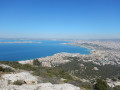
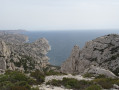
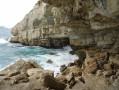
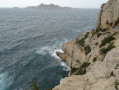
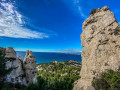
(1) After about 330 metres, turn right at the Fork in the road. The path leads over small valleys and is dotted with rocky outcrops which sometimes require you to use your hands to get past. Views of the rocky, steep coastline between La Madrague Montredon and Callelongue, not to mention the surrounding islands. It winds along a ledge as far as the Col du Brès,
(2) At the Col du Brès, carry on straight ahead, staying on the path marked Black andGR®®98/GR®®51. Here, the path begins a lovely descent, highlighted by the small rock outcrop known as ‘le Pas Edgard de la Heath’. Pass above the Fortin des Goudes and follow the path to the left.
No signposting
(3) 1.1 km after the Pas Edgard heath, leave the “Sentier du Président” and theGR®®98/GR®®51. Take the path branching off to the left, then after about 120 metres, cross the “Pas du Lapin”, which you must descend on the right-hand side. Head straight down, then after about 20 metres rejoin the “Sentier du Président” and theGR®®98/GR®®51; follow it to the left. The path widens into a slightly gravelly track.
Yellow markings (path no. 3)
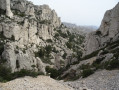
(4) At the foot of the descent, at the Fork in the road, continue to the left. The scree path climbs up the Vallon Saint-Michel. At the end of the scree, the path narrows, allowing only a narrow passage beneath the dense trees. Several sections over boulders begin, until you reach the “Escalier des Géants”.
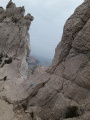
On the vertical wall (3–4 metres high), weathered notches provide footholds. An alternative route is provided on the right-hand side, marked with a yellow dotted line. Continue up the Vallon Saint-Michel until you reach the junction with the red trail.
Yellow markings (trail no. 3) and Red markings (trail no. 1)
(5) After joining the Red trail, continue uphill for 100 metres until you reach Col Bouvier.
Yellow markings (trail no. 3) and green markings (trail no. 1)
Then continue to the right along the Yellow and Green trails towards the Rocher de Saint-Michel. You’ll reach the foot of the first cave, known as the Grotte de l’Ours. Pass between several columns and through a narrow passage to discover a large chamber. Right next to it, with its entrance clearly visible, is the small Grotte de Saint-Michel d’Eau Douce.
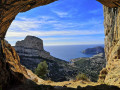
Carry on along the Green trail, skirting the cliffs of the Rocher Saint-Michel, to reach the Grotte de l’Ermite. The entrance is reached after a bit of climbing. A rope is provided to aid the ascent. A promontory in front of the cave offers a stunning panoramic view.
Yellow dotted markings (path no. 2a)
Below the cave, continue along the path branching off to the right. Look for the series of ledges leading to the Lames des Goudes, as far as the “Pas de la Demi-Lune”, a natural gap cutting through the Lames du Rocher de Saint-Michel.
Markings: Green dotted lines (trail no. 2a)
After crossing the Pas, on the other side of the Rocher de Saint-Michel, continue to the left. The path descends.
After 250 m, pass below the Grotte du Déserteur. The inconspicuous entrance is on the left, via a small ascending path through the vegetation. Continue the descent along the path marked with green dots.
Yellow markings (trail no. 2)
300 m after the cave, you’ll come to the Yellow-marked path; carry on straight ahead along it for about a hundred metres.
(6) You’ll arrive in the Vallon de la Mounine (below the Pas de la Mounine) at the junction with the Green Trail No. 2. Continue left along the path, marked in yellow (Trail No. 2). After 120m, take the path that branches off to the left in a hairpin bend. Ignore the path leading down to the right and you will soon reach the Col de la Galinette.
No signposting
Continue to the right over the scree slope, which descends steeply. At the bottom of the descent, you’ll emerge into Grand Malvallon. A fork in the road is marked by a cairn; continue straight ahead.
Green markings (trail no. 3)
You’ll then find yourself on a lovely track that descends gently on a slight false flat.
Black markings (trail no. 2) andGR®®98/GR®®51
(7) You’ll reach the Calanque de Marseilleveyre. Turn left onto theGR®® to follow the seafront eastwards. After about 650m, you’ll pass the Calanque des Queyrons.
Then, after about 250 metres, you’ll come to a small fork in the road. Take the right-hand fork to descend to the beach at the Calanque de Podestat, following the cliff face along the seafront.
Marked with black dots (trail no. 2c).
Join the path that climbs eastwards along the seafront. You will then rejoin theGR®®98/GR®®51.
Green markings (path no. 5)
(8) At the barely marked Fork in the road ahead, turn right (almost a hairpin bend) towards Anse de la Melette (marked in green). A short section requiring some scrambling leads to a beautiful flat rock by the sea.
Continue eastwards, following the green markings, to reach the headland of the Calanque de l’Escu. Then cross the Pas du Bénitier. The ledge section is equipped with a sheathed cable. Be careful: the protective sheath tends to slip.
Continue along the path, which then descends through the Pas du Pêcheur, equipped with two cables to aid the descent.
Green Dot markings (path no. 5a)
At the foot of the Pas du Pêcheur, turn right to make a round trip to the Calanque de l’Escu. Pass by the various climbing routes, then head to the old cistern beneath the limestone arch.
Return to the foot of the Pas and then follow the route to Cortiou (marked in green); stay on the green-marked path heading east, whilst walking along the seafront.
No signposting
(9) After walking for about 450 metres, you’ll arrive just before Anse de la Melette. When theGR®®98/GR®®51veers sharply to the right, look out for two large boulders on the left. A small, inconspicuous path appears on the left just after this.
Head up through the Bois des Walkyries. Stick to the path on the left through the scree and stream bed to avoid the dense undergrowth. There are a few scattered cairns. The path climbs steeply in places. The route generally heads north.
You’ll reach an easy first ledge, which forms the first part of the Pas Inférieur de la Mélette. This ledge veers slightly to the left. You’ll then emerge onto the Pas Inférieur de la Mélette itself, which is significantly steeper.
Brown marker
The exit from the Pas is to the right, via a small, exposed ledge. You’ll need to go round a small dihedral. Then follow the clearly visible path which climbs northwards. You’ll soon come out onto theGR®®98/GR®®51, then turn right.
Brown markings (path no. 3)
(10) After a few metres past the cairn, continue left along the path. Leave theGR®®98/GR®®51. The track climbs quite steeply through scree.
The path then leads to the Pas Supérieur de la Melette. A rope serves as a handrail to help you cross the limestone slab. Continue the easier ascent beyond the Pas until you reach the plateau, still following the markings.
Green markings (path no. 4)
(11) Just before the Plateau de l’Homme Mort, cut across the Green trail and turn right onto it. You’ll soon cross the Blue trail no. 1 (there’s a cairn here), continuing straight on along the Green trail as it descends northwards.
(12) After 350m, you’ll cross Yellow Trail No. 4. Continue straight on down the scree slope. Descend rapidly through the Vallon de l’Homme Mort and arrive at the foot of the descent at a junction of trails.
Red markings (Path No. 1)
(13) Take the second path on the left, which descends slightly. After 150m, you’ll reach the Fontaine de Voire (on the right, beneath the cliff).
No markings
Next, take the tarmac track on the left which climbs steeply. This turns into a track suitable for vehicles. On a slight levelling-off, continue straight ahead.
(14) At a junction of paths, take the path on the left which climbs.
Red markings (path no. 1)
When you reach the summit, carry on straight ahead, following the signposting.
Yellow signposting (trail no. 2)
(15) On the descent, follow the path to the right. Pass through the Grotte Tunnel des Goélands and continue down the slope, following the markings. At the bottom of the descent, turn left. Yellow markings via path no. 2C. Walk for approximately 450 metres.
No markings
(16) At the junction, turn left and take the wide, vehicle-accessible track leading downhill. When this track takes a wide bend to the right after 300 metres, go straight on along the path that joins it. Then ignore the turn-off on the right and continue straight ahead.
Descend through the woodland.
Markings: Yellow (trail no. 1), Brown (trail no. 1), Green (trail no. 1)
(17) Once you reach the houses, turn left. Walk past the boules courts. The path climbs. Walk past the climbing walls (on the right).
Signposting: Yellow (trail no. 1), Black (trail no. 5)
(18) At the junction of the paths, turn left. The path continues to climb. On the level stretch, look out for a discreet path leading down to the left. You’ll need to scramble down a short section to find yourself facing the entrance to the Grotte Rolland.
Two chambers are easily accessible: the “Chapelle du Diable” and the “Galerie du Trésor”. After visiting the cave, retrace your steps back to the junction of the paths below.
Signposting: Brown (trail no. 1), Black (trail no. 1), Green (trail no. 1)
(18) Once you reach the junction, continue straight ahead. The path leads uphill.
No markings, then green markings
After about 200 metres, turn left onto the path which continues to climb. You will then come to a green marker. Pass in front of a boulder on which “Col des Chèvres” is painted in green. Walk along the right-hand side of the cliffs through small scree slopes until you reach the foot of the Pas de la Cabre. After crossing the small ledge, the climb continues quite steeply through a long fault.
Green signpost (path no. 1)
(19) At the Col des Chèvres, continue to the left then immediately to the right onto the path which descends through the Vallon de l’Aigle. The descent continues until you reach the Pas du Pin. A small crevice on the cliff face provides a safe passage.
Red markings (trail no. 1)
Shortly after crossing the Pas du Pin, you’ll come to the Red trail. Continue along this trail, turning right. The markings remain the same as those for the Green Trail No. 1 for a few metres.
Yellow markings (trail no. 3) and Red markings (trail no. 1)
Pass once more by the path leading up to the Rocher de Saint-Michel. Continue down the slope.
Red markings (trail no. 1)
(5) When the Red Trail branches off to the right, stay on it. After joining the Red Trail, climb for 100 metres until you reach the Col Bouvier.
No markings
(20) After a 450m descent, at the bottom of the slope where the Red trail makes a sharp bend to the left, take the second path on the right which leads uphill, then immediately turn right at the Fork in the road ahead. Ignore all the paths you cross, continuing straight up the slope (path facing north).
Brown markings (trail no. 1)
(21) At Col Moutte, at the junction of the Yellow and Brown trails, continue straight on along the Brown trail. Descend through the Vallon du Piadon.
Blue markings (trail no. 1), brown markings (trail no. 1), black markings (trail no. 1) andGR®®98/GR®®51
(1) After a 750m descent, reach the Fork in the road. Continue straight on. Continue the descent along theGR®®98/GR®®51and the Sentier du Président to reach Mont Rose (S/E).

 Visorando Member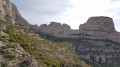
 Difficult
 Moderate
 Easy
Easy