Country:

 City:
City:


Reach Rodès via the N116 and then the D16. Park in the car park on the left just before the post office or town hall, which are almost in the same place.
(S/E) From the car park, stay on the road and pass in front of the post office to enter the historic village of Rodès. Turn left towards the Guillera Gorges. Continue on the road for about 500 metres.
(1) Cross the Têt river over a stone bridge, leaving the path to the Guillera gorges on your right at the entrance to the bridge. Take the DFCI track on the left at the end of the bridge, then after about 300m take the first path on the right. The path climbs north-east and arrives near the old granite quarry.
(2) Continue in the same direction along this beautiful path overlooking a small depression (a cirque where a jazz festival is held every year), often with stone patterns on the ground. You will come to a first fork in the path.
(3) At this first junction, continue straight ahead. The path begins to descend overlooking the Têt river and arrives at a ford.
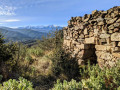
(4) Cross the ford and follow a carriage road, continuing north-east and ignoring a path on the left after the ford. Head towards the ruins of the first abandoned village of Casesnoves. This is a very pleasant spot and a good place to stop.
(5) Turn around and return to the path you left earlier.
(6) Take the path on the right towards Sarrat dels Mallols (signpost). The path climbs north-west until it crosses a wide track.
(7) Cross this track, rejoin the path opposite and pass in front of a ruined house to find another wide track, which you take heading north. You are now on a forest fire defence track (DFCI). There is a signpost on the left with several signs, including one for Puig Pedros. Leave the wide track on the right, pass close to a ruin on the right and arrive at a large plateau, a crossroads of paths.
(8) At this plateau, turn onto the path on the left and after about 300 m, take a path on the right towards Puig Pedros (south-west) through a wetland area. You can see the marker on the summit. You will reach a first fork in the path.
(9) Take the path on the left, which climbs steeply, and you will soon reach a second fork (cairn).
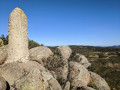
(10) At the second fork, turn right and head towards the obvious summit, following the path through the rocks. The path passes between two rock piles at the summit. The marker is on the right, about ten metres away, climbing over the rocks that hide it from view.
(11) Puig Pedros boundary marker: rejoin the path and continue along it until you reach a wide track again at a bend. Immediately take the path on the left which descends into a ravine and crosses two small streams before climbing back up to an elevation of 360 metres near a track. Do not take the track but stay on the beautiful path which heads south to a crossroads.
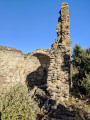
(12) (Option to return to point 3 about 300 m to the south to shorten the route). At the crossroads, turn right onto the path heading west (Roca Sabardana), which climbs slightly at first and then remains level at an altitude of 400 m. Follow the GPS tracks carefully, ignoring the paths to the right or left, to reach an altitude of 464 m on a flat area. You will have been able to see the ruins of the church and the distinctive high wall to the west for some time.
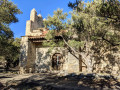
(13) At the plateau, the path descends to the bottom of a ravine to the south-west before climbing back up to the ruins of Les Cases.
(14) Be careful of falling rocks along the ruins. From the old church, take the path that descends to the south-east, first through pretty low walls that are the remains of the old village, then continuing downhill to the junction with the wide path along the Têt.
(15) Follow this beautiful path (benches) to the stone bridge.
(1) Return in the opposite direction to the arrival car park (S/E).

 Visorando Member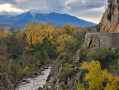
 Moderate
 Association / Club / Walk leader
 Easy
Easy