Circular route from La Caillaudrie to Les Villedonnes, featuring an ancient Roman road

A pleasant walk through a hilly area south of Pouffonds and across the plateau to the east. This route begins with a walk mainly along small roads until you reach the wonderful village of Coubortiges, with its many well-restored old houses. It continues through the countryside, with its varied crops, in search of an ancient Roman road which you follow in the second half of this walk. This nature-filled route is suitable for all weather conditions.

Details

1052978
Creation:
Last update:
Last review:
  • Walking
    Activity: Walking
  • ↔
    Distance: 5.72 mi
  • ◔
    Average duration: 2h 45 
  • ▲
    Difficulty: Moderate

  • ⚐
    Back to start: Yes
  • ↗
    Ascent: + 177 ft
  • ↘
    Descent: - 187 ft

  • ▲
    Highest point: 476 ft
  • ▼
    Lowest point: 374 ft
  • ⚐ Country: France
  • ⚐ City: Pouffonds (79500)
  • ⚑
    Start/End: N 46.20391° / W 0.116088°
  • ❏
    IGN map(s): Ref. 1629SB
  • Hour-by-hour weather

Photos

Description of the walk

Parking available in the Route des Écoles car park near the Mairie housing estate.

(S/E) Leave the car park and cross the village via Route des Écoles heading east towards Saint-Macou Church. Walk past the school and proceed to the junction at the corner of the cemetery. Turn right onto the D44, Route de Saint-Génard, and continue to the next junction immediately after the cemetery.

(1) Ignore the road on the left, which will be the return route; continue straight on along the D44. Pass the hamlet of La Caillaudrie, where you will see an old cottage with an upstairs barn in the courtyard (see the Practical Information section). Pass the hamlets of Champbertier and Les Brousses on your right, and a tiny wood just behind them on your right. Continue to a Y-junction. Carry on downhill along the left-hand road, lined with a hedge of trees, until you reach a crossroads.

(2) Above the Marcillé spring water collection station (below the road), take the farm track to the left. There is a pumping station at the junction. The track climbs slightly before becoming a road as you reach the hamlet of Le May. At the first junction between detached houses surrounded by gardens, turn right to reach, shortly afterwards, a junction with a north-south road.

(3) Turn right and head towards the hamlet of La Grotte. Continue along the road, which descends and then climbs quite steeply, lined with scattered properties, until you reach a T-junction. Turn left towards the village of Coubortige, notable for its many restored old houses. As you enter the village, turn left at the first junction and proceed to the second junction nearby, where there is a sort of open space on the right.

(4) Continue by crossing the open space diagonally to take a narrow lane between two buildings, heading north-east. Follow the lane to the road that circles the village. Turn right. Walk past some beautiful houses (one of which offers guest rooms) and turn left, heading east, to leave the village. At the T-junction (with a path opposite), turn right uphill. Continue to the Teil area in Féron at the junction with a cross-road. Cross the road and continue straight ahead along the path until you reach the junction with a path on the left just ahead.

(5) Turn left onto the path leading to the Chef-Boutonne road (D737). This grassy path is very ‘natural’ but maintained by the local farmer. Follow the D735 to the right with care for about two hundred metres. As you pass, admire the buildings of the Fontiville Farm, in particular a majestic lime tree, undoubtedly over a hundred years old, in front of a residential house.

(6) After the village, cross the D737 road with care, then turn onto a path to the left of the road, heading north-east. Continue until you reach a crossroads.

(7) Continue by turning left onto a path that follows an old Roman road. Further north, the path joins the Chef-Boutonne road (D737).

(8) Cross the D737 road with care and continue along the path opposite (an old Roman road) heading north-west.

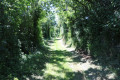
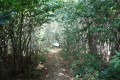
(9) At the first crossroads, below the fields, continue straight on, still heading north-west. The path climbs slightly before descending gently, then becomes a road. Immediately take the path forming a sort of canopy of vegetation on the left. Further on, the flat path leads onto a street. Continue straight on to reach, a little further on, the junction of the circular route.

(1) Turn carefully to the right and follow the route taken on the way out to reach, after the cemetery, Rue des Écoles and the car park (S/E).


Waypoints

  1. S/E : mi 0 - alt. 436 ft - Car park at the École de Pouffonds
  2. 1 : mi 0.2 - alt. 394 ft - Crossroads of the circular loop
  3. 2 : mi 1.16 - alt. 374 ft - Crossroads near the pumping station
  4. 3 : mi 1.73 - alt. 423 ft - Crossroads near Le May
  5. 4 : mi 2.13 - alt. 423 ft - Crossroads in Coubortige
  6. 5 : mi 2.7 - alt. 440 ft - Crossroads near Le Teil in Féron
  7. 6 : mi 3.1 - alt. 443 ft - Crossroads – Chef-Boutonne road
  8. 7 : mi 3.53 - alt. 476 ft - Crossroads of farm tracks
  9. 8 : mi 4.09 - alt. 433 ft - Crossroads – Chef-Boutonne road
  10. 9 : mi 4.61 - alt. 436 ft - Crossroads
  11. S/E : mi 5.72 - alt. 436 ft - Car park at the École de Pouffonds

Notes

There is a car park opposite the Town Hall on Rue du Lotissement de la Mairie (preferably use this one), and another next to the school at 21 Rue des Écoles.

This walk over varied terrain requires sturdy footwear.

This walk is only occasionally marked in yellow. The rest of the route is unmarked. Consequently, it is advisable to follow the directions in the description and on the map, whilst paying close attention to the landscape. The waypoints (with their GPS coordinates and the distance from the starting point) serve as aids for walkers exploring the route for the first time.

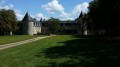
The first two kilometres of the route follow a road. However, for those who prefer trails, it is possible to walk along the wide, grassy verge on the right-hand side. This offers a view of the courtyard of the Caillaudrie farm, featuring an old house with an external staircase typical of the Poitou region leading to an upstairs barn and a dovecote. The rest of the route follows good farm tracks or grassy paths.

Walk completed by the author on 18 May 2020

Worth a visit

Pouffonds
A bit of history
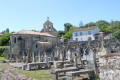
Experts disagree on the origin of the name Pouffonds; it probably comes from ‘Puy’, meaning a high place, and ‘Fons’, meaning fountain. In Gallo-Roman times, Pouffonds was close to the secondary road linking Melle to the main Roman road from Poitiers (Limonum) to Saintes (Mediolanum); we can assume that not far from here there was a place of worship in the time of the Druids.
There is a long gap between the Gallo-Roman era and the present-day church; what happened over the centuries? As in many places, there was probably an early church, around which village life developed; we can assume that Junian (6th century) passed through here and evangelised the area, and that Christians settled here for centuries…
The name Pouffonds appears in several donations made in the last quarter of the 10th century to the Abbey of Saint Jean d’Angély.
Source: Town Hall website, extract from Le Petit Journal no. 24

Melle
The countryside around Melle is a land of gentle rolling hills, meadows and forests planted with chestnut and walnut trees.
The soil, composed of clay interspersed with limestone fragments, is rich and suitable for growing alfalfa, clover, sainfoin and wheat.

The town is built on a promontory situated in the centre of the Melle plateau.
Located 27 km south-east of Niort, 60 km from Poitiers and 45 km from Saint-Jean-d’Angély, Melle is the county town, having previously served as a sub-prefecture of the Deux-Sèvres department until 1926.
Melle lies on the Via Turonensis route of the pilgrimage to Santiago de Compostela, on the Poitiers–Saintes axis.

Three watercourses flow through the commune. These are the Béronne (known as the Ruisseau de la Fontaine de Triangle), a tributary of the Boutonne, the Ruisseau du Rivault and the Ruisseau de Vireblanc, which all flow into the Béronne.
We should also mention the Pinier, another tributary of the Béronne.

Melle relies heavily on tourism for its development, particularly thanks to its exceptional heritage and its reputation as a botanical, green and flower-filled town.

The municipality of Melle is small; as soon as you leave the town, you are quite quickly outside the municipal boundaries, and most of the shops, factories, workshops and other businesses surrounding the town are often located within the boundaries of neighbouring municipalities.

The area around Melle relies mainly on agriculture. The bocage landscape has been destroyed by land consolidation schemes.
For a long time, Melle was renowned for its breeding centre for Poitou mules and donkeys. The latter have almost disappeared from the Melle landscape. The motorisation of the countryside has, in fact, brought an end to the use of this animal. For years, donkeys were used by the army. Numerous fairs were organised, attracting visitors from beyond France’s borders.

The ‘Usines de Melle’ and Saint-Léger-de-la-Martinière were established in the 19th century for the industrial production of ethyl alcohol from sugar beet.
They were originally established by Alfred Cail, son of the industrialist Jean-François Cail, as a factory producing sugar from sugar beet.
Following bankruptcy in 1885, the factories were bought out and converted into beet alcohol distilleries. A unit for producing absolute alcohol was built in 1910, followed by another for acetates around 1912 (for which demand would be high during the war).
With the First World War, the factories shifted towards industrial chemistry and biochemistry, manufacturing solvents and products used in the manufacture of explosives for munitions, the production of which was becoming intensive.
Following several takeovers (including one in 1972 by the Rhône-Poulenc group, at a time when the factory employed 750 people), they went on to produce cyclopentanone (from 1980) and now manufacture various chemical products; the company is partly owned by the French group Rhodia and partly by the Danish group Danisco. The Rhodia factory is a source of technological risk and pollution, but has also become the second-largest company in the department, behind Rougier (founded in 1923).

Places and monuments
Saint-Hilaire Church.
Saint-Pierre Church.
Saint-Savinien Church
The Hôtel de Ménoc or Bishop’s Palace
Arboretum
The Frankish kings’ silver mines
A Protestant church, built in 1836
Baltard-style market halls built in 1903 by Mr Mongeaud, the departmental architect. They stand on the site of the former wooden market halls built in 1836.
An Art Deco-style metal bandstand, built in 1930.
Source: Tourist Office, the town’s official website and Wikipedia (excerpts)

Reviews and comments

4.7 / 5
Based on 1 review

Reliability of the description
5 / 5
Ease of following the route
5 / 5
Route interest
4 / 5
pgetrochon
pgetrochon

Thank you for your message.
I understand your suggestion, which is an interesting one. However, I was restricted to keeping the route between 9 and 10 km, given the group of walkers for whom I planned this route and the time we have available.
Happy hiking

Machine-translated

Picton79
Picton79

Overall rating : 4.7 / 5

Date of your route : May 29, 2020
Reliability of the description : ★★★★★ Very good
Ease of following the route : ★★★★★ Very good
Route interest : ★★★★☆ Good
Very busy route : No

a leisurely walk. At point 5, I went straight on towards the Chemin des Romains. I rejoined the original route at point 7;

Machine-translated

Other walks in the area

For more walks, use our search engine .

The GPS track and description are the property of this route's author. Please do not copy them without permission.