Country:
 City:
City:


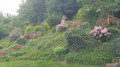
Park in the church car park on Rue de l'Église in Schlierbach. There is another car park opposite the town hall, as well as a bus stop.
(S/E) From the car park, go around the church on the left, then the cemetery. A remarkablefirst cross surrounded by statues catches the eye. Walk past the school entrance and take the path that descends to the left of the town hall. Cross the street (protected crossing) and head to the Place Lauzun car park. Note the signpost depicting a leaf and two oak trees on the left.
(1) Walk down Rue de Bâle. Pass Rue du Ruisseau on your right. Thesecond cross is on your left. Continue to the next crossroads opposite thethird cross.
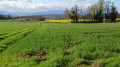
(2) Just before this crossroads, turn left onto the path that starts next to a playground. It runs alongside a ditch and fields to the cycle path and a picnic area. Turn right at the next crossroads and thefourth cross.
(3) Turn right onto Baseler Weg, then keep to the right at the edge of the road to find the Chapel of Our Lady of the Valley of Tears.
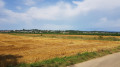
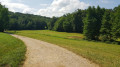
Continue straight ahead, passing afirst path on your left, then asecond. Behind you, there is a beautiful view of the Blauen (1165 m). Just before the first houses, a path branches off to the left between two fences (sign).
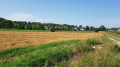
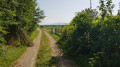
(4) Climb this grassy path towards the woods, which you will reach very quickly after a right-hand bend. On your right, you will see the village. At the end of the path, you will arrive at the crossroads at the entrance to Schlierbach on Rue de Geispitzen, marked with a blue and white rectangle (variant of the GR®531). Note the bench and garden overlooking the crossroads.
(5) Leave Rue de Koetzingue opposite (variant of the GR®532 marked with a yellow and white rectangle), which is the way back. Climb up to the left, following the GR®531. The street quickly becomes a sunken path. When you reach the top, you will see afifth wrought iron cross on the right. The path descends and rejoins the fields. Ignore the paths on the left and arrive in the middle of a cluster of trees at the start of a path on the right.
(6) Climb up to the right to the top of this path (view of the Jura on the left). Atthe first crossroads, turn right towards a water reservoir and a shelter with benches and a viewpoint over the Black Forest. The path continues downhill and meets the GR®532.
(7) Cross over. A sign announces the start of the Sentier des deux Chênes (two oaks trail), (marked with a red ring and two oaks), and another warns of slippery conditions. The trail starts with a slight descent, then climbs again after a spring on the right-hand side and exits the forest.
(8) Turn left at the edge of the forest. After a right-hand bend, the grassy trail re-enters the forest and you will see thefirst educational sign (the Robinia). Further on, there are other signs, including the magnificent American red oak (near a bench), then wooden sculptures of a wild boar, deer and owl, ending with the Goblin, "guardian of the place". The slope becomes gentler. Just after the Hornbeam sign, you will come to a T-junction opposite a bench.
(9) Turn left for about a hundred metres and you will rejoin the GR®532. Turn left, continue along the edge of the forest and you will come to a fork under a high-voltage power line.
There is a table and two benches at the entrance to the path on the right. Leave this path, keep left on the GR® and return to the edge of the forest, then to the junction at the entrance to the Sentier des deux Chênes.
(7) Continue straight ahead on a gentle descent towards the entrance to Schlierbach. Ignore the paths branching off to the left or right and you will arrive at the crossroads at the entrance to Schlierbach.
(5) Turn left and continue straight downhill to Rue du Ruisseau. Then turn right and continue to thefirst crossroads.
(10) Turn left along the beautiful fountain (1892) and go up Rue de la Croix. At the next street on the right, you will find the town hall, then the cemetery and the church, which you should go around on the left (S/E).
 In wet weather, the Sentier des Deux Chênes can be muddy and very slippery. In strong winds, there is a risk of falling branches, especially from diseased ash trees.


 Visorando Member

 Moderate