Country:

 City:
City:


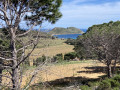
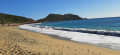
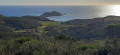
(S/E) From the Saint-Michel car park, head back towards the track that runs along the coast and follow it to the left, heading east. You will reach the gate marking the entrance to the woodland, directly opposite the eastern end of Gigaro Beach. Continue straight on along the Route Forestière de Gigaro, which winds round the last few houses, curving to the left. As it climbs the hill, this track makes a wide circular loop to the right, leading to a fork in the road.
(1) Take the Piste du Fer à Cheval on the left, which continues to climb steeply towards the Col de Collebasse. Follow it for 1.3 km, initially through woodland, then, as you climb, through fairly dense heath, until you reach the ridge overlooking the entire landscape. Before reaching the ridge, at the first hairpin bend, pass a path branching off to the right, then a second one to the left after passing the third bend. Reach the ridge and rejoin the Route Forestière des Brouis.
(2) Turn right onto this track and head towards the highest point, a few hundred metres away. When the track reaches the summit, leave it and take the path that climbs steeply up the slope to the right to reach the Vigie viewpoint.
(3) From this highest point, the view is spectacular and takes in not only the entire route, but also a much wider panorama of the Var coastline, from the Hyères Islands to the Esterel.
Head back down the same path and rejoin the track, then turn right to continue the walk.
Pass the pillars of an old gate, and take the path that branches off to the left up the slope, about fifty metres further on.
The tall umbrella pines marking this entrance are the survivors of a vast fire that destroyed the magnificent forest of Cap Lardier; the charred remains of the trees can be seen at various points along the route ahead.
(4) Follow the track to the left, which descends steeply through the dead trees. On several occasions, you’ll need to go round tree trunks that have collapsed across the path. It’s a bit of a brush and a bit of a prick at times, but the path is clearly visible throughout the descent. Keep an eye on the rows of vines that criss-cross the valley floor below, however. At the bottom of the slope, you’ll come out onto a track that follows the edge of the vineyard, just above the bottom of the valley.
Cut across this track to reach the other side of the slope. Head left onto a path running parallel to the track. Join it just before the barrier blocking access.
(5) Important: from this point onwards, the route marked in pink on the IGN map is no longer accessible and has been replaced by a route signposted with yellow signs leading to Plage de la Briande.
Follow these markings, heading uphill to the right between burnt woodland and vineyards, then turn left and cross a steep wooded area. After about 300 m, the path joins another track. Turn left and head downhill towards a residential area.
(6) Before reaching this, let the track branch off to the left and carry on straight ahead along the path which bypasses the houses to the right. When you reach the vineyards again, turn right and continue along the edge between the vineyards and the forest. You’ll soon emerge onto Briande Beach, nestled in the hollow of Cap Taillat, whose mass blocks the horizon.
(7) Walk up the beach on the left, cross the rocky escarpment at the far end, and head back down onto the sandy isthmus linking Cap Taillat to the coast.
A lovely spot for a quick dip or to continue exploring the area: add a 1.5 km round trip to visit the Pointe du Cap Taillat.
(8) Retrace your steps to the other end of La Briande Beach.
(7) This time, carry on straight ahead along the path leading to Cap Lardier.
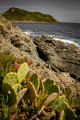
Sometimes hugging the shoreline closely, sometimes veering away to bypass particularly steep sections, this path is very uneven and requires particular care. And as the views it offers of this stretch of coastline are exceptional, it’s well worth stopping to take the time to admire the scenery.
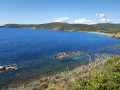
As you walk, you’ll come to a stretch of vineyards overlooking the shore, and pass a small hut nestled on the hillside just above a picture-perfect cove.
You’ll pass another cove piled high with marine debris, then walk a few hundred metres before beginning the climb up to the ridge overlooking Cap Lardier (which is inaccessible).
The view then opens up on both sides of the cape.
(9) With your back to the headland, follow the track along the ridge for about 600 metres.
Turn left at the first fork to go round to the left and beneath the old semaphore station. Further on, join the track leading to it.
(10) As the view opens up – a dizzying vista of the cove below – take the first path on the left which leads down the cliff. Steep all the way to Plage du Brouis, it consists of a series of steps and requires particular care. The sense of vertigo is, however, lessened by the very dense vegetation through which the path has been carved.
Reaching Brouis Beach is a wonderful reward, provided it isn’t too crowded.
(11) Leave the beach via its north-western end and follow the path that skirts around Pointe du Brouis. Gigaro Beach now seems just a stone’s throw away, but it still takes over half an hour’s walk to reach it. Continue along the narrow coastal path, which alternates between rather rugged sections and a few inviting coves.
(12) You’ll come out onto Gigaro Beach; walk up it for about a hundred metres and exit via the first access point on the right. Join the track you took on the way there. Then turn left, go through the barrier in the opposite direction and walk up the coastal road until you reach Boulevard Saint-Michel and the car park of the same name (S/E).



 Visorando Member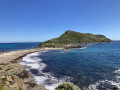

 Easy
Easy 
 Difficult