The banks of the Seine from Le Plessis-Chênet to Évry

The banks of the Seine and the town of Corbeil have a rich historical and industrial past, which is highlighted on this walk. Among other things: Kings and Queens of France, famous figures, historical events, and prestigious industrial establishments. It is also a walk where, despite increasing urbanisation, nature and beautiful landscapes are still very much present.

Details

876716
Creation:
Last update:
Last review:
  • Walking
    Activity: Walking
  • ↔
    Distance: 12.79 km
  • ◔
    Average duration: 3h 45 
  • ▲
    Difficulty: Moderate

  • ⚐
    Back to start: No
  • ↗
    Ascent: + 20 m
  • ↘
    Descent: - 34 m

  • ▲
    Highest point: 61 m
  • ▼
    Lowest point: 33 m

Photos

Description of the walk

Start from Plessis-Chênet station (RER line D). It is also possible to start from the Coudray-Montceaux lock, located just below.

(S) Head downhill to reach the left-bank towpath (tarmac). Follow the towpath towards Corbeil (north).

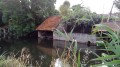
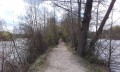
(1) Leave the tarmac road by taking the path on the right that runs alongside the Seine. Enter a sheltered, tree-lined area, separated from the road by a low wall. This was the port of Bas-Vignon, as evidenced by the presence of mooring bollards, a (fairly high) quay and, on the left, ruined buildings which, despite their dilapidated state, retain a certain architectural quality.

(2) On leaving the port, follow the path straight ahead along the Seine. At a junction (marker 36), ignore the path branching off to the right and continue along the road (known here as Chemin des Bas Vignons). Continue straight ahead until the second junction with Rue de la Dauphine and Rue des Ormes.

(3) Turn left onto Rue de la Dauphine. Cross Boulevard Henri Dunant. At the next junction, continue left onto Rue Dauphine, leaving Rue Sabatier on your right. At the next junction, turn right onto Chemin du Parc de Nagis, then left onto Rue Lamartine. Continue by turning left onto Rue de Gournay, then take the first right onto Rue Berthollet.

(4) At the end, turn right onto Rue Lavoisier, which runs alongside the Essonne (Moulin S. Huteau). At the end, turn left onto Rue d’Alsace-Lorraine. Cross the Essonne and immediately turn left onto Rue Widmer. Note the chapel of the Commanderie de Saint-Jean en l’Isle on the left.

(5) Turn right onto Rue de la Commanderie, then take the first right onto Rue Oberkampf. Turn left onto Rue des Chevaliers de Saint-Jean. At the junction, continue almost straight on along Rue Édouard Petit. At the end, turn right onto Rue Carnot. Just before the bridge over the Essonne, turn left onto Quai de l’Essonne, which runs alongside the river.

(6) Take the second left onto Rue de Cullion. Take the first street on the right, Rue Vigier, and cross the Essonne via a small footbridge. Cross the car park on the left to take the passageway under the remains of Corbeil’s old ramparts. Then follow Rue du Trou-Patrix, which runs alongside the Essonne. This will take you to the forecourt of Saint-Spire Cathedral.

(7) Walk round the cathedral on the right, leaving Rue Abélard on your right. Pass under the old gate of the Cloître Saint-Spire and follow the street of the same name to the left. At the end, turn right, cross the quay and take the Pont de l’Armée Patton over the Seine.

(8) At the roundabout, turn left onto Rue du 14 Juillet. Immediately after, take the first right, Rue du Barillet. Then take the first left, Rue de la Poterie. Take the first left, Rue Audiffred Bastide, then the second right, Rue de l’Enfer. At the end of this street, turn left into Rue du Paradis (it ends well). Turn right into Rue Waldeck Rousseau (caution: very busy street). After about a hundred metres, cross the street and follow Rue du Port des Marines opposite.

(9) At the end of the street, on the left, take the few steps leading down to the banks of the Seine. Follow the north-north-west path and walk along the Seine on your left. After a few hundred metres, the path veers away from the river and follows the edge of Rue Waldeck Rousseau. Take the first path on your left, which will lead you back to the banks of the Seine. Continue with the Seine on your left and note the pike spawning ground just before the bridge.

(10) Pass under the N104 bridge (Francilienne) and continue along the Seine on theGR®2. On two occasions, follow a short detour to take a bridge crossing a stream. Pass under the Pont d’Évry and arrive at the Écluse d’Évry.

(11) Take the footbridge at the Évry Lock to cross the Seine. On the other bank, head south-east and follow the tarmac towpath with the Seine on your left. Walk alongside one of the ports of Évry. Rather than continuing along the path, take the Manouchian Park on the left, closer to the Seine.

(12) Almost at the far end, leave the park by turning right. Cross the towpath and take Rue Robert Pissonier. At the end, you will find Évry-Val de Seine station on the left (E).

You can return to Plessis-Chênet station via the RER D, likely changing at Corbeil-Essonnes station.


Waypoints

  1. S : km 0 - alt. 47 m - Gare du Plessis-Chenet
  2. 1 : km 1.5 - alt. 36 m - Riverbank - Seine [la]
  3. 2 : km 2.42 - alt. 36 m - Exit from the port
  4. 3 : km 3.54 - alt. 37 m - Rue Dauphine
  5. 4 : km 4.56 - alt. 38 m - Rue Lavoisier - Essonne (l')
  6. 5 : km 5.09 - alt. 39 m - Rue de la Commanderie
  7. 6 : km 5.79 - alt. 37 m - Saint-Pire Cathedral
  8. 7 : km 6.24 - alt. 37 m - Rue de Cullion - Essonne (l')
  9. 8 : km 6.66 - alt. 38 m - Roundabout after the bridge
  10. 9 : km 7.39 - alt. 35 m - Path along the riverbank - Seine [la]
  11. 10 : km 8.48 - alt. 38 m - Bridge on the N104
  12. 11 : km 11.4 - alt. 34 m - Évry Lock
  13. 12 : km 12.54 - alt. 34 m - Leave the banks of the Seine
  14. E : km 12.79 - alt. 38 m - Gare d'Évry-Val de Seine

Notes

To get to Plessis-Chênet station by train, take the RER D (the line between Paris and Melun via Corbeil-Essonnes).
To get there by road – In Corbeil-Essonnes, take Rue du Bas-Coudray. It passes in front of the Stade Nautique and its car park. Continue along this road, keeping the stadium on your left. Ignore the no-entry sign. It is permitted for local residents and customers of the restaurant further along in Le Coudray. The road changes its name and is called Chemin des Bas Vignons at one point. Continue along this road until you reach the Écluse du Coudray.
In Corbeil, in the Pont area, on both sides of the Seine, there are numerous reasonably priced restaurants where you can rest and have a bite to eat.

Worth a visit

Plessis-Chênet Station: it opened in 1965 on the hillside to serve the IBM semiconductor factory, the largest in Europe at the time with 3,800 employees. From its footbridge, there is a fine view of the Coudray Lock just below.

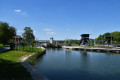
The Coudray Lock: it was modernised in 2013 (automated, new footbridge with lift, fish ladder, etc.). It handles 15,000 barges a year, the equivalent of 100,000 lorries.

Alfred Jarry (1873–1907): this writer, who was also a keen angler, had a small hut built near the lock, lived there and even organised a reception to which he invited the sub-prefect.

(1) The Port des Bas Vignons: Corbeil and Essonnes were historic centres of paper manufacturing. Here, around 1860, the Darblay Paper Mill had a port built to supply it with raw materials such as wood and coal. These were transported to the paper mill on the banks of the Essonne by train. A tunnel had been dug through the hill separating the two rivers for this purpose. A pumping station, the remains of which can still be seen, was used to send water from the Seine – 25,000 m³ per day – to the paper mill, as the flow of the Essonne was insufficient for its needs. It was the largest paper mill in Europe, or at least in France. The ruined buildings are the remains of these facilities.

(4) The Moulin S. Huteau: this was the former mill of a gunpowder factory. This gunpowder factory was a scourge for the towns of Corbeil and Essonnes, which suffered damage caused by numerous explosions. This gunpowder factory was under the supervision of Lavoisier, who was the administrator of gunpowder and saltpetre. He and Berthollet, the two greatest chemists of their time and founders of modern chemistry, came to this factory in 1788 to conduct industrialisation trials on a new gunpowder using potassium chlorate. A violent explosion occurred, killing two people, including the factory manager, but fortunately for science, the two scientists emerged unscathed. The factory reached its peak in 1794, when it extended as far as Saint-Jean-en-l’Isle.
Eleuthère-Irénée Dupont de Nemours, on Lavoisier’s recommendation, worked at this factory before emigrating to the United States. He returned in 1801 to obtain plans and processes, and in 1802 founded in the USA what became the Dupont-de-Nemours firm.
Much to the relief of local residents, this gunpowder factory closed in 1822. In 1895, Sosthène Huteau converted it into a flour mill. It is his name that can be seen on the building. Of note on this site is the house spanning a branch of the Essonne.

(5) The Commandery of Saint-Jean de l’Isle: the Hospitallers of Saint John of Jerusalem established a priory on this island at the end of the 12th century. Queen Ingeburge was the founder of the present church and a large house which would later form part of the Commandery. She lived there for 13 years following the death of her husband, Philip Augustus. She died there and is buried in the church.
It was here that Henry IV, following the siege of Corbeil and its surrender, received the keys to the town.
In 1794, the premises were used as an extension of the powder magazine. The church was restored in 1894.

Queen Ingeburge: In 1193, Philip Augustus married Ingeburge, daughter of the King of Denmark, in his second marriage. Aged 18, she was, according to chroniclers, very beautiful and cultured. The wedding night was a failure and the very next day the king wanted to repudiate her. A long diplomatic conflict ensued, lasting 19 years, involving Denmark and the Papacy, during which the Queen refused to relinquish her rights; she was imprisoned or confined to convents (depending on the twists and turns of the diplomatic situation), Philip Augustus remarried, was excommunicated, and the Kingdom was placed under an interdict. In 1213, Philip Augustus finally released her, claimed to resume their life together, and restored her rights as wife and queen. They shared ten years of married life, though perhaps only in name. In his will, he referred to her as ‘his dear wife’. A widow, she retired to Corbeil, where she died in 1336.

(7) Saint-Spire Cathedral: this was the church (built between the 12th and 15th centuries) of a collegiate church intended to house the relics of Saint Spire (Saint Exupère). Together with its outbuildings, it was surrounded by a wall and formed the cloister, of which the gate still remains. Louis XI, Francis I and Anne of Austria attended religious celebrations and festivals there.

Pierre Abélard: this great philosopher, who became a monk following his unfortunate misadventure, lived in Corbeil from 1104 to 1107 as a schoolmaster. During this period, the most peaceful of his life, he was able to establish relations with the Count of Corbeil, which proved very useful for the rest of his life. The street on the right leading to the church commemorates him.

The Castle, the Bridge and the defences of Corbeil: as early as the 10th century, there was a bridge at the site of what was probably a ford. Viking raids on the Seine led to the construction of defensive structures: a mighty castle on the left bank and a bastion on the right bank, of which a remnant of the foundation wall can still be seen. The castle itself stood on the site of the Grands Moulins de Corbeil. It was frequented by the queens of France who, as widows, received Corbeil as their dower.
There were ports on both banks at this location. Water coaches, known as ‘corbeillards’, carried passengers and goods between Corbeil and Paris. The word ‘corbillard’ (hearse) derives from this term, referring to their slowness.
The bridge, destroyed by the Germans like the other bridges over the Seine, was rebuilt after the last war.

The Grands Moulins de Corbeil: these are the only large mills remaining in the Paris region. It is the leading flour producer in France. The port, which facilitates the unloading of grain and the loading of flour, is still in operation, and the terminal serving this purpose is a recent addition. The façade and the lifting tower of the Grands Moulins are listed buildings (designed by the architect and engineer Paul Friésé).

Castel-Joly: it is to the left of Rue du Port des Marines and currently undergoing renovation. It was the country residence of Pierre Waldeck-Rousseau, a minister and prominent President of the Council during the Third Republic. His tenure as minister was the longest of that period. He is particularly credited with a law legalising trade unions and the 1901 law on associations.

The Decauville works: on the other side of the Seine, you can see these works, which have changed both their name and their purpose (specialised handling equipment). The Decauvilles were enterprising farmers who, to facilitate the harvesting of their beet, devised a portable railway track that could be assembled and dismantled as the vehicle progressed. They industrialised this idea. Tracks with gauges of 40 cm, 50 cm, 60 cm and 1 m were manufactured, along with rolling stock, wagons and locomotives. Their equipment was exported to the French colonies and all over the world. By the early 20th century, it had become a major manufacturer of railway equipment.

Between the Pont de la Francilienne and the Pont d’Évry, information boards provide details on the route’s points of interest. Among other things, we learn that we are passing through the former lands of the Marquise de Pompadour and that General Patton led part of his army across the Seine on 23 August 1944 via a pontoon bridge.

The Magdalenian Site at Etiolles: situated nearby between the Seine and the road, close to the Ru des Hauldres. It is one of the most significant prehistoric (Magdalenian) excavation sites in Europe, having been excavated for over 45 years. The Magdalenian people, hunter-gatherers, occupied this site seasonally. At that time, 13,000 to 15,000 years ago, the site and the climate resembled the Siberian steppe. The excavations reveal a highly hierarchical and organised settlement.

On the left bank, on the hillside overlooking the Évry Lock, stood the Château de la Montespan.

Manouchian Park: at one end, a memorial stone reminds us that on 16 November 1943, Missak Manouchian, a prominent member of the Resistance, was arrested here (L’Affiche Rouge). A small monument on the other side of the street commemorates the passage of General Patton’s army.

Always be cautious and plan ahead when you're outdoors. Visorando and the author of this route cannot be held responsible for any accidents occurring on this route.

The GR® and PR® markings are the intellectual property of the Fédération Française de Randonnée Pédestre.

Reviews and comments

4.6 / 5
Based on 5 reviews

Reliability of the description
4.7 / 5
Ease of following the route
4.8 / 5
Route interest
4.2 / 5
libertysurf
libertysurf

Overall rating : 4 / 5

Date of your route : Dec 30, 2024
Reliability of the description : ★★★★☆ Good
Ease of following the route : ★★★★☆ Good
Route interest : ★★★★☆ Good
Very busy route : No

I really enjoyed strolling along the Seine in the winter sunshine; the historic centre of Corbeil was undergoing renovation work, but it’s still a lovely walk.

Machine-translated

minette88
minette88

Overall rating : 5 / 5

Date of your route : Jul 14, 2024
Reliability of the description : ★★★★★ Very good
Ease of following the route : ★★★★★ Very good
Route interest : ★★★★★ Very good
Very busy route : No

A lovely nature and culture walk! Very easy to follow.
Thank you to the organiser of this route!

Machine-translated

fabienne_vsk
fabienne_vsk
• Edited:

Overall rating : 4.5 / 5

Date of your route : Jan 01, 2021
Reliability of the description : Not used / Not applicable
Ease of following the route : ★★★★★ Very good
Route interest : ★★★★☆ Good
Very busy route : No

First walk of the year, 1 January 2021.
Very easy – we just follow the Seine!
As I thought the route was a bit short, I adapted it. We set off from Le Coudray Montceau station, just under 2 km south of Le Plessis-Chenet (the next stop on the RER D line). We take the tarmac towpath. At the weir, a splendid crossing via the footbridge over the bubbling waters of the Seine, followed by a circular route of about 1 km along the right bank via the quay path and the Chemin des Îles, before returning to the footbridge and the left-bank route.
A beautiful winter’s day, cold and sunny, and a walk that opens your eyes and mind. The sun and the cold aren’t guaranteed, but the beauty of the landscape certainly is!

Machine-translated

fabienne_vsk
fabienne_vsk
• Edited:

Overall rating : 4.5 / 5

Date of your route : Jan 01, 2021
Reliability of the description : Not used / Not applicable
Ease of following the route : ★★★★★ Very good
Route interest : ★★★★☆ Good
Very busy route : No

comment deleted

Machine-translated

Geneleclercq
Geneleclercq

Overall rating : 4.7 / 5

Date of your route : Nov 05, 2018
Reliability of the description : ★★★★★ Very good
Ease of following the route : ★★★★★ Very good
Route interest : ★★★★☆ Good

We did the walk "backwards" from Evry to Le Plessis-Chênet, then took the RER back, using your route description and a bit of mental gymnastics – but nothing to give us a headache!
How interesting it is depends on what the walkers are expecting.
We were looking for a route along the Seine.
You walk along a mix of towpaths and city streets.
It was lovely!!!!
.

Machine-translated

Other walks in the area

For more walks, use our search engine .

The GPS track and description are the property of this route's author. Please do not copy them without permission.