The Kilometre Zero Trail - World War I

Kilometre Zero is the starting point of the front line established during theFirst World War. It is located on the current French-Swiss border, at a place called Le Largin. The Kilometre Zero trail explores three sections of the front line, the first kilometres of the French and German fronts, and the Swiss front at Le Largin, established along the border opposite the no man's land where boundary marker No. 111, considered the zero point of the Great War front line, is located.

Details

110068
Creation:
Last update:
Last review:
  • Walking
    Activity: Walking
  • ↔
    Distance: 7.94 km
  • ◔
    Average duration: 2h 30 
  • ▲
    Difficulty: Easy

  • ⚐
    Back to start: Yes
  • ↗
    Ascent: + 88 m
  • ↘
    Descent: - 90 m

  • ▲
    Highest point: 464 m
  • ▼
    Lowest point: 401 m

Photos

Description of the walk

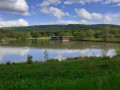
Parking is available on the bank of the pond next to the Moos bridge on the D24.
Specific signposting for the "Circuit du km Zéro"

(S/E) Cross the Moos bridge (yellow railing) and head for the Pfetterhouse water reservoir dating from 1936, which is the starting point of the circuit.

(1) A series of structures in the bend of the D24, where the circuit winds its way around the bend. (Sign 1: German infantry outpost on the Largue bridge (structure No. 8). Sign 2: German machine gun outpost on the Moos bridge. Sign 3: Roadblock position on the Moos road (north of the road: structures No. 5, 6 and 7).)

Cross the D24 at altitude 416. Take the forest path on the right until you reach a trail on your right to reach Panel 4 (Roadblock on the Moos road; north of the road: structures 2, 3 and 4).

(2) Sign 5 (Outpost on the riverbank (structures no. 1). Signs 6 and 7 are not accessible.
Retrace your steps, return to the forest path and turn right until you reach a Y-junction. On your left, a wooden staircase leads to Sign 8 (Infantry casemate).

(3) Return to the Y-junction and take the right-hand fork to Panel 9 (First German front line).

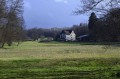
(4) Cross the footbridge over the Largue and the border with Switzerland, Panel 10 (Footbridge over the Largue). From the footbridge, you have a beautiful view of the Largin farm.
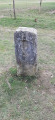
Follow the edge of the pine trees to reach marker 111, signpost 11 (Km 0 marker on the Western Front, then border marker No. 111A, known as the Espenkolonne marker).
Follow the stream (on your right) for a few dozen metres and cross the stream to find the traces of the French trenches, where time and nature have reclaimed their rights.
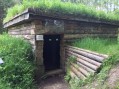
Retrace your steps and return to the wooden shelter in the middle of the clearing. Signpost 12 (Swiss Army Observation Post No. 2). This post is a pleasant picnic spot with a table.

(5) Take the forest path on the right to reach the Largin farm. When you reach the farm, take the path on the right.
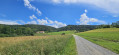
Follow the long straight path marked with yellow rings until you reach a Y-junction, where you will find information and parking.
Take the right-hand fork. After a few dozen metres, turn right and follow the well-maintained path to cross the border again.
The path leads to a forest track (former railway line). Turn right, signpost 14 (former Pfetterhouse-Bonfol railway line), until you reach the Vosges sandstone bridge pillars.
Signpost 15 (old railway bridge known as Altmühlenweg); elevation 455.

(6) Continue along the path until you reach a bridge, signpost 16 (Güterholz railway bridge).
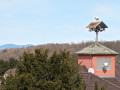
Cross the bridge, leave the woods, cross the field to reach a T-junction, turn right towards the wooden hunting observatory.
Enter the woods, cross a small wooden bridge to reach the "Villa Agathe" (the first concrete structure on the French front starting from the Swiss border. Sign 17: Villa Agathe).

(7) Retrace your steps to the hunting observatory at the edge of the woods. Turn right and follow the edge of the woods to pass the pond and a small green house.
Cross the field to reach the next wood. Before reaching the D24 road, turn right onto a path that runs alongside the road and leads to the vertiginous French trenches, where time and nature have reclaimed their rights.

(8) Continue until you reach a forest path, turn left to rejoin the road and the car park (S/E).

Waypoints

  1. S/E : km 0 - alt. 407 m - Parking is available on the bank of the pond next to the bridge
  2. 1 : km 0.18 - alt. 407 m - German outpost on the bridge - Largue (rivière) - Affluent de l'Ill
  3. 2 : km 0.94 - alt. 405 m - Barricade position on the Moos road
  4. 3 : km 1.98 - alt. 429 m - German infantry casemate
  5. 4 : km 2.55 - alt. 415 m - First German position on the front line
  6. 5 : km 3.01 - alt. 417 m - Swiss Army observation post No. 2.
  7. 6 : km 5.46 - alt. 454 m - Old railway bridge
  8. 7 : km 6.89 - alt. 437 m - Villa Agathe
  9. 8 : km 7.79 - alt. 411 m - Vertigo in the French trenches
  10. S/E : km 7.94 - alt. 406 m - Parking is available on the bank of the pond next to the bridge

Notes

Walking shoes and a torch are recommended if you wish to enter the casemates.
The trail can be accessed by mountain bike (allow 1.5 hours).

Worth a visit

Panel 1: German infantry outpost on the Largue bridge (structure no. 8)
This observation and defence casemate controlled the exit of the road bridge over the Largue. It has five embrasures covering an angle of 180°. It was built in the autumn of 1915 in front of the barrage position of the Moos bridge. The structure's roof was destroyed after the war when the ceiling rails were removed. The exterior was carefully restored by rounding all surfaces above ground level. Note the front door, which opened onto a covered trench leading to the abutment of the road bridge over the Largue. The single-arch stone road bridge was destroyed in 1917 for fear of a French attack with tanks.

Panel 2: German machine gun outpost on the Moos bridge.
This exceptional defensive position, dating from autumn 1915, was set up to control the road bridge over the Largue and respond to the French machine gun post established in autumn 1914. The important position comprises a central casemate for the machine gun (structure no. 9), flanked by two observation and defence posts with a single embrasure. Fifteen metres behind, another concrete shelter (structure no. 10) was reserved for the soldiers manning the post. Due to their exposure to French view, the other structures are connected by underground tunnels. The water, which is very present in the soil, is drained by three cesspools. The position has been restored to its original state by the Friends of Km 0.

Panel 3: Barrage position on the Moos road (north of the road: structures nos. 5, 6 and 7)
The roadblock position established in early 1915 in front of the front line extends on both sides of the road from Pfetterhouse to Moos. On each side, the trench is reinforced by three small concrete structures for infantry. Post No. 6, whose ceiling was not built with rails, has been preserved from vandalism by scrap metal dealers. The position was camouflaged by small fir trees, planted mainly near the concrete blockhouses. One of them is still in place.

Panel 4: Barrage position on the Moos road (north of the road: structures nos. 2, 3 and 4)
This section of the roadblock position, in front of the main German defence trench, is reinforced by three concrete casemates. Structure No. 3, the middle one, dates from autumn 1915 and is shaped like a caponier projecting over the trench. The other two belong to a series of four similar structures built later. This reinforcement of the position, probably dating from late 1916, coincided with the emergence of a new danger: tanks. The one on the right (structure no. 4) was restored in 2012 by the Friends of Km 0, who replaced its roof with pieces of railway track.

Panel 5: Outpost on the riverbank (structure no. 1)
This concrete defence and observation outpost is connected to the barrage position by a straight trench. At the front, a door leads to a trench descending towards the bed of the Largue. To avoid being seen by the enemy, this passage was covered by wooden formwork (traces of which were found during the redevelopment of the site). The covered trench allowed soldiers to fetch water from the river or make incursions into no man's land without being seen.

Panel 8: Infantry casemate
This concrete infantry bunker (for military units fighting on foot) controlled the front of the first German position. It is remarkably well preserved. It offers a high level of protection for the two men it can accommodate. It is suitable for small numbers of guards on the surveillance line. The entrance has been reconstructed using jute bags filled with concrete, a technique already used by the Germans at the time.

Panel 9: First German front line position.
This is where the German front began, stretching to Ostend on the North Sea in Belgium. This first defensive position consists of three elements. In the centre, you can see the concrete blockhouse designed to house a revolving cannon. The large embrasure facing north, perpendicular to the front line, indicates that the structure was intended to protect the flank from attacks on the German lines. A pentagonal observation post made of steel covered with concrete. Further back, there is a buried shelter made of curved sheet metal for soldiers on duty. This defensive complex is located on the Swiss border.

Panel 10: footbridge over the Largue
The footbridge over the river was built and installed in August 2012 by a team of Swiss army engineers. Before 1918, the Largue, which forms the border here, ran behind boundary stone No. 110 (laid in 1743). After the Great War, the course of the river was shortened and the border rectified in 1950. Strangely, boundary marker No. 110 was mostly ignored on German military maps of the Great War.
On the left, you can see the Largin farm, a former inn and grocery store famous as a place of refuge for Alsatian refugees in 1943 and 1944. The Saillant du Largin or Bec de Canard is a point of Swiss territory that juts deep into Alsatian soil. This distinctive feature led to it being chosen in autumn 1914 by the military governor of Belfort, General Fréderic Thévenet, as the anchor point for the front on the Swiss border.

Panel 11: Km 0 marker on the Western Front
Border marker No. 111 was chosen to symbolise the starting point of the Western Front on the Swiss border. Erected in 1743, the marker bears the marks of the vicissitudes of history. On the Swiss side, the Bernese bear recalls that in 1815, the Episcopal Principality of Basel, which included the commune of Bonfol, was given to the Swiss canton of Bern. The date 1817 engraved on the left side commemorates the year in which the border was verified by the Swiss and French authorities. In 1793, the former principality, which had proclaimed itself the Rauracian Republic the previous year, was annexed by France and became the department of Mont Terrible. In 1800, this territory was incorporated into the Haut Rhin department and remained French until the fall of Napoleon I. On the French side of the boundary stone, the various changes in the nationality of Alsace can be seen in the traces of successive hammering of the marks of sovereignty.

Panel 12: Swiss Army Observation Post No. 2
Observation post no. 2 of the Swiss army is a wooden blockhouse rebuilt identically by Swiss engineers in 2012. The federal army occupied the Saillant du Largin throughout the Great War. The Swiss safeguarded their country's neutrality by carefully monitoring the border and observing the movements of the two belligerents: the French on the left and the Germans on the right. The Swiss military installations were made entirely of earth and wood. They had no defensive function, but were simply intended to protect the soldiers of the Confederation from stray bullets and, on occasion, deliberate fire from one or other of the belligerents. The line of defence was located at Les Rangiers. In the event of an invasion, the Porrentruy salient would not have been defended.

Border marker No. 111A, known as the Espenkolonne marker
When the owner of Le Petit Largin, a farm and bakery built on Swiss territory, built an inn opposite his house in around 1890, but on Alsatian territory, the authorities erected a new border marker (marker 111A) between the two buildings. The aim was to show customers that there was a difference in sovereignty and therefore in customs regulations between the grocery store and the inn. The farm disappeared around 1900, while the inn was destroyed by a stray shot from German artillery on 13 October 1914. After Gauleiter Robert Wagner imposed forced conscription into the Wehrmacht on young Alsatians on 25 August 1942, many of them fled to Switzerland. Due to its exceptional location, Largin became one of the most popular crossing points for escapees. Thus, on the night of 11 to 12 February 1943, 183 conscripts from the Riespach area, known as the Espenkolonne, arrived at this spot around midnight. After crossing the border, they gathered around marker No. 111A and sang in unison: "You shall not have Alsace and Lorraine..."

Panel 14: Former Pfetterhouse-Bonfol railway line
Located on the Dannemarie-Porrentruy railway line, the Pfetterhouse-Bonfol section was inaugurated in 1910. International traffic on the line was suspended on 31 July 1914. In February 1916, the Swiss authorities removed the rails at the border. Reopened on 14 July 1919, the line was finally closed to traffic in 1970.

Panel 15: Old railway bridge known as the Altmühlenweg
Destroyed by the Germans on 19 November 1944, the Altmühlenweg bridge (formerly the mill road) remained intact throughout the Great War. The French had installed a German mail wagon under the bridge. Equipped with a telephone, it served as a command post under the name Poste Wagon Largin. The lack of protection against shells was compensated for by the relative comfort offered by the railway equipment.

Panel 16: Railway bridge known as the Güterholz
Under this bridge, the French had installed a German wagon, identical to the one at point 15, which served as a command post under the name Poste Wagon de la Gare. From the bridge, you can see the former border station of Pfetterhouse (1910-1970), which was occupied by the French army's 55th RIT (Territorial Infantry Regiment) from 15 October 1914. The station first served as an advanced stronghold, then, when the front was pushed back to the Largue, it housed a hospital and other services. In 1918, a large underground shelter, partly concreted, was built under its walls.

Panel 17: Villa Agathe
Built by the 26/53 Engineering Company and partly by French cement workers in 1918, the casemate, known as Villa Agathe, was the first concrete structure on the French front from the Swiss border. It served as a post for two machine guns and as a superstructure for underground installations. Much of the walls are made of local limestone masonry covered with thick roughcast. The roof slab and the floors above the foundation are made of reinforced concrete. The small room near the entrance was used for the immediate defence of the building using a Vivien Bessière anti-personnel grenade launcher. The weapon was fired through an opening in the centre of the ceiling. This type of device in a concrete structure is very rare.

Reviews and comments

4.6 / 5
Based on 56 reviews

Reliability of the description
4.7 / 5
Ease of following the route
4.4 / 5
Route interest
4.7 / 5
User 28559463

Overall rating : 5 / 5

Date of your route : Feb 22, 2026
Reliability of the description : ★★★★★ Very good
Ease of following the route : ★★★★★ Very good
Route interest : ★★★★★ Very good
Very busy route : No

Very pleasant walk on this route with our dog, everything is well marked, we will do it again.

Machine-translated

User 3621075

Overall rating : 5 / 5

Date of your route : Dec 04, 2025
Reliability of the description : ★★★★★ Very good
Ease of following the route : ★★★★★ Very good
Route interest : ★★★★★ Very good
Very busy route : No

A beautiful hike on an autumn day, although the ground was a little muddy in the forest.
The route is very interesting, with the structures beautifully enhanced by the Friends of KM0. Perhaps due to the season, some shelters are somewhat buried in the vegetation and difficult to access. Definitely worth repeating in the spring!

Machine-translated

User 17967609
• Edited:

Overall rating : 3.3 / 5

Date of your route : Oct 13, 2025
Reliability of the description : ★★★☆☆ Average
Ease of following the route : ★★★☆☆ Average
Route interest : ★★★★☆ Good
Very busy route : No

very average signage

Machine-translated

DID90
DID90

Overall rating : 4.7 / 5

Date of your route : Aug 30, 2025
Reliability of the description : ★★★★★ Very good
Ease of following the route : ★★★★☆ Good
Route interest : ★★★★★ Very good
Very busy route : No

A very interesting, easy and enjoyable route.
The only slight downside is that the signs are not always accessible and the structures are in dire need of maintenance. Even though we understand that the volunteers from the associations cannot do everything on their own. What a shame!

Machine-translated

User 26628923

Overall rating : 4.3 / 5

Date of your route : Jul 21, 2025
Reliability of the description : ★★★★☆ Good
Ease of following the route : ★★★★★ Very good
Route interest : ★★★★☆ Good
Very busy route : No

Towards the end of the tour, we veered off towards Villa Agathe (bunker) and didn't retrace our steps. It was a little poorly signposted, but easy to fix

Machine-translated

User 26494322

Overall rating : 5 / 5

Date of your route : Jul 10, 2025
Reliability of the description : ★★★★★ Very good
Ease of following the route : ★★★★★ Very good
Route interest : ★★★★★ Very good
Very busy route : Yes

The description provided on the website was a great motivation to embark on this hike. The information was helpful and easy to follow, ensuring an enjoyable hike. Most of the route is shaded by woods, which is pleasant during the summer. There were no particular difficulties to report.

Machine-translated

User 18892707

Overall rating : 5 / 5

Date of your route : Jul 05, 2025
Reliability of the description : ★★★★★ Very good
Ease of following the route : ★★★★★ Very good
Route interest : ★★★★★ Very good
Very busy route : No

Nice route
Shady and varied

Machine-translated

Ulyss
Ulyss

Overall rating : 5 / 5

Date of your route : Jun 23, 2025
Reliability of the description : ★★★★★ Very good
Ease of following the route : ★★★★★ Very good
Route interest : ★★★★★ Very good
Very busy route : Yes

A lovely, easy walk with historical interest.

Machine-translated

Papy jluc
Papy jluc

Overall rating : 5 / 5

Date of your route : Nov 11, 2024
Reliability of the description : ★★★★★ Very good
Ease of following the route : ★★★★★ Very good
Route interest : ★★★★★ Very good
Very busy route : Yes

A beautiful walk with no elevation gain and very interesting

Machine-translated

danone88
danone88

Overall rating : 3.7 / 5

Date of your route : Aug 09, 2024
Reliability of the description : ★★★★☆ Good
Ease of following the route : ★★★★☆ Good
Route interest : ★★★☆☆ Average
Very busy route : No

The route is well shaded in this hot weather.
It's a shame that the ruins are in poor condition on the French side, while some have been restored on the Swiss side.

Machine-translated

jean-jacques.rysak
jean-jacques.rysak

Overall rating : 3.3 / 5

Date of your route : Feb 26, 2024
Reliability of the description : ★★★★☆ Good
Ease of following the route : ★★☆☆☆ Disappointing
Route interest : ★★★★☆ Good
Very busy route : No

We did the circuit and were a little disappointed that some points are no longer accessible, such as five, seven and eight, but otherwise it's still decent. It just needs some forest maintenance

Machine-translated

Richmond
Richmond

Overall rating : 3.3 / 5

Date of your route : Nov 19, 2023
Reliability of the description : ★★★☆☆ Average
Ease of following the route : ★★★☆☆ Average
Route interest : ★★★★☆ Good
Very busy route : Yes

Signage a bit confusing

Machine-translated

Régine Gozzi
Régine Gozzi

Overall rating : 5 / 5

Date of your route : Jul 31, 2023
Reliability of the description : ★★★★★ Very good
Ease of following the route : ★★★★★ Very good
Route interest : ★★★★★ Very good
Very busy route : Yes

A very interesting walk from a historical point of view... I was surprised by the large number of walkers. Very easy walk 🚶‍♀️🚶‍♂️👍👍

Machine-translated

Elise68
Elise68

Overall rating : 4 / 5

Date of your route : Nov 02, 2022
Reliability of the description : ★★★★☆ Good
Ease of following the route : ★★★☆☆ Average
Route interest : ★★★★★ Very good
Very busy route : No

A very beautiful hike with lots to see, the children were motivated to keep going! The information signs are also very well done.
However, the route is a bit outdated and I think the signposting has been redone (particularly between points 3 and 4). But if you follow the yellow circle markings for the zero kilometre circuit, you can't go wrong!

Machine-translated

Faiti 17
Faiti 17

Overall rating : 4.7 / 5

Date of your route : Oct 24, 2022
Reliability of the description : ★★★★☆ Good
Ease of following the route : ★★★★★ Very good
Route interest : ★★★★★ Very good
Very busy route : Yes

Very interesting, and definitely worth sharing with schools to help students understand the value of a united Europe and how many sacrifices were made to achieve freedom of movement.

Machine-translated

Other walks in the area

For more walks, use our search engine .

The GPS track and description are the property of this route's author. Please do not copy them without permission.