Country:

 City:
City:


In Saint-Saturnin, park by the cemetery, alongside the D8, on a lay-by/car park on the opposite side of the road to the cemetery.
(S/E) Take the first path on the right, to the north-west of the car park (opposite the village centre). At a right-hand bend, ignore a path branching off to the left, then you’ll come to another path, the Chemin de Naja. Follow it to the left. Further on, the path becomes tarmac just before the junction with the Chemin du Huit Mai. Take this road to the right, then, at the next crossroads with paths, carry on straight ahead. Turn slightly left to cross the Place du Huit Mai (in front of the town hall), then you’ll reach a junction with several streets, near the information boards about Saint-Saturnin. Opposite, take a small cobbled street, Rue des Farges, towards the castle and the church. Just after this, ignore the Impasse de l’Enfer on the right, and further on, you’ll reach the junction with Rue Cote Gros Jean.
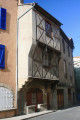
(1) Continue straight ahead along Rue de la Boucherie, passing a house with a remarkable 15th-century façade. Further on, you’ll reach Place de l’Église (information board and yellow directional signs) where you’ll notice, in particular, at No. 4, a beautiful Renaissance-style house, the Hôtel Villot.
Walk round the beautiful Church of Notre-Dame (one of the jewels of Romanesque architecture in Auvergne) on the right (towards the Route de Randol, indicated by a yellow sign), passing to the right of the Chapel of Sainte-Madeleine and then in front of the former cemetery, which has been turned into a small park, before continuing along Rue de la Madeleine. Just before you reach the castle gates, look out for a Renaissance-era fountain on the right, built in the Gothic style (information sign).
Take the narrow lane leading off to the left of the castle, following the direction indicated by a small sign for “Chemin des Lavoirs”, which continues as a path leading down towards the Monne, below the ramparts. Further down, you’ll come to a junction marked with signs pointing towards two wash houses. You’ll also find an information panel about the volcanic flow that forms the bedrock of the village of Saint-Saturnin.
(2) Continue to the right for a return walk to the Lavoir de la Freydière. This pretty washhouse is sheltered beneath the rock face. Information boards recount the lives of the washerwomen and explain the water route.
(2) Back at the junction, head down to the right towards the bridge over the Monne (signpost indicating the directions ‘lavoir’ and ‘pont’). Cross the river and head back up the other side through the woodland. Further on, the path shown on the left on the map does not exist in reality. Higher up, you’ll reach a junction with a wide path.
(3) Turn right, following the Saint-Jacques signposting (aPR®® sign pointing in the opposite direction to you), then take the first path on the left, leaving the Saint-Jacques signposting behind as it continues straight on. Ignore a path coming from the left at aPR®® sign (pointing in the opposite direction to you), then reach a junction with another path at anotherPR®® sign (pointing in the opposite direction to you) and a Yellow Cross on the path to the left.
(4) Turn right, then, about 200 metres further on, leave this path and head up to the right at anotherPR®® sign (in the opposite direction to you). Further on, as the path curves to the left, ignore a path on the right (Yellow Cross). At the next junction, head up to the left despite the Yellow Cross. Further on, the path curves to the right and offers a beautiful view of the Sancy Massif and Randol Abbey, with its modern architecture, which overlooks the Monne Valley.
(5) As you approach the first houses of Saint-Sandoux, ignore a path on the right and you’ll come to a road, the D74. Cross it and, at the Fork in the road just after, continue to the left, towards the town centre, via Rue Cote des Chartres. Carry on along this street until you reach Rue de l’Arbre Blanc, opposite some road signs. Walk a few metres to the left, then turn right onto Place de l’Église. Walk round the church on the right, then take a vaulted alleyway to reach Place de la Mairie. Note the fountain in the square, one of the oldest in the village, with a circular basin typical of the 16th century (information panel).
(6) Leave the square via Rue du Docteur Darteyre. At the next junction, with Rue de la Fontille, look out for the Fontaine des Forts on your left, set against a wall (information panel). Continue straight on along Rue des Peigneurs. At the junction with Rue des Jardins, you’ll come face to face with the Fontaine des Orneufs (information panel). Turn left, then right onto Rue de l’Arbre Blanc to leave the village. At the roundabout, with an iron cross on the low wall to your left, take the Chemin du Château de Travers opposite. At the fork in the road, ignore the dead-end path straight ahead leading to the castle (private and well hidden, of no interest to walkers) and continue to the right. Ignore a path on the right before reaching a fork in the road with an electricity pole in the middle.
(7) Turn left past the pole and, shortly afterwards, ignore a path branching off to the left. Further on, ignore a footpath to the left. Shortly afterwards, the path begins a long descent. You’ll pass close to a telecoms mast. On this stretch, take note of the beautiful orchards with espaliered trees. You’ll reach a crossroads.
(8) Carry on straight ahead, continuing downhill, until you reach a bridge crossing the Monne, opposite Murol Castle in Saint-Amant. A picnic area and a washhouse are situated below on the left. Cross the bridge, then take the first street on the right. This turns left then right and leads to a junction with several streets. To the right of the château, take Rue du Château. At a Fork in the road further on, turn slightly left and continue straight ahead along Rue du Bas Mur. At the next junction, turn slightly left onto Rue des Réveillons, then carry on straight ahead at the next crossroads onto Rue des Bouteix. Shortly afterwards, take a narrow street on the left – Rue de Versailles – which continues as a path and leads to a small esplanade offering a view over the Monne valley. A flight of steps takes you back up to the Allée des Marronniers.
(9) Turn left to follow this road to a roundabout at the entrance to Saint-Saturnin.
(10) Pass a transformer on your left and take Rue Nobée (no-entry sign), which climbs opposite, running parallel to the Allée des Marronniers. Continue along this street, lined with old stone houses. Take particular note of a large mansion with turrets and, next to it, the beautiful 15th-century façade of the Maison Courtial (information panel). Further on, an esplanade on your left offers a view of the valley (information panel on the Monne). On the other side of the street, look out for a small statue in a niche in the wall. Further on, walk past the house of the painter Lucien Madrassi, then past an information panel on Rue des Nobles. You will finally arrive opposite the Church of Notre-Dame. Note the information panel on the Chapel of Sainte-Madeleine. Follow the same route as on the way there, walking to the right of the church along Rue de la Boucherie, then turn right to reach the junction with Rue Cote Gros Jean.
(1) Leave the route you took on the way there and turn right. Cross Rue Principale (information board), then Place du Marché (information board), with its bread oven and old horseshoeing bench, and continue straight on along Rue du Marché. Pass an information board about the Quartier des Lépreux. Shortly afterwards, ignore Rue des Granges on the left and pass to the right of a beautiful house. The street turns into a track. At the Fork in the road, head slightly to the right to join the track (Chemin de Naja) at a tree growing on a large rock. Continue along the track opposite, to the left of the tree.
(11) Shortly afterwards, turn onto a track on the left (Blue Cross and Yellow Cross), the Chemin de Salles. Further on, ignore a track on the left. You’ll come to a junction with another track. Turn left to reach the D8 shortly afterwards. Follow it to the left to return to the small car park opposite the cemetery (S/E).




 Visorando Member
 Easy
Easy 
 Tourism professional