Reichshoffen
Reichshoffen, a town with many facets
Reichshoffen is a charming village in the north of the Bas-Rhin department, at an altitude of 180 metres. The commune is situated 50 km north-west of Strasbourg, halfway between Haguenau and Bitche, almost on the border of the Alsace region. It had a population of 5,148 in 2016 and covers an area of 1,738 ha.
On 28 September 1972, Reichshoffen merged with Nehwiller, which became an associated commune. This small rural village of 402 inhabitants is situated 5 km north-east of Reichshoffen. It covers an area of 273 ha at an altitude of 289 m.
Since 5 August 1961, Reichshoffen has been twinned with the German town of Kandel (Palatinate).
A past to preserve
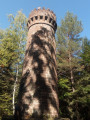
Reichshoffen retains many reminders of its rich historical past: three listed buildings (St Michael’s Church, De Dietrich Castle, the Altkirch), the historical and industrial museum (Iron Museum), two watchtowers, the ‘Battle of Reichshoffen’…
Its industrial development
In addition to shops and services, the town is home to several industrial companies.
Alstom Transport, formerly De Dietrich Ferroviaire, designs and manufactures components (notably passive safety components) and railway rolling stock. From the manufacture of TGV end carriages, TER X73500/73900 railcars for France and Germany, AGC intermediate carriages, railcars for Finland and trams, to the refurbishment of railway rolling stock, the Reichshoffen site has just unveiled the new TER Regiolis trains destined for the French regions. In 2016, Senegal purchased around fifteen regional trains, the manufacture of which ensures the order book is full until mid-201912.
The von Dietrich family also owned a subsidiary specialising in track equipment for railway networks, which has been part of the Vossloh Group since 2002 under the name Vossloh Cogifer.
Founded in 1922, the steel processing workshops of the Treca company were transferred from Puteaux to Reichshoffen, to the premises of the former brewery built in 1890. Initially specialising in high-strength steel wire, the company diversified into the manufacture of steel wire for springs, wire ropes and, finally, spring mattresses. In 1935, the first Treca mattresses (an abbreviation of TREfilerie-CAblerie) were produced. The wire rope business ceased operations in July 1985, but the company continued to manufacture high-end, hand-stitched mattresses.
Fehr S.A., a company specialising in concrete building materials, is based on Route de Frœschwiller.
Places and monuments
Dietrich Castle: The first castle was built in 1232 for the Duke of Lorraine. It was entrusted to the Counts of Ochsenstein after 1286 and demolished in 1769. It comprised an approximately circular enclosure flanked by four round towers. The present castle was built for Jean de Dietrich (1719–1795) by Joseph Massol, an architect from Strasbourg. The structural work was carried out between 1770 and 1771 under the supervision of Christian Gstyr. Before the war, the south-east dormer bore the inscription IFD HANVER 1779, which has since disappeared. Around 1807, Mathieu de Faviers removed the connecting passageway that linked the outbuildings to the north; the east wing of the outbuildings was demolished by the Renouard de Bussière family in 1811 and 1812, whilst the west wing remains in part, having been completely refurbished. The château, which was severely damaged during the last war, has been carefully restored. It now serves as the administrative headquarters of the Société De Dietrich. One of the towers of the old château that had survived was rebuilt in 1807 to serve as a hydraulic lift. On the northern edge of the park are farm outbuildings and a former gardener’s house with a hipped roof, which already appeared on the Napoleonic cadastral map around 1840.
Manor mill.
The Swedish Tower, built in the 14th–15th centuries, restored in 2007.
Former leprosarium or church known as Altkirch.
The Historical and Industrial Museum – Iron Museum.
The Reischshoffen synagogue, built in 1851–1852.
The memorials:
The Cuirassiers Monument,
The 1870 Ambulance War Memorial,
The war memorials
St Michael’s Church is the work of the architect Charles Christiani.
The pilgrimage chapel of Notre-Dame-du-Bon-Secours, dedicated to the Virgin Mary and Saint Wolfgang, in the hamlet of Wohlfahrtshoffen. The Gothic choir with ribbed vaulting is thought to date from the 14th century, as is the sacristy, although its inner door is dated 1770. The Neo-Gothic nave was rebuilt in 1851. An inscription in German on the sacristy’s outer door commemorates its extension and embellishment by the parish priest Lehmann of Reichshoffen in 1852. Next to the chapel stands the caretaker’s house, probably built in the second half of the 18th century. In front of the chapel stands a monumental cross dating from 1812. The bell dates from 1732
The parish church of the Sacred Heart of Jesus.
__The school, known as the Evangelical Lutheran Church of Nehwiller.
Reichshoffen railway station.
Notable figures associated with the commune
Christophe Joseph de Brusselles (born 12 September 1727 in Mannheim – died 19 April 1811 in Reichshoffen), general of the French Revolution.
François Grussenmeyer: served on the municipal council for 42 years. Mayor of the commune for 18 years.
Gaston Fleischel: inventor and industrialist.
The Dietrich family.
Rémy Bricka (although he was born in Niederbronn-les-Bains, he spent his childhood in Reichshoffen), French musician and singer
Arthur Le Duc, sculptor, creator of an equestrian statue entitled ‘Sur la terrasse Reischoffen’ (sic), depicting the standard-bearer of the 3rd Cuirassier Regiment, mortally wounded. A replica is on display at the Arthur-Le-Duc Museum in Torigny-les-Villes.
Its natural riches
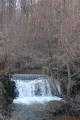
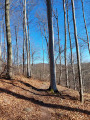
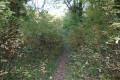
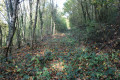
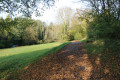
Forests, rivers, lakes, orchards, meadows and the hills of the Northern Vosges form the backdrop to the town, which serves as the gateway to the Northern Vosges Regional Nature Park.
Source: Wikipedia (excerpts) and the town’s official website (excerpts)



 Country:
 City:
City:




 Visorando Member
 Difficult
 Very difficult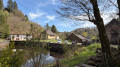
 Moderate