Country:

 City:
City:


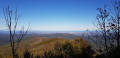

From Le Boulou, head towards Céret via the D115. At the entrance to Céret, at the Pont du Diable, turn right onto the D615 towards Llauro. At Coll de Llauro, turn left onto the D13 towards Oms. Continue along the D13.
When you reach the Coll d’en Forto (Col du Fourtou), turn left onto the D618 towards Saint-Marsal.
Once you’ve passed the sign for Saint-Marsal, turn right and then right again towards the car park at the foot of the church.
Yellow markings
(S/E) Carry on due west, keeping the cemetery on your left.
Climb steadily along the wide, carriageable track, ignoring the tracks to the left and right.
(1) Join a small road and cross it. Go through the iron gate and close it properly. Directional sign.
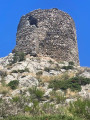
Volta se Santa Anna (Tower of Saint Anne).
There is another information board about this pastoral area, featuring warnings.
Climb, following a sunken path alongside a fence on your left.
Markings: White and Yellow + Yellow
(2) Junction. Keep slightly to the right as you go downhill. Pass a còrrec (depression) and continue along a fence on your left.
Further down, another junction. Continue downhill, this time with the fence on your right.
(3) Go through a scrap-metal gate – remember to close it properly – on the right and immediately join the road.
Turn left onto the wide verge on the right.
Take care, even though there is very little traffic.
(4) Leave the road and follow a very good path to the right through the forest, which descends rapidly to the valley floor.
(5) Còrrec el Bolès ford. Lots of water (12 March 2020).
Take care. This is a tricky spot to navigate over the slippery stones.
Climb steeply up the opposite side and rejoin a good, well-marked path.
Cut across a grassy track to climb up the opposite slope towards a low wall.
On reaching the low wall, take a right-hand bend. Join a track and head left for 50 metres.
(6) Take care to spot and follow the yellow markings: even though everything looks straightforward on the IGN map.
Some paths and tracks are not shown on the IGN, OSM or OSM Trails maps.
1) Join a track and head left for about 80 metres.
2) At thefirst left-hand bend on the track, turn right uphill. Continue towards the large entrance gate to the house.
3) Just before this gate, head uphill to the left to go over the top of the house, which lies below on your right.
4) Then cut across the track leading to the house and continue straight ahead along a good path through the woodland.
You’ll come out at the end of a road. Turn immediately left uphill, behind the house.
You’ll arrive above a lovely orchard opposite and some beautiful gardens further on, to your right and below.
In the village, a sculpture and an old mining skip are situated at the end of the track.
At this crossroads, look out for a well topped with a stone cone on the other side of the road.
To the right of the large building, look out for the toilets, which have a play area and a drinking water point.
(7) Go round the well on the right and head up alongside the concrete house on your right.
Join a grassy track in a grazing area. Follow it for a few metres. Yellow markings.
Leave the house in the distance on your right, and head further to the left along the edge of the woodland on your left.
(8) Cross the D13, then, a little further on, a grassy track.
Cross the D13 a second time. Then rejoin it a third time further on.
(9) Turn left onto the left-hand verge. Take care. Pass the Cortal de Vincenç on your right.
Continue along the D13 towards Sarrat de las Creous (hamlet of the crosses).
At Cortal d’en Baux, head up to the right along a path to walk alongside the road below on your left.
Pass through a gate, which you must close behind you. Join the D13 again at a water tank and continue to the right.
(10) Coll Palomeres. A vast area. Numerous paths and tracks, as well as the D13.
Pass by the large information board for the area (map, walking routes).
Head down to the left immediately afterwards. The start of the path is eroded. Still follow the yellow markings.
Be sure to put the double electric fence back in place. It is by doing this that the paths will continue to pass through private property. There is no prohibition.
(11) Go through an iron gate with a spring-loaded latch. ‘Private property’ sign (³).
Turn left. Walk along a fence on your left, following a good, narrow path.
Cut across an access track leading to the llama enclosure. Head down the path opposite.
You’ll come to a muddy patch; turn left, continuing to follow the fence uphill.
Go through a second iron gate with a spring-loaded latch.
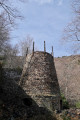
Continue along the signposted path. The view is magnificent. You can see the oven at the bottom of the gully on the left.
Pass by an old ruined building (Casa del Rey).
Pass the piles of ore and reach a developed area. Recent signpost (October 2019).
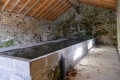
You’ll reach the old mines and a huge water reservoir hewn directly out of the rock by the miners.
This hazardous area is protected by safety nets.
At this point, off the yellow trail markings, head down to the left along a good path clearly marked on the ground, to reach the large stone furnace via a return route.
Follow the orange markings.
(12) Climb back up from the furnace; further on, staying on level ground to the left, take a return trip to explore the large miners’ building and a ballast wagon (²). Note the large hopper carved directly out of the rock, running through the mountain to the right and left.
Return to the original path and head uphill through the forest along a good path that is consistently well marked in yellow.
Further on, cut across a grassy track and continue climbing straight ahead. The path is in poor condition in places. Cross two Còrrec and continue climbing along the path, which is clearly marked on the ground.
End of the yellow markings
(13) Old mining railway line (¹). Leave the yellow-marked path that climbs straight ahead.
Alternative route: See: practical information.
Head left along the hillside and follow this for approximately 3.2 km.
Pass through a railway tunnel in very good condition, though somewhat obstructed by a rockfall.
Gaps in the forest offer views of the landscape.
Ignore a path leading down to the left (Green Cross).
You’ll come to the old Caseta railway station. This is a great spot for a well-deserved break.
You’ll reach an open area with a clearing in sight.
Scatteredyellow markings.
(14) Crossroads in the forest. Signposts. Head far to the left along a very pretty path, heading down towards Saint-Marsal.
(15) Pla de l’Abella. Crossroads of tracks and paths. Open, mown area.
Caution: the markings are unclear at this point. Take care.
Take a short first turn left then right to rejoin the cart track known as the ‘Romaine’.
The area has been mown (12 March 2020). If not, follow the track downhill for 700 m and turn right up the hairpin bend to rejoin the marked path.
On this descending path, you’ll come across two distinct sections of the track worn down by cart wheels.
(16) Collada del Pou (Puits Pass). El Pou de Florentí (Florentì’s Well). The well is secured (confirmed on 16 April 2024). Continue along the wide track.
Pass an open-air, fenced-off water reservoir to the left of the track.
(17) Col de Santa Creu (Holy Cross). Continue straight ahead along the DFCI track. The view remains unobstructed.
(18) Turn right and head steeply downhill. Leave the DFCI track, which turns into a road.
Arrive at the pretty village of Saint-Marsal via the Carrer d’Amunt (Upper Path) leading to the square.
In the village square, there is a water tap, and 100 m down the road to the right is the Bistrot de Pays.
Walk round Saint-Marsal Church. Turn left onto Carrer dels Vents (Chemin des Vents) towards the car park (S/E).

 Visorando Member
 Moderate