Mont Thabor and its twenty lakes

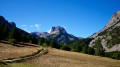
This splendid alternative to the usual linear route takes in more than 20 lakes around the Mont Thabor viewpoint.

Setting off early in the morning allows you to avoid the crowds and enjoy the many sunrises behind the peaks.

A short section of the walk is off-trail and requires navigating by sight, but it’s easy to find your way.

Details

17335939
Creation:
Last update:
Last review:
  • Walking
    Activity: Walking
  • ↔
    Distance: 14.99 mi
  • ◔
    Duration according to the author: 10 hrs 
  • ▲
    Difficulty: Very difficult

  • ⚐
    Back to start: Yes
  • ↗
    Ascent: + 5,036 ft
  • ↘
    Descent: - 5,013 ft

  • ▲
    Highest point: 10,427 ft
  • ▼
    Lowest point: 5,745 ft

Photos

Description of the walk

Warning:
Information on how to reach the starting point, as well as details regarding difficulties, alternative routes and precautions to take, is summarised in the ‘Practical information ’ and ‘During the walk’ sections. Any difficult walk requires preparation, and this very difficult walk is no exception.

Signposting:
Much of the walk follows variants ofthe GR®®57, so the markings are red and white. Elsewhere, there are no markings, particularly between points 3 and 6, between 14 and 15, and between 2 and 18; the path is barely marked or even non-existent between 4 and 6.

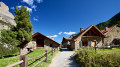
(S/E) From the car park, take the wide path heading north-west which passes between the houses and bars of Les Granges de la Vallée Étroite.

(1) Carry on straight along the path and follow it (north-west then north-north-west) to the bottom of the valley (Combe de la Mine).

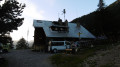
(2) A signpost indicates Lac Lavoir and Mont Thabor to the left (west). Follow this direction, either via the winding track suitable for vehicles or via the more pleasant footpaths that cross it. The route turns northwards towards the Maison des Chamois, a white-painted mountain hut. Pass this refuge and emerge from the scrub to enter the Clot Solide mountain pasture, heading due west.

(3) Leave the path and cross the undulating terrain of Clot Solide, heading due west, until you reach a slope which you follow westwards to reach the stream bed (alternatively, stay on the path until you come to a footbridge over the stream; do not cross this footbridge, but turn left to head westwards up the right bank of the stream). Follow the stream upstream to Lac Lavoir.

(4) Go round the lake to the left to reach its tributary. Follow this tributary upstream, initially on the left bank, heading westwards, up a steep slope. When the slope levels off, cross the stream and head for the scree at the base of the Pierres du Tambour. Reach a small lake—more like a puddle—and turn northwards there to head up towards the Lacs de la Grande Tempête plateau.

(5) At the lakes, head up and round the uppermost lake to cross to the north, still off the beaten track, and join theGR®® 57. Turn left here and follow it westwards. You will then come within sight of Lac Chardonnet (see also the alternative routes starting from this lake).

(6) Continue the ascent westwards, leaving the small Lac Est du Col des Muandes on your right. You will reach the Col des Muandes.

(7) Climb the path to the right (north) that runs along the ridge. This will take you to the Roche du Chardonnet.

(8) Continue along the ridge to the east-north-east, above the Lacs des Glaciers on the left, to reach the Col de Valmeinier.

(9) Cross the pass along its ridge and climb up to the left through the scree beneath the west face of the Roc de Valmeinier, following a curve that gradually turns north-north-east, to reach the Col de la Chapelle.

(10) Pass the pass, continuing north-north-east, and climb the ochre-coloured slope (or snowfields) of the cirque beneath the east face of the Pointe des Angelières. The path veers eastwards and joins, at a small pass, the other variant ofthe GR®®57which climbs directly to the Thabor.

(11) Then follow theGR®®57as it winds its way up, first heading north, then west, to reach the chapel and then the summit of Mont Thabor.

(12) From the summit, retrace your steps to the junction of the routes.

(11) Continue south-east on a steep descent. As you approach the Petit Adret hill, the path veers eastwards to descend to the Col des Méandes.

(13) Continue eastwards on theGR®®57(do not head down to the right towards Lac du Vallon du Dîner). Reach the Sillon des Chances du Peyron, between alpine meadow on the left and black scree beneath the Grand Séru on the right, facing the Roche Bernaude. At the end of the gully, theGR®® begins to curve northwards and Lac du Peyron comes into view. Follow the path to the lake.

(14) Pass the lake’s outlet and head towards the Vallon du Peyron torrent, without crossing it. Descend its right bank, along a fairly well-marked path, heading east-southeast. This path leads out onto the Plaine de Tavernette plateau, where it joins the GR®®.

(15) Follow this route due south, on a very gentle descent, until you reach the tiny Lac de Tavernette on the left-hand side of the path.

(16) Continue the descent. Shortly after the lake, the path turns right before beginning a steep, winding descent to reach the bottom of the Vallée Étroite at the Pont de la Fonderie. Cross the bridge to reach the Combe de la Mine.

(2) Leave theGR®® you followed on the way there and turn left, heading north-east down a track through a gently sloping meadow. Take the wooden footbridge crossing the Vallée Étroite stream. Then follow the track to the right, which comes to a steep slope. Climb the few hairpin bends up this slope and emerge onto the meadows of a broad ridge shaded by sparsely scattered larch trees. A faint path continues south-southeast; follow it, particularly where it branches off along the right-hand flank of the ridge and reaches a junction signposted ‘Lac Vert’. Turn left (east) and follow the hairpin bends down to the lake.

(17) Walk round the lake to the north and admire its emerald green waters. Once you reach the opposite end, head due south through the forest, passing a small, tree-cluttered pass to join the path on the left bank of the Vallée Étroite (Alternatively, south of the lake, head back up the hairpin bends you descended earlier, then descend towards the Ruisseau de la Vallée Étroite, and before the footbridge, turn left to join the same path on the left bank). Follow this path south-east to a house on the left bank, opposite a footbridge.

(18) Cross the footbridge, then head up to the left along the right bank towards the Granges de la Vallée Étroite path and rejoin the path you took on the way there.

(1) Turn left, walk through the Granges de la Vallée Étroite and head straight down to the Granges de la Vallée Étroite car park (S/E).


Waypoints

  1. S/E : mi 0 - alt. 5,745 ft - Les Granges de la Vallée Étroite car park
  2. 1 : mi 0.31 - alt. 5,768 ft - Junction – Granges de la Vallée Étroite
  3. 2 : mi 1.49 - alt. 6,227 ft - Combre de la Mine
  4. 3 : mi 2.26 - alt. 7,028 ft - Downstream from Clot Solide
  5. 4 : mi 3.26 - alt. 7,484 ft - Lac Lavoir (Névache)
  6. 5 : mi 4.46 - alt. 8,153 ft - Lower Lakes - Lacs de la Grande Tempête
  7. 6 : mi 5.26 - alt. 8,596 ft - Above the - Lac Chardonnet
  8. 7 : mi 5.86 - alt. 9,301 ft - Col des Muandes
  9. 8 : mi 6.15 - alt. 9,656 ft - Roche du Chardonnet
  10. 9 : mi 6.59 - alt. 9,367 ft - Col de Valmeinier (2869m)
  11. 10 : mi 7.05 - alt. 9,659 ft - Col de la Chapelle
  12. 11 : mi 7.43 - alt. 10,052 ft - Junction of the GR57 variants
  13. 12 : mi 7.77 - alt. 10,427 ft - Mont Thabor
  14. 13 : mi 9.02 - alt. 8,921 ft - Col des Méandes
  15. 14 : mi 10.25 - alt. 7,995 ft - Lac du Peyron
  16. 15 : mi 11.35 - alt. 7,221 ft - Tavernette Plain
  17. 16 : mi 12.31 - alt. 6,962 ft - Lac de Tavernette
  18. 17 : mi 13.78 - alt. 6,007 ft - Lac Vert (Névache . Hautes-Alpes)
  19. 18 : mi 14.42 - alt. 5,771 ft - Footbridge under Les Serres
  20. S/E : mi 14.99 - alt. 5,745 ft - Les Granges de la Vallée Étroite car park

Notes

?️ Park at the last car park in the Vallée Étroite, N 45.06893° / E 6.625558°. By clicking on this Waze link, you can enter these coordinates directly into your favourite sat-nav app.

? There is plenty of water near the lakes, but none between the Col des Muandes (7) and Lac du Peyron (14); make sure you bring enough with you.

? Dogs are allowed in Les Cerces, but it is best to keep your dog on a lead so as not to disturb the wildlife.

?♀️ The TD rating for this hike is primarily due to the combination of its length and total ascent. A few off-track sections require caution.

? Best undertaken in good weather to ensure you can find your way easily.

? The hike is well suited to bivouacking; the Lacs de la Grande Tempête (or the Lavoir) are ideal spots.

? Standard hiking kit is sufficient. Early in the season, when snowfields are still present, ice axes and crampons make it easier to climb Thabor and also to cross the junction between the Valmeinier (9) and La Chapelle (10) passes, which are often covered in hard snow.

⏰ At the start of the season, it is essential to set off very early to ensure the snow is firmly packed beneath the passes and peaks facing due east. The slope below Thabor is steep and, if the snow is soft, crampons will not prevent a potentially dangerous slip.

? Finding your way is easy in good weather, but a GPS — or, of course, the Visorando app — is recommended.

  • ‘Right bank’ and ‘left bank’ always refer to the orographic direction, i.e. relative to the direction of water flow.
  • A tributary is a stream or watercourse feeding into a lake (the opposite is an outlet).
  • Upstream is the direction towards the top (the mountain); downstream is the direction towards the bottom (the valley).
  • The ‘adret’ is the sun-facing slope; the ‘ubac’ is its opposite.

? There is only one emergency number in France: 112. Other numbers (15, 17, or direct numbers…) have no priority on mobile networks, do not route via other operators’ networks when there is no signal, and in the event of an overload of calls, ongoing calls are cut off to prioritise 112. So forget about them as soon as possible; they are dangerous and no longer serve any purpose (contrary to what some outdated guidance claims). If you cannot speak or hear, use 114 to communicate via text message. 112 works on any mobile phone (and landlines, of course), including on a locked phone and even if the SIM card is blocked (however, since 2004, France has been in breach of European recommendations and blocks calls to 112 when there is no SIM card in the phone. This blocking measure required special investment, as the GSM standard naturally allows calls without a SIM card. Taxpayers will appreciate this particularly clever use of public funds).

⚠️ Please note: if your call is cut off, it is your responsibility to ring the emergency services again: they have no way of contacting you or locating you if your mobile network operator does not provide coverage. Remember to note down your GPS coordinates before calling, as the French government has still not deigned to equip mountain rescue centres with AML (Advanced Mobile Location) technology (despite this having been made mandatory by the EU since 2018).

? In the mountains, switch your phone to 2G: the range of this technology is 4 to 8 times greater than that of newer technologies, and it uses significantly less power. Remember to switch off your Wi-Fi, as it drains the battery quickly and serves no purpose outside homes and offices. ? Bear in mind that your phone’s GPS location tracking works even in aeroplane mode (GPS has nothing to do with mobile phone calls).

?Checklist

  • ☑︎Essential items in addition to standard hiking kit
  • ☑︎ice axe and crampons until the start of the summer season
  • ☑︎head torch (if setting off early in the morning)
  • ☑︎1.5-litre water bottle
  • ☐Optional
  • ☐trekking poles
  • ☐water filter
  • ☒not needed
  • ☒rope
  • ☒climbing equipment

⚠️ As a general rule, treat IGN topographical maps with a pinch of salt (in my experience, the institute never corrects reported errors, even after serious accidents caused by these errors – see my profile for further details and an example). The base maps for IGN topographic maps date back more than 25 years and have not been updated since (!). The free OpenStreetMap, updated by volunteers, is usually much more up to date; it is best to consult the OpenTopoMap version, which is easier to read.

Worth a visit

? Alpine wildlife is less visible around Mont Thabor than in the rest of the Cerces range, due to the high volume of visitors to the summit. However, ibex are sometimes found on the western slopes below the Col de la Muande or on the ridge leading towards the Grande Tempête, as well as on the slopes below the path between (8) and (11).

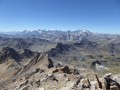
The Col de Valmeinier as seen from the Col de laChapelleLacquet below Mont Thabor? The views from the passes and summits are superb – see these interactive panoramas from Mont Thabor (?) and from the Col des Muandes (?) or from the summit of the Rochers du Tru (?) if you take a detour that far.

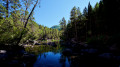
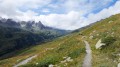
But what makes this route particularly photogenic are the lakes dotted along the way.

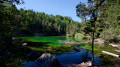
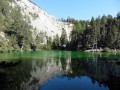
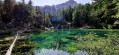
Lac Vert from thesouthernshore; reflections of the Roc de Valmeinier and the Grand Adret in Lac Lavoir. Here are a few of them, with their northern latitude and eastern longitude in brackets: Lac Lavoir (45.086627, 6.580983), the small Lac des Pierres du Tambour (45.08543, 6.570642), the eight Lacs de la Grande Tempête (45.088509, 6.566397), and two unnamed lakes which may form part of the previous group (45.091082, 6.571746), Lac Chardonnet (45.097046, 6.56096), Lac Est du Col des Muandes (45.097476, 6.554391), the Glaciers Lakes (45.107079, 6.54626), which form a trio; Lake Blanc de Valmeinier (45.098339, 6.567227); Lake du Vallon du Dîner (45.102298, 6.577882); Lac du Peyron (45.10799, 6.591611), Lac de Tavernette (45.096593, 6.608665) and Lac Vert (45.079656, 6.615359)… to name just those closest to the circular route. The highlight of the trip is undoubtedly the group of lakes known as the Grande Tempête (?).

This public album provides access to higher-resolution photos from my latest outing.

? Several alternative routes are possible. At sunrise, a short detour via the Rocher du Tru will allow you to watch the Grand Séru being illuminated – a magnificent sight. This is a good option if you’re bivouacking at Lac Lavoir. The off-trail route is described in this hike (stages 11 to 13).

LacChardonnet; the Col de Valmeinier as seen from the Col de la Chapelle;another superb alternative is to climb to the Col de la Chapelle (10) directly from Lac Chardonnet (6). To do this, you need to go round the lake (via its outlet) and then head up towards the promontory marked at 2,644 m on the IGN topographical map. From there, you skirt the base of the southern shoulder of the Roc de Valmeinier to pass over a small pass overlooking the very pretty Lac Blanc. Then, simply follow the valley between the southern ridges of the Roc de Valmeinier and Mont Thabor until you reach the Col de la Chapelle.

? Explanation of a few terms:

  • ‘aup’ or ‘aulp’ refers to an ‘alpe’, i.e. a place where herds graze in summer.
  • A cairn is a pile of stones used as a landmark along a route. You can add cairns if you’re sure of the route, and it’s useful to replace stones that have fallen from a cairn.
  • A ‘casse’ is a scree slope.
  • a ‘combe’ is a relatively wide valley or the hollow of a fold in the terrain.
  • A ‘muande’ is a shepherd’s hut.

Always be cautious and plan ahead when you're outdoors. Visorando and the author of this route cannot be held responsible for any accidents occurring on this route.

The GR® and PR® markings are the intellectual property of the Fédération Française de Randonnée Pédestre.

Reviews and comments

4.9 / 5
Based on 3 reviews

Reliability of the description
5 / 5
Ease of following the route
4.7 / 5
Route interest
5 / 5
FrancescoDeLaRonna
FrancescoDeLaRonna
• Edited:

Overall rating : 4.7 / 5

Date of your route : Aug 24, 2024
Reliability of the description : ★★★★★ Very good
Ease of following the route : ★★★★☆ Good
Route interest : ★★★★★ Very good
Very busy route : No

A very beautiful circular route starting from the narrow valley, but it allows you to join the path at the Col de Muande that leads from the Laval refuge up to the Thabor and then descends, skirting the Grand Seru via the Tavernette valley. This route thus allows you to avoid the classic path from the narrow valley. We encountered quite a few people, mainly during the first part of the descent from the Thabor.
Walking past all these lakes is a real treat, with some magnificent photo opportunities.
We didn’t encounter any major difficulties, but we certainly savoured the rest day afterwards!
It took us just under 10 hours, including breaks.

Machine-translated

samugino
samugino

Overall rating : 5 / 5

Date of your route : Aug 01, 2023
Reliability of the description : ★★★★★ Very good
Ease of following the route : ★★★★★ Very good
Route interest : ★★★★★ Very good
Very busy route : No

A wonderful hike today in mixed weather (cold at the top of Thabor) and a light drizzle on the way down. The scenery was still magnificent from start to finish, despite everything!

For your information: I did it on my own (with my dog) in 6 hours 45 minutes (at a brisk pace but without running)

Many thanks for the guide

PS: the distance was spot on for me at 24.95 km

Machine-translated

bernardino
bernardino ★

Hello
I notice that you’ve pointed out on this hike that:
The distance in kilometres is incorrect
Could you tell us why, how you measured it, what equipment you used – in short, anything that might help us identify where the error lies? It is very useful for us to know where the errors are so that we can correct them.
However, please note that generally speaking, on the website, when a route is plotted, we have noticed that the distances displayed are correct.
Have a good day.

Machine-translated

bertholon christiane

Overall rating : 5 / 5

Date of your route : Mar 07, 2022
Reliability of the description : ★★★★★ Very good
Ease of following the route : ★★★★★ Very good
Route interest : ★★★★★ Very good
Very busy route : Yes

The distance isn't right.
We did this hike last year and we’re planning to do it again this summer.
Stunning scenery, very pleasant, long but technically challenging.

Machine-translated

Other walks in the area

For more walks, use our search engine .

The GPS track and description are the property of this route's author. Please do not copy them without permission.