The Dolmen des Trois Pierres via Chambors

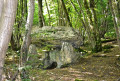
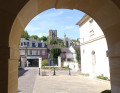
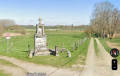
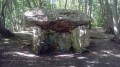
The destination of this hike is an imposing Neolithic dolmen and a small menhir. The hike takes you through fields and woods, with the charming village of Chambors halfway along the route. The commune of Chambors is part of the Vexin-Thelle Community of Communes. It has 314 inhabitants, known as Camborsiens and Camborsiennes.

Technical sheet

83642240
Creation:
Last update:
Last review:
  • Walking
    Activity: Walking
  • ↔
    Distance: 12.35 km
  • ◔
    Average duration: 4h 05 
  • ▲
    Difficulty: Moderate

  • ⚐
    Return to departure point: Yes
  • ↗
    Vertical gain: + 185 m
  • ↘
    Vertical drop: - 178 m

  • ▲
    Highest point: 143 m
  • ▼
    Lowest point: 63 m

Photos

Description of the walk

Depart from the car park at Chaumont-en-Vexin station.

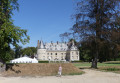
(S/E) Take the footbridge over the railway tracks to the south side of the station. At the bottom of the footbridge, go through a gate in a fence and turn left to reach the foot of an old mansion.

(1) Cross Rue de la Laiterie, follow Chemin de la Pissotte opposite, and walk alongside the site of the old dairy. Go up and turn right with the road. Pass under a high-voltage power line and you will immediately reach an intersection.

(2) Turn right onto the old Chambors road and walk alongside a wood on your right.

(3) Ignore a path branching off to the left. At the next fork, keep left and continue along a field path.

(4) At the next fork, keep left again. Pass between two wooded areas and ignore a path coming from the right. At the crossroads at the end of a tarmac road (elevation 133), go straight ahead.

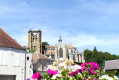
(5) At the next junction, continue straight ahead and walk alongside a wood on your right. Enter the wood and walk downhill, ignoring all the paths branching off to the sides. Enter Chambors via Rue des Vignes. Go straight ahead at two successive intersections. Follow Rue du Blouet to the end (Saint-SulpiceChurchon your left).

(6) Turn left and follow Rue Bertinot Juel. Pass a dead end on the left and you will immediately come to another intersection.

(7) Turn left, cross Rue de la Ferme on the right-hand side, and follow Rue du Réveillon until you reach a wash house on the left-hand side. Retrace your steps back to Rue Bertinot Juel.

(7) Turn left onto Rue des Sources. At the next intersection, continue straight ahead onto Rue des Groux.

(8) At the fork, turn right, walk past the cemetery on your left, and follow a field path. Walk steadily uphill until you reach a crossroads at the edge of a wood.

(9) Continue straight ahead (ignore the two paths on the right) and enter the woods. Cross the woods, keeping to the north-east. Leave the woods and continue along the edge.

(10) At the crossroads, continue straight ahead along the edge of the woods. Then enter the woods again. Go straight ahead (north-east) and descend to a crossroads.

(11) Continue straight ahead and downhill. Then turn right and walk along a railway line, some distance away, on your left.

(12) At an intersection, turn right onto a path and walk uphill to the dolmen.

(13) At the crossroads just behind the dolmen, turn left.

(14) After about 250 metres, make a short detour to the left to see a menhir. Continue east-northeast along the main path.

(15) At the crossroads, take the second path on the right and follow the railway line again. Ignore the path coming from the right.

(16) You will come to a gravel path; follow it to the right. Continue straight ahead (south). At the crossroads (elevation 136), continue straight ahead between the fields and you will soon reach an intersection.

(17) Turn left and continue straight ahead until you reach the crossroads you took at the start of the walk.

(4) Turn left again. At each intersection, take the left-hand lane until you reach Rue de la Laiterie.

(1) Cross the street, take the footbridge over the railway tracks, and you will arrive at Chaumont-en-Vexin station (S/E).

Waypoints

  1. S/E : km 0 - alt. 84 m - Gare de Chaumont-en-Vexin
  2. 1 : km 0.15 - alt. 84 m - Rue de la Laiterie x Chemin de la Pissotte
  3. 2 : km 0.54 - alt. 112 m - Intersection
  4. 3 : km 1.26 - alt. 131 m - Fourche
  5. 4 : km 1.89 - alt. 135 m - Crossing of the circular
  6. 5 : km 3.39 - alt. 130 m - Crossroads
  7. 6 : km 4.67 - alt. 65 m - Eglise Saint-Sulpice (Chambors)
  8. 7 : km 4.79 - alt. 65 m - Rue Bertinot Juel x Rue des Sources
  9. 8 : km 5.32 - alt. 82 m - Fourche - Cemetery
  10. 9 : km 5.69 - alt. 114 m - Crossroads at the edge of a wood
  11. 10 : km 6.53 - alt. 140 m - Crossroads
  12. 11 : km 7.06 - alt. 101 m - Crossroads
  13. 12 : km 7.81 - alt. 85 m - Intersection
  14. 13 : km 7.99 - alt. 97 m - T-junction - Dolmen des Trois Pierres
  15. 14 : km 8.22 - alt. 104 m - Intersection - Menhir
  16. 15 : km 8.58 - alt. 96 m - Crossroads
  17. 16 : km 9.53 - alt. 103 m - Gravel path
  18. 17 : km 10.13 - alt. 142 m - Intersection
  19. S/E : km 12.35 - alt. 84 m - Gare de Chaumont-en-Vexin

Practical information

Chaumont-en-Vexin station is accessible by TER from Paris-Saint-Lazare, Gisors and Dieppe stations.

Motorists can park in the station car park.

The route is not particularly difficult, with a few moderate inclines.

In the nearby area

La Pissotte. On your left was Chaumont's largest company, the Société Anonyme du Vexin (S.A.V), which employed a hundred workers and manufactured furniture in the 1950s. In 1965, a terrible fire completely destroyed this company, which was the lifeblood of the town of Chaumont.

Chambors. The village was the seat of the La Boissière family from 1528 until the French Revolution. This family served the Kings of France as maîtres d'hôtel. Among these kings were Charles VIII, Charles IX, Henri III and Henri IV. There were also members of the Académie des Lettres and Lieutenant-General.

The "Dolmen des Trois Pierres" in Trie-Château is a covered passageway in the Garenne de Trye.
It has been attracting the attention of both walkers and scientists for hundreds of years. An enigmatic place steeped in legend, this burial passageway of the Seine-Oise-Marne civilisation, classified as a Historic Monument in 1862, marks the settlement of our Neolithic ancestors in our region.

The menhir, located some 200 metres from the Allée Couverte, is a limestone block of the same type as that of the Allée, standing about 2 metres above the ground. This "standing stone", which was first reported in 1877, was democratically classified as a menhir during an excursion organised by the Société Normande d'Etudes Préhistoriques (Normandy Society for Prehistoric Studies) in 1905. In 1932, R. Pillon carried out excavations that he described as "fruitful". The museum (in the courtyard of Chaumont Town Hall) has three flint sickles that were found there.

Other walks in the area

For more walks, use our search engine .

The GPS track and description are the property of the author. Do not copy them without permission.