Country:

 City:
City:


(S/E) The walk starts in the courtyard of the town hall, which occupies the site of the former Récollets Convent, completed in 1637. (See also the section: Nearby). Turn right as you leave the courtyard, passing in front of the war memorial.
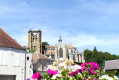
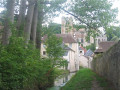
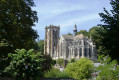
(1) As you cross the square, admire the Church of Saint Jean-Baptiste, which dominates the town on the hillside. Lucien Pissaro, the son of Camille Pissaro, set up his easel here in 1926 to immortalise this view. Immediately turn right onto Passage Damiens and continue along Chemin des Écoliers.
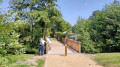
(2) After crossing a green space, which used to be a marshy area unsuitable for any activity, cross the Marquemont Canal, which was dug to drain the area, on a recently installed footbridge. Continue along Chemin du Préville. Halfway along, on your left, you will see a beautifully restored wash house on private property. At the end of Rue du Préville, turn left onto Rue Roger Blondeau, go downhill to the left, then turn left again at Café Saint-Martin on the corner of Rue de la Foulerie to reach the square of the same name.
(3) This square was once used for tanning hides, flax and hemp before it was drained by the digging of the Marquemont Canal, completed around 1830. Admire the majestic plane tree planted around 1800 from seeds said to have been brought back from Syria by the gardener of the Château du Rebetz. It was classified as a "Remarkable Tree of France" in 2015. After admiring it, head behind it towards the small Ruelle de la Chapelle, which will take you back to Rue de l'Hôtel de Ville. Follow this street to the right until you reach Place du Marché.
(4) Dominating the square, the bailiwick, built in 1543, frequently hosts exhibitions (check the town hall website). In front of its entrance door, turn left and climb the steps leading to the church. Immediately on your right is the courthouse. Above the 16th-century door, you will find two coats of arms with fleurs-de-lis. One belongs to the Duchess of Estouteville, the other to the Duke of Longueville. The Estates General were held here during the Revolution. The church at the top of the steps is only accessible via this 16th-century staircase. ( See also the section: Nearby).
(5) From the church forecourt, take the staircase leading to the presbytery. Pass to its left to take Chemin de la Fontaine Salée. At the end of this path, before taking Rue du Jard on your left, was the "salt fountain" where horses were treated for scabies with brackish water flowing down from the feudal mound. This site is currently being researched. Follow Rue du Jard to the left. At the bottom of the street, turn left into Rue de Laillerie.
(6) Take Impasse du Rousselet, at the end of which runs a branch of the Troësne, the river that irrigated the marshes before the Marquemont canal was dug. A wash house is due to be rebuilt here soon. Retrace your steps.
(6) Turn right onto the pavement opposite and walk to No. 14 Rue de Laillerie. In a niche above a window is a pretty statue of Saint Roch, the patron saint of pilgrims, among others. Retrace your steps slightly and turn left onto Rue de la Libération. At this crossroads, the Chaumont Liberation Festival (13 September 1944) was held for several years. Walk about a hundred metres and enter the courtyard of the EHPAD, where you turn right towards the chapel.
(7) You are now in the courtyard of the former Priory of Notre-Dame de Laillerie, founded in 1120, which became the House of the Sisters of Compassion, named after the order that was established there. Turn right in the courtyard to visit the chapel, where you can admire a 13th-century bas-relief. Before leaving the chapel, head towards the small door at the back on the right. It leads to the cemetery of the Sisters of Compassion and the donors of this establishment to the Order. When you leave the Maison de la Compassion, turn right. Walk down this street for 300 metres and turn left onto Rue Brachedal, which will take you to the lime tree-lined Avenue de la Gare. Cross the avenue and turn left, then continue straight on Rue Jean Lefèvre, walking alongside the walls of a large private property called Propriété Gay-Lussac. (See also the chapter: Nearby).
(8) Continue along Rue Jean Lefèvre, veering to the left. At the bottom of Rue Jean Lefèvre, at the crossroads, take the small Rue Augustin Auger, which branches off to the right. Take the gravel path that branches off to the left after the town hall car park. After crossing the small wooden bridge over a branch of the Troësne, turn left to return via Chemin des Écoliers, where you will have another lovely view of the church before returning to the town hall (S/E).
 Visorando Member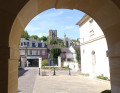
 Average