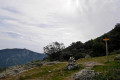
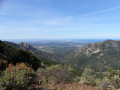
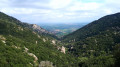
The castle of Ultrera and Notre-Dame du Château from the Valley of the Tortoises

A hike starting from La Vallée des Tortues in Sorède, which passes through the suburbs of Sorède and leads to the Sant Ferriol de la Pave Chapel, then up to the heights of the Albères to the ruins of the Château d'Ultrera, before descending slightly to the old Himalaya solar oven and then on to the Hermitage of Notre-Dame du Château, where a break is a must. The return via the Pont de la Resclosa bridge takes you back to the valley and its wildlife park, which is well worth a visit.

Details

14046019
Creation:
Last update:
Last review:
  • Walking
    Activity: Walking
  • ↔
    Distance: 11.33 km
  • ◔
    Average duration: 4h 40 
  • ▲
    Difficulty: Moderate

  • ⚐
    Back to start: Yes
  • ↗
    Ascent: + 495 m
  • ↘
    Descent: - 490 m

  • ▲
    Highest point: 532 m
  • ▼
    Lowest point: 86 m

Description of the walk

Go to Sorède to park in the large shaded car park at the Vallée des Tortues animal park (signposted route). You can move away from the park entrance to find shade further away, to the north-west.

(S/E) From the main entrance, head north-west to the edge of the park (fence on the right). Turn right at the meadow and head down towards the River Sorède (Ribera de Sureda). Follow the river (on your right) and turn left until you reach the outskirts of Sorède via Rue du Mas Soula.

(1) Before a left-hand bend, leave this street and turn right onto a well-marked path that crosses the Rivière de Sorède below and climbs up to Rue du Mas Félix. Head north, continuing straight on, until you reach the second intersection.

(2) Turn right onto Traverse de Notre-Dame du Château.
Follow it until the junction with Rue de Notre-Dame d'Ultrera. Then turn right and continue to the edge of the residential area. There, turn left onto a well-marked path that runs alongside the housing estate (guide on the left).

(3) At the junction with Rue du Mas del Rost, turn right onto the tarmac road that leaves the built-up area to the east. Take the shortcut straight ahead rather than following the winding road. Further on, after the last houses on the left, you will come to a large crossroads.

(4) Turn right to head south. Continue along this DFCI AL27 track, ignoring any side paths. Further on, you will come to a crossroads with yellow directional signs.

(5) Continue straight ahead on the same track to descend to the hamlet of La Pave (la Pava). At the crossroads of tracks at the entrance to the hamlet, turn right to reach the Sant Ferriol de la Pava Chapel. Walk around it. Old fountain nearby

(6) Retrace your steps and head west along a marked path.

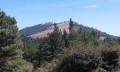
(5) Back at the crossroads, continue straight ahead, slightly to the right, towards the Hermitage of Notre-Dame du Château (signposted). The steady climb is along a rocky path. Beautiful views of the coastline (Argelès, Saint-Cyprien, Canet). Arrive at a fountain restored in July 1952 with a huge rock nearby. Follow the signs to the left of the water source. As you climb the marked trail to Puig de Sant Miquel, enjoy views of the coastline, the Roussillon plain and the hinterland, not to mention the Corbières and the Canigou Massif. You will arrive at the flat area of Castrum du Castell d'Ultrera.

(7) Please note: in bad weather or after rain, keep to the right on the marked path.
Leave the yellow markings and turn left to go around the rocky outcrop dominated by the castle ruins. At the start, the path is more or less visible among the outcropping rocks. There is then a series of ascents and descents until you reach a crossroads. Go up to the right towards a ruined wall. The entrance is through a gap in this wall. Immediately after, turn right to continue climbing (wall on the right). Turn left to cross the metal ladder. You will arrive at the highest point of Castell d'Ultera.

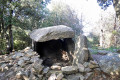
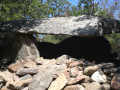
(8) Caution: take care at the start of this path, which is a ledge overlooking the void. Stroll at your leisure among the ruins, which offer magnificent 360° views. Retrace your steps, climb the ladder and wall to exit through the gap and descend to the crossroads. Turn right to continue around the hill. Keep close to the rock. Further on, the path moves away from the rock face as it descends. On the left, there is a huge rock resting on top of others. You will arrive in the undergrowth. There is a natural shelter at the foot of the rock face. Shortly afterwards, the path climbs up to the right and comes to a fence just before a visible crossroads, at an altitude of 497 m. Turn left and walk about ten metres along the fence to find a path leading to the former site of the Himalaya solar oven. View of the rocky spur of the Château. Retrace your steps to the crossroads at an altitude of 497 m and descend to the left to reach the Hermitage of Notre-Dame du Château via the rocky path.

(9) You can visit the Chapel of the Hermitage of Notre Dame du Château (Mare de Déu del Castell) and have a picnic in the shade (furnished area). See the fresco of the Procession dating from 1938. Descend a few metres to reach the track below the hermitage. Head west towards the Chapel of Christ (Capella del Crist), on the right along the track. Continue to a fork in the track.

(10) Keep left along this downhill DFCI track, which passes a junction of marked tracks in front of a cistern until it bends to the left.

(11) Leave the track and take a visible, well-trodden path that serves as a shortcut. It crosses the DFCI track four times. Thefifth time, turn right onto the track and continue. After several hairpin bends, you will come out onto the road to La Vallée Heureuse (Rue de La Farga).

(12) Turn right and walk carefully along this street, passing over the Pont de la Resclosa bridge until you return to the car park of the Vallée des Tortues animal park (S/E).


Waypoints

  1. S/E : km 0 - alt. 142 m - Animal park car park
  2. 1 : km 1.27 - alt. 105 m - Trail fork
  3. 2 : km 1.65 - alt. 90 m - Notre-Dame du Château crossing
  4. 3 : km 2.3 - alt. 86 m - Rue du Mas del Rost
  5. 4 : km 2.71 - alt. 95 m - Turn-off towards Chapelle de la Pave
  6. 5 : km 4.93 - alt. 189 m - Crossroads of the chapel circular
  7. 6 : km 5.59 - alt. 167 m - Sant Ferriol de la Pava Chapel
  8. 7 : km 7.06 - alt. 480 m - Bypass rocky outcrops.
  9. 8 : km 7.32 - alt. 532 m - Ruins of - Château d'Ultrera
  10. 9 : km 7.89 - alt. 448 m - Notre-Dame du Château Hermitage
  11. 10 : km 8.24 - alt. 428 m - Fourche
  12. 11 : km 8.92 - alt. 408 m - Fork in the path
  13. 12 : km 10.83 - alt. 154 m - Rue de la Farga, on the right
  14. S/E : km 11.32 - alt. 142 m - Animal park car park

Notes

  • In case of bad weather, after rain, or to avoid the climb to the Château d'Ultrera: go directly from (7) to (9). Then continue on the marked rocky path that descends to the Hermitage of Notre-Dame du Château.

Walking sticks are useful for the sometimes steep ascents and descents of Puig de Sant Miquel.

Bring a hat and water in hot weather.

There is a picnic area with designated and authorised fire pits at the Hermitage of Notre-Dame du Château.

In strong winds, access to the mountainous area is restricted to limit the risk of fire (see the Prefecture 66 website).

Worth a visit

- The Romanesque church of La Pave. Information panel. The Church of Saint-Ferréol de la Pava (or Sant Ferriol de la Pava) is a 10th-century pre-Romanesque church located in the hamlet of La Pava (municipality of Argelès-sur-Mer). It was originally dedicated to Saint Alexander and is still known as the Church of Saint Alexander of La Pava. The oldest part of the building is a pre-Romanesque chapel, consisting of a single rectangular nave extended to the east by a circular apse. The walls of the nave appear to have been renovated during the 10th century, then, at an unknown date that historians place between the 17th and 19th centuries, the church was enlarged with another nave, also rectangular but larger, on the same axis to the west.
The church is mentioned in the 12th century, in the 14th century under the name of S. Alexandro de la Pausa, then dedicated to Sainte-Marie and, in 1858, to Saint-Ferréol, who had the advantage of having the same first name as the archpriest of Vallespir at the time. The church was the seat of a hermitage. It has been listed as a historic monument since 28 November 1991.

- The Château d'Ultrera (sometimes Frenchified as Ultrère, Oltrère, in Catalan Ultrera or Oltrera) is a fortified castle, now in ruins, located at the top of a steep rocky spur in the Albères massif. It is located at an altitude of 571 metres. Ultrera "was a real vulture's nest, both literally and figuratively". The castle stands on a barren rocky outcrop overlooking the entire Roussillon plain and the Lavail gorges. It is part of a series of fortifications (including the Massane watchtower and the old castle of Montbram, located above the hamlet of Lavail) designed to defend and monitor a natural passage between Roussillon and Catalonia. This highly strategic point was fortified by the Romans, probably at the time of the conquest of the Iberian Peninsula, but most of the building dates from the Visigothic period (6th and 7th centuries). During the Middle Ages, the castle was attached to the seigneury of Sorède. It was Jeanne de Vilaplana (wife of Gaston de Foix and Béarn), often referred to as the "Lady of Béarn", who had it destroyed in 1675. She requested that the chapel be demolished and the furnishings brought to her.

- Padre Himalaya's solar oven: It was in Sorède, on the heights of Notre-Dame du Château at "Coll del Buc", that Padre Himalaya, then aged 32, was the first to experiment with a solar oven. During the summer of 1900, craftsmen from Sorède carried the scientist's machine on their backs and on mules to assemble and install it. This oven had a 5-metre diameter optical system equipped with 260 truncated cone mirrors, fixed to a metal structure that could be oriented towards the Sun. The nature of the reflective metal used remains unknown. The heat of the Sun concentrated by the mirrors enabled the scientist to achieve a temperature of around 900°C. The remains of the experimental platform, the dry stone walls and the cement track that supported the circular horizontal rail can still be seen today. The solar furnace was rebuilt in 2015 at Mas del Ca in Sorède (on the road between La Vallée des Tortues and Sorède).

- The Hermitage of Notre-Dame du Château (1681): a former hermitage and sanctuary dedicated to the Virgin Mary located in the Albères massif. It was François, canon at Elne and brother of Jeanne de Vilaplana, who built the Hermitage of Notre-Dame du Château at the end of the 17th century, reusing most of the elements of the old chapel of the Château d'Ultrera, including the blue-veined white marble portal, the bells and, of course, the Virgin. The altarpiece and the Virgin Mary in the hermitage are both listed as Historic Monuments.

- La Vallée des Tortues Animal Park: open from early April to early November. Over time, it has become a veritable Noah's Ark, home to hundreds of animals. Alongside the tortoises, there are reptiles in the new vivarium, leaping marmosets, meerkats standing on their hind legs, and many other mammals and birds. See website

Reviews and comments

4.5 / 5
Based on 8 reviews

Reliability of the description
4.4 / 5
Ease of following the route
4.4 / 5
Route interest
4.8 / 5
bernard coulomb
bernard coulomb

Overall rating : 5 / 5

Date of your route : Jun 16, 2025
Reliability of the description : Not used / Not applicable
Ease of following the route : ★★★★★ Very good
Route interest : ★★★★★ Very good
Very busy route : No

One of the most comprehensive routes in the region: challenging, sweeping panoramas, history and cork oaks.
No difficulty with GPX.

Machine-translated

palou31
palou31

Overall rating : 5 / 5

Date of your route : Dec 01, 2024
Reliability of the description : ★★★★★ Very good
Ease of following the route : ★★★★★ Very good
Route interest : ★★★★★ Very good
Very busy route : No

A very beautiful parish-specific to Brittany hike that is definitely worth it, feasible for people who suffer from vertigo as long as they stay on the marked trail. On the fifth climb, the steps can be high and you may need to use your hands. You must also watch out for slippery rocks, even when it is not raining, due to the mist. The view from the Castrum plateau is spectacular.

Machine-translated

GiBidou
GiBidou

Overall rating : 4.3 / 5

Date of your route : Oct 05, 2024
Reliability of the description : ★★★★☆ Good
Ease of following the route : ★★★★☆ Good
Route interest : ★★★★★ Very good
Very busy route : No

Beautiful hike with numerous viewpoints. Steep climb after passing near the chapel. Caution required when bypassing the rocks (point 7), which is likely to be more difficult in wet conditions.

Machine-translated

bruanne
bruanne

Overall rating : 4 / 5

Date of your route : Jul 23, 2024
Reliability of the description : ★★★★☆ Good
Ease of following the route : Not used / Not applicable
Route interest : ★★★★☆ Good
Very busy route : No

WARNING: route for experienced hikers or trail runners - in my opinion, the "medium" difficulty rating is underestimated - up to the 6th kilometre and the Sant Ferriol de la Pava chapel, there are no particular difficulties, with a good path and a steady climb - then between the 6th and 8th kilometres, it gets really complicated, with steep, stony and rocky, and technically you need a certain amount of experience. A mobile phone is highly recommended so you don't get lost and stay on the right path (even then, you sometimes feel a bit lost). You need to take water and a small snack with you. The scenery is magnificent and this hike (which I did more as a trail run) is fantastic. The start of the descent can be a bit technical, but overall it's fine. You can follow the firebreak path to avoid the technical part, which adds a few kilometres but that's just part of the game.

Machine-translated

casillas
casillas

Overall rating : 5 / 5

Date of your route : Jun 03, 2024
Reliability of the description : ★★★★★ Very good
Ease of following the route : ★★★★★ Very good
Route interest : ★★★★★ Very good
Very busy route : Yes

Very beautiful hike, but from point 7 onwards, the entire elevation gain is there. The climb is very difficult, a small V-shaped path eroded by rain. We did not climb up to the castle ruins, but passed underneath them and had a snack at the N-D du Château hermitage. There are two water taps: the one on the left is not drinkable, but there is nothing on the right. I filled my water bottle and did not get sick. The rest of the route was fine.

Machine-translated

casillas
casillas

Overall rating : 4.3 / 5

Date of your route : Jun 03, 2024
Reliability of the description : ★★★★☆ Good
Ease of following the route : ★★★★☆ Good
Route interest : ★★★★★ Very good
Very busy route : Yes

A beautiful hike with stunning views, up to point 7 the climb is easy on a good path, but after that the climb is very steep and narrow in places, it is V-shaped, the hardest part is under the castle ruins where you have to abandon your walking sticks to climb and hold on with your hands to get through. Snack at the chapel. The descent is via a wide path if you want to avoid the shortcuts, as there were two hikers on this route (thanks to the tracker).

Machine-translated

Stendhale23
Stendhale23

Overall rating : 3.7 / 5

Date of your route : Dec 26, 2023
Reliability of the description : ★★★★☆ Good
Ease of following the route : ★★★☆☆ Average
Route interest : ★★★★☆ Good
Very busy route : No

Up to point 4, the walk is easy going as it is flat.
Point 6 is not particularly interesting, and if you don't read the details, you may even pass by the chapel without seeing it.
After the ruined castle, it can be difficult to find the right path.
Finally, the passage before the solar furnace is now (December 2023) obstructed by trees and branches.

Although a few points could be improved, the hike is very pleasant and can be completed in 4 hours and 15 minutes without any particular difficulty.

Machine-translated

christine Coquery
christine Coquery

Overall rating : 5 / 5

Date of your route : May 11, 2022
Reliability of the description : ★★★★★ Very good
Ease of following the route : ★★★★★ Very good
Route interest : ★★★★★ Very good
Very busy route : No

Very beautiful route, challenging climb but exceptional views.

Machine-translated

Other walks in the area

For more walks, use our search engine .

The GPS track and description are the property of this route's author. Please do not copy them without permission.