Country:

 City:
City:


Park at the Tancoutier car park (shortly after a hairpin bend on the way up the Route de Cotteyssard).
(S/E) From the car park, continue along the road for about fifty metres, looking to the left for the start of an old forest track heading due west. This wide track is now overgrown with grass.
Take this track and follow it to its end, without ever taking the few narrower paths that join it. The track crosses the Chabotte path near some old signposts and turns into a steep, winding path heading generally north. Blue markers indicate the route sporadically from this junction.
The path veers westwards and crosses the Ferret path at a point where the latter is level. Continue climbing fairly steeply west-north-west until you reach an OBP210 signpost indicating the direction of Les Chalanches (following the ascent) and that of Allemont (from where you have come).
(1) Behind this, another rusty metal sign points towards the Grande Lance de Domène on the right. Follow this steep, winding path (north-north-west) until you reach a level path above the forest.
Turn right (east-northeast) onto this path and continue to the signpost for the Pierre Assise.
(2) If it is already daylight, a detour via the Pierre Assise offers a fine view (10 mins round trip; follow the direction indicated by the sign). In any case, continue along the level path, now heading north then east, to the Cabane du Chazeau.
(3) At the hut, turn north towards Lac de Belledonne, following theGR®® 549 (Red and White). The path leads back into the forest then through mountain pastures covered in blueberry bushes and rhododendrons, arriving at the easy-to-navigate rock formations of Pas du Bessey.
(4) At the Pas du Bessey, take the main path heading due west, which runs level through the scree and snowfields in the valley below the Barre des Écus. You will reach a signpost.
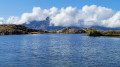
(5) Leavethe GR®® and follow the signposted route to Lac de Belledonne (yellow stripes or blue dots, as you prefer – the blue ones are the old routes, generally rougher and wilder) to the north-west, until you reach Lac de Belledonne.
This section is the most difficult part of the hike and is off-trail.
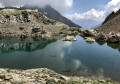
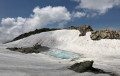
(6) At the mouth of the lake, cross the gabion-lined section over the Ruisseau du Molard to visit a small lake situated 250m further north-north-east. From there, you can either go round the lake along its left bank, or return to point (6) to go round it along its right bank and admire the view of the western end of the lake. If there is significant snow cover (generally until the end of July), you can cross the western part of the lake over the snowfields.
Before doing so, make sure you have a clear idea of the route up to the pass; see the photo and caption for this photo.
From the western shore of the lake, climb up through the snowfields and scree to the west-southwest to go round the base of a rocky promontory and end up beneath a steep snowfield (scree in late August). Put on your crampons, stow your poles in your rucksack and take out your ice axe, even if the snowfield is thin.
If the snow has frozen sufficiently, ascend via the first snowfield; otherwise, take the gully slightly further to the right, heading west-northwest. Once past the first narrow section between the rocks, aim to reach the middle of the couloir below the pass and ascend it either on the snowfields if they are frozen, or, if not, through the unstable, sandy scree.
When the slope steepens, continue over the snowfield towards the pass visible higher up.
(7) At the Col de Belledonne, follow the well-marked path to the right (east) leading to the Croix de Belledonne.
(8) Return to the pass.
(7) Continue straight ahead and look out for the small lake, usually frozen over, below the hypothetical helipad indicated by the IGN.
The route becomes off-trail again.
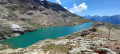
(9) From the lake, follow the gentle valley floor that passes another small lake, usually free of ice from mid-July onwards, to descend south-west towards Lac du Bœuf. Approach the lake by descending through rounded rocks, heading for its western shore.
(10) At the lake, take a detour – if you’re up for it – via a small lake situated 100m further north-west (approx. 20m elevation gain), then return to skirt Lac du Bœuf along its right bank to reach its outlet and descend along the right bank of the outlet, aiming for the gentler slopes on the right (west). A few rocks may require you to use your hands or even your bottom to get past, but the descent is relatively gentle.
Head for the right bank of Lac du Bois below.
(11) Once at Lac du Bois, go round it along its right bank to its spillway. Follow its outlet south-southeast along the right bank, initially through scree, until you reach a rocky narrowing less than 200m past the lake. The rocky escarpment on the right is easily crossed and leads onto a steep scree slope.
Descend this scree (south-southeast then south) until you reach slightly less steep grassy slopes. Continue south to reach the bed of the Bâton torrent and, after a long flat section, reach its spillway (stone structure). Cross to the left bank of the torrent if you haven’t already done so.
(12) From the weir, follow the overgrown path which winds pleasantly downwards to the south and then climbs back up to the south-southeast beneath the Roche Berchon promontory. Cables (of little use – if used, watch out for metal splinters) secure a crossing over a ravine before the tip of the promontory. Shortly after the promontory, turn east and arrive at a goods lift station.
(13) Cross the facilities (a tin-roofed building and another less unsightly one) and take the well-marked but overgrown path which heads level off towards the north-east. After a ravine, this path winds down in very gentle switchbacks to the south-southeast before heading east again. Shortly after a sign reading “This is my land, this is my hunting ground, I shoot with live ammunition”, join the winding path that climbs towards the pretty Chalanches hut.
(14) Turn right (west) to descend generally south-east towards Clot des Ayes.
(15) At the Clot, a sign points towards Allemont (east). Follow this route, which is almost level, and you’ll reach a track leading to the Tancoutier car park (S/E).



 Visorando Member
 Moderate
 Difficult
 Easy
Easy