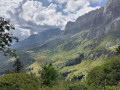
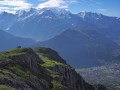
The Tête du Colonney via the Désert de Platé from Praz Coutant

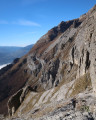
Starting from Praz Coutant (Plateau d’Assy), I suggest a lovely route to reach the Tête de Colonney via the magnificent Désert de Platé. This route is challenging, and part of it takes place in a rather rocky environment, particularly through chaotic sections of sharp limestone pavement.

Please note: there are difficulties on a few tricky sections, where caution is required. See the route description and the ‘Practical Information’ section.

Details

64905704
Creation:
Last update:
Last review:
  • Walking
    Activity: Walking
  • ↔
    Distance: 9.02 mi
  • ◔
    Average duration: 8h 45 
  • ▲
    Difficulty: Very difficult

  • ⚐
    Back to start: Yes
  • ↗
    Ascent: + 5,308 ft
  • ↘
    Descent: - 5,295 ft

  • ▲
    Highest point: 8,793 ft
  • ▼
    Lowest point: 3,855 ft

Photos

Description of the walk

The route starts from the car park at Praz Coutant, which is situated near a hairpin bend on the D43 leading from the Plateau d’Assy to Plaine Joux.

(S/E) Follow a path heading due north towards Platé. Quite soon, turn right at the first fork.

(1) At the Roc des Fiz memorial, turn left onto the path. Continue straight on until you reach a track suitable for vehicles. Follow this for a short while, keeping in the direction of the Chalets de Platé at any junctions you come to. Cross thefirst stream and look for the start of a path on the right.

(2) Take this path and begin a long climb of approximately 600 m in elevation gain to the foot of the cliffs.

(3) Continue along the path, which gradually winds its way up some steep slopes through a predominantly rocky landscape. After a short while, you’ll reach the plateau after crossing a ledge and a short footbridge.

(4) Carry on straight ahead along the path to reach the Chalets de Platé in a short while.

(5) Pass to the left of the Refuge de Platé, then, fairly soon after, turn right towards the Col de Colonney.

(6) About 300 m further on, continue to the left towards the Col de Colonney, following the GR®96 route for a short while.

(7) Turn slightly left as you approach some formations of sharp limestone pavement: follow the red-and-white GR® markings to reach the Col du Colonney.

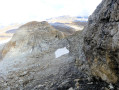
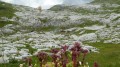
(8) Head left and follow the blue markings off the beaten track through a beautiful, rugged landscape of sharp limestone pavement. You’ll reach an unnamed pass and join a faint path coming from the Aup de Véran.

(9) Continue straight on, following the blue markings, still over sharp limestone pavement, to reach the top station of the Lindars Nord chairlift.

(10) Head straight along the path until you reach the junction with the path you’ll take on the way back.

(11) Head straight on, then, a little further on, turn right, following the blue markings. You’ll soon reach the Tête des Lindars.

(12) Continue straight on downhill and then join another path coming from the left. Carry on straight ahead through a tricky section. Take care on a ridge section and a short descent equipped with a chain and rungs. Press on to the Col de Tré l’Épaule.

(13) Descend to the right for a few metres: it is recommended that you do not follow the blue-marked route, which runs overhanging a chasm. See § Practical Information.

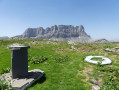
(14) Continue along the path up the slope whilst staying at the foot of a cliff: be careful, as snowfields may make it difficult to find your bearings. Once you reach a cairn, turn left, following the more or less visible red markings to begin a ‘stair-like’ ascent. At the top, continue to the right along a clearly visible path; shortly afterwards, proceed with caution along an exposed section on a narrow ridge: take care. Reach the summit of the Tête du Colonney, crowned by its clearly visible pyramid-shaped metal structure.

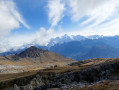
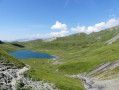
(15) Enjoy the beautiful views all around, including the Aravis Range, the Bargy Range and Mont Blanc. Then retrace your steps to a cairn, and take care to find the path you took on the way up. On the descent, head for the cairns below, then turn right at the foot of the cliff (see also § Practical Information). Reach the Col de Tré l’Épaule after a short climb.

(13) Follow the same route as on the way out, taking care at all times. At a junction, continue to the right below the Tête des Lindars so as not to take exactly the same path again.

(11) Just before the chairlift facilities, turn right onto the path. Follow this for a short while, keeping an eye out for the fairly regular red markings, until you reach the Refuge de Platé.

(5) Once you arrive, continue to the right towards the Plateau d’Assy.

(4) After crossing the footbridge, a long, clearly visible descent begins: please take care.

(2) Turn left and follow the ascent route in the opposite direction to return to the car park (S/E).


Waypoints

  1. S/E : mi 0 - alt. 3,858 ft - Croix de Praz Coutant
  2. 1 : mi 0.12 - alt. 3,953 ft - Roc des Fiz memorial
  3. 2 : mi 0.91 - alt. 4,534 ft - Ugine Torrent
  4. 3 : mi 1.43 - alt. 5,538 ft - Beneath the Rochers de Miot
  5. 4 : mi 1.87 - alt. 6,565 ft - Le Bout
  6. 5 : mi 2.15 - alt. 6,654 ft - Refuge de Platé
  7. 6 : mi 2.33 - alt. 6,857 ft - Junction
  8. 7 : mi 3.2 - alt. 7,579 ft - Combe à Roger
  9. 8 : mi 3.33 - alt. 7,628 ft - Col du Colonney (2321m)
  10. 9 : mi 3.71 - alt. 7,749 ft - Unnamed pass
  11. 10 : mi 4.1 - alt. 8,130 ft - Lindars Nord chairlift
  12. 11 : mi 4.16 - alt. 8,143 ft - Junction towards the Chalets de Platé
  13. 12 : mi 4.33 - alt. 8,373 ft - Tête des Lindars
  14. 13 : mi 4.46 - alt. 8,264 ft - Col de Tré l'Épaule
  15. 14 : mi 4.51 - alt. 8,317 ft - Below the Col de l’Epaule
  16. 15 : mi 4.84 - alt. 8,773 ft - Tête du Colonney
  17. S/E : mi 9.02 - alt. 3,855 ft - Croix de Praz Coutant

Notes

The starting point can be viewed on Google Maps: click here.

Good walking boots and walking poles are recommended.

Please take your rubbish away with you – nature will thank you for it.

Below is a difficulty rating for each section (the route is not uniform):
- Green: fairly straightforward walking with no significant elevation gain or difficulty.
- Blue: steeper slopes and/or greater elevation changes on a well-marked route.
- Orange: routes presenting some technical difficulties and/or poor trail conditions (markings or visibility of the path).
- Red: a difficult route due to significant elevation changes that may require some climbing, in an environment presenting certain hazards.
- Black: a route on a fairly difficult trail and/or involving imminent dangers.
- White: routes through very challenging technical terrain requiring specific equipment.

From (S/E) to (1): Green difficulty
Very easy walking on this section.
Signposts are present. No trail markings.

From (1) to (3): Blue difficulty
After a short stretch along an easy path, the route follows a track suitable for vehicles, with a few steep sections in places. After the junction, the route follows a path up a fairly steep slope through an environment that gradually becomes rather rocky.
Signposts are in place. Orange markings.

From (3) to (4): Orange difficulty
As you go on, the slope becomes steeper over rather stony ground, particularly when crossing the gorge (take care not to dislodge any stones, as there may be other people below). After crossing the footbridge, the route becomes easier.
Signposts are in place. Orange markings.

From (4) to (5): Blue difficulty
The path is relatively easy to follow.
Signposts are in place. Orange markings.

From (5) to (6): Blue difficulty
This section follows a path with no significant difficulties.
Signposts are in place.

From (6) to (7): Blue difficulty
You follow a path that is generally fairly level for a short while.
White-red GR®96 markings + signposts.

From (7) to (8): Blue difficulty
On this section, the route occasionally goes off-trail over slightly rugged terrain.
White-red GR®96 markings + signposts.

From (8) to (12): Orange difficulty
From this point onwards, caution is required on more rugged terrain, including a few sections of sharp limestone pavement.
Regular blue markings.

From (12) to (13): Orange difficulty
Difficulties are encountered whilst crossing an exposed ridge and during a well-equipped descent section (featuring a chain and rungs). Please take care.
Blue markings.

From (13) to (14)
From the pass, I suggest three routes:
- either by following the route indicated by the markings on the right: with this more direct option, you’ll encounter a difficult section when tackling an overhanging passage above a small, rather exposed chasm (a cable would be useful here) – Orange difficulty
- or by going round the chasm to the right – Blue difficulty
- or by continuing straight on along a ridge that requires caution, then descending to the right shortly afterwards – Orange difficulty
I recommend thesecond option.
Blue markings.

From (14) to (15): Orange difficulty
The route follows the foot of a cliff as you ascend (I also suggest an alternative route: click here).
At a cairn, turn left to begin another section of stair-like ascent up to a ledge (follow the slightly faded red markings), then continue almost directly opposite in the same manner.
On the higher ground, continue to the right along an easier route. Shortly afterwards, take care when traversing a slightly exposed ridge (caution) to reach the summit of the Tête du Colonney.
Cairns + red markings.

From (15) to (13): Orange difficulty
On the return leg, be sure to spot a cairn to mark the start of a descent shortly afterwards (note that the red markings are not very visible in this direction). Once you reach a ledge, head slightly to the left, then head for a cairn situated below. Then head right onto a more visible path at the foot of the cliff to reach the pass (be careful of the chasm).
Cairns + red and blue markings.

From (13) to (11): Orange difficulty
You’ll encounter the same challenges as on the outward leg (notably a short section of climbing aided by a chain), then follow the marked route bypassing the Tête des Lindars.
Blue markings.

From (11) to (5): Blue difficulty
For quite a while, you follow a path through meadowland, punctuated by a few slightly rugged sections on the outskirts of the sharp limestone pavement (the regular markings make it easy to find your way).
Red markings.

From (5) to (4): Blue difficulty
A fairly easy route overall.
Orange markings.

From (4) to (3): Orange difficulty
The descent involves a few steep and slippery slopes on fairly stony ground. Take care and be mindful not to dislodge any stones.
Signposts and orange markings are in place.

From (3) to (2): Blue difficulty
The descent continues over gentler slopes without any significant difficulties.
Signposts and orange markings are in place.

From (2) to (S/E): Blue difficulty
Follow a track suitable for vehicles back to the starting point.
Signposts are in place.

A good idea is to complete the route over two days via the Refuge de Platé (with the option of exploring other parts of the area).

Worth a visit

  • The Assy Plateau disaster of 16 April 1970: this was one of the deadliest landslides in France, claiming the lives of 71 people (including 56 children). For further information, see the Wikipedia article.
  • The Platé Desert: this is a vast karst limestone plateau reaching an altitude of 1,480 metres (Grandes Platières). For further information, see the Wikipedia article.
  • La Tête du Colonney: see the Wikipedia article.

Always be cautious and plan ahead when you're outdoors. Visorando and the author of this route cannot be held responsible for any accidents occurring on this route.

The GR® and PR® markings are the intellectual property of the Fédération Française de Randonnée Pédestre.

Reviews and comments

5 / 5
Based on 1 review

Reliability of the description
5 / 5
Ease of following the route
5 / 5
Route interest
5 / 5
FlickaPatsy
FlickaPatsy

Overall rating : 5 / 5

Date of your route : Aug 05, 2025
Reliability of the description : ★★★★★ Very good
Ease of following the route : ★★★★★ Very good
Route interest : ★★★★★ Very good
Very busy route : No

A magnificent hike that is only suitable for hikers who are used to steep slopes. Some sections are tricky, particularly the Egratz fault, especially on the descent. The landscape is magical with beautiful views of the Platé desert. It can get a little busy between the refuge and the Col du Colonney, where you will encounter hikers coming from Flaine.
A very enjoyable hike under the Lindars, walking on sharp limestone pavement (caution advised with children due to deep faults).
We went as far as the Col de Très L'épaule but didn't dare continue to the Tête du Colonney due to the presence of a snowfield and no visible trail. Nevertheless, it was 1,480 metres of elevation gain and a little over 15 kilometres.
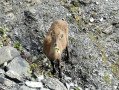
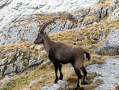
The highlight: two young chamois near the refuge and a beautiful marmot on the way back.

Machine-translated

Other walks in the area

For more walks, use our search engine .

The GPS track and description are the property of this route's author. Please do not copy them without permission.