Country:
 City:
City:


The starting point for this hike is located at the car park of the Santuario de Santa Maria Magdanela in the town of Novelda.
To get to this starting point by car, see the "Practical information" section below.
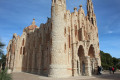
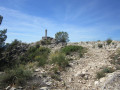
(S/E) From the car park, retrace your steps a little and start the hike with a "cultural" section. Head towards the trumpeting angel and visit the fountain. Then climb up to the castle (Castilo de la Mola) and visit it, and finally go to the sanctuary of Mary Magdalene and visit it.
Retrace your steps and at the signpost for "La Teulera", take the path downhill. Walk carefully on this descent. You will come to a tarmac road, which you should take on the right.
(1) At a large chimney on the right-hand side of the road, take the path on the left. Cross the Riu Vinalopo and turn onto the path on the left that follows the river. Early in the morning, you can see lots of rabbits and birds. This path is very pleasant, running alongside reeds.
(2) At the signpost, head towards "Naixement de Salinetes" on the right. This is a local trail (SL-CV 127), so follow the white and green markings. Go under the railway bridge and continue following the signs.
(3) Take the path on the left, then do the same at the next intersection. The path is easy to follow: just go up the river. Depending on the water level, you will have to cross it many times to find the best dry path. In this small barranco, you are sure to be alone. The white deposits on the banks are salt deposits. Follow the posts with white and green markings to reach the motorway.
(4) Go under it. A few moments later, you will come to a pretty spot with a fountain. Continue to follow the stream.
(5) Leave the return path on your right, pass under a bridge and continue until you reach the source of the river: Font de Salinetes with the sign "Naixement de Salinetes". It is not uncommon to see people filling large containers with water (there is a car park just above).
(6) Continue straight ahead, then at a kind of wheel, turn right and join a path that passes above the spring: follow the GPS route or the bicycle tracks. When you reach a road, continue on the path almost opposite, slightly to the right.
(7) At the intersection, turn left and do the same at the next intersection. This is a pretty path that passes near quarries and in the distance you can see the castle and the sanctuary (our destination for the return trip). Once you can see the river, leave the path to reach it and find the way back.
(5) Turn left and a few hundred metres further on, after passing under the railway line, you will arrive at the area with the fountain you saw on the way there. Then follow the path in the opposite direction and return to the signpost you passed earlier.
(2) Turn right towards "Cami del Clot Negre i del clot Roig".
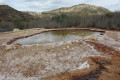
(8) Arrive at Clot Roig. Turn left, then right and cross the footbridge that leads directly to a small lake. This small pool with water containing a lot of iron oxide is traditionally used as an open-air thermal bath for skin conditions and rheumatism.
(9) Retrace your steps and continue to the left.
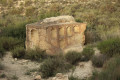
(10) Keep the clearly visible building in sight and cross the Rio Vinalopo on very large stones. The location is superb. Continue and pass in front of the building. Climb the stairs in front of you and, once at the top, follow the path on the left. This path does not appear on maps but it does exist and allows you to easily connect the various large electricity poles. Using these poles as landmarks and passing close to each one, you will be able to follow the path or at least the direction without any problems. If you are unsure at any junctions, piles of stones on the ground will prevent you from going in the wrong direction. You will then arrive at a tarmac road.
(11) Continue straight ahead along this road.
(12) At the bend, leave the paved road and take a small path on the left.
(13) Cross a narrow but safe bridge and, a little further on, cross another narrow bridge.
(14) At the ruins, take the path on the left and follow it uphill until you come to a well-marked path on the left: this is the "Senda Refugios de Canteros" (the path of the shelters for quarry workers).
(15) Pass a quarry (no access). Further on, pass a picnic area with tables and benches. Continue downhill to the right. You will then reach a paved road (CV-8325). Turn right and follow it uphill to return to the car park (S/E).
 Visorando Member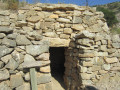
 Easy
Easy 


 Difficult