Country:
 City:
City:


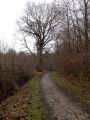
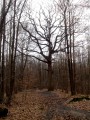
Starting point and access: Saint-Nom-la-Bretèche station – Marly Forest.
- Transilien - Line L, terminus of a section departing from Paris-Saint-Lazare and via La Défense.
Take the only exit, at the front of the train.
Red and yellow markings
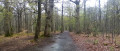
(S/E) At the end of the platform, turn left to cross the level crossing. Follow the road and, shortly after, turn left to cross a small car park. At the end, take the path leading into the forest (posts from an old forest barrier). After a few metres, at a fork in the road, take the left-hand path, the one running alongside the railway line at a distance (wire fencing).
Pass under a small bridge, a remnant of an old railway line. Immediately after the bridge, turn left: the path becomes narrow and winding. At a T-junction (railway bridge on the left), first turn left then right. Cross a stream then climb up through the young trees, heading south-east, ignoring the paths branching off to the left or right.
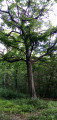
(1) At the crossroads (Étoile Pavée on the map), continue straight ahead, still heading south-east (oak tree bearing plot number 121 and a red and yellow marker). Caution: do not take the wider path on the left, which has a tree also bearing a red and yellow marker.
Head uphill through a forest canopy that is much more open than before. Cross a small path. About fifty metres further on, at a crossroads, take the path on the left, with two fine beech trees on the right-hand side, the first of which bears a faded red and yellow marker. Descend slightly and reach the Étoile d'Actéon (signpost).
(2) Do not continue straight on towards the forest gate, but take a path on the right which starts a few metres to the left of a tree bearing the sign “Étoile d’Actéon”. Cross the D161 road and continue straight ahead along a wide, compacted track (ONF information sign). At the next crossroads, turn left onto the main track. Then cross a small path at the boundary between plots nos. 136 and 135. Walk in an east-northeast direction, then northeast.
No signposting
(3) When you reach a small clearing, let theGRP®® continue straight ahead uphill. Turn sharply right and follow a wide path that runs between two large oak trees. After about a hundred metres, at a junction (plots nos. 140 and 138), turn right and pass a fitness trail on your left. You will soon reach theGR®®1.
Red and white markings
(4) Ignore a fitness trail staircase branching off to the left and continue on theGR®®1. Follow a stream on your right, then turn right to cross it. The path climbs (plot no. 134) and becomes a footpath.
(5) From the Étoile de la Côte (no signpost until point 6), stay on theGR®®, which is the main path, and ignore the paths you encounter at the successive junctions. The D161 road is crossed diagonally to the left and requires caution due to limited visibility. The path continues in a westerly or west-north-westerly direction. It alternates between short ascents and short descents. The climb to reach the junction at the boundary of plots 116, 117, 122 and 123 is particularly steep. You will emerge at a T-junction.
(6) At the junction, turn right onto a wide path heading north-west. Pass a junction with a blue double-sided sign and continue north-west, climbing gently. At the junction with a tarmac road (Route Royale), immediately take the path branching off to the right alongside this road. At the boundary between plots nos. 106 and 107, cross a small road, continue straight ahead and reach the Étoile de Dryade (sign; if necessary, options to shorten the walk, see practical information).
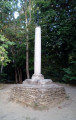
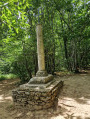
(7) Continue north-west. At a T-junction, with a road about a hundred metres ahead, turn right. Cross a stream. The path bends to the right: the surroundings become increasingly open and you will soon see the Croix Saint-Michel. Walk to the cross.
No signposting
(8) When you reach the foot of the cross and look east towards the esplanade, from where you have a sweeping view, theGR®® continues to the left, due north. Look for a tree to the right ofthe GR®® bearing a red and white cross. Look for a triangle of paths that can be positioned relative to this tree with a cross:
- at the foot of the tree, to its right, a first path heads north-west, first descending then ascending (both slopes are clearly visible);
- this path crosses a second, perpendicular path after about ten to twenty metres;
- a third path branches off diagonally to the right, descending, and quickly joins the perpendicular path.
Take this third path, passing at the foot of two twin trees on the right-hand side; at the junction with the second path, continue to the right. Descend and pass a large oak tree on the right-hand side bearing plot number 108.
At a crossroads, with plot no. 109 opposite on the right, continue straight on, due east. The path continues to descend, passes at the foot of a very large oak tree on the right, first turns left then right, with another very large oak tree on the right, and leads to a T-junction. Then turn right onto a wide path, heading due east, through a well-cleared high forest. The path narrows and leads to a small hillock with a tree marked plot no. 12. You will find the red and yellowGRP®® markings on the other side.
Red and yellow markings
(9) Turn right as you go downhill to follow theGRP®®. You will immediately reach a junction (on a tree, a sign reading “Étoile de la Maison Rouge”). Head slightly diagonally to the right (oak tree with a “Piste cavalière” sign). Cross a stream. Shortly afterwards, at a Fork in the road, take the left-hand path towards the station, which is clearly visible. Note the unobtrusive Maison Rouge Fountain on the left of the path (incorrectly positioned on the map). Continue to the Route des Muses (car park on the right). Turn left to cross the bridge and the railway line, then turn left again to return to the station (S/E).



 Visorando Member

 Very difficult
 Difficult
  Easy
Easy