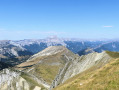
La Croix du Lautaret and the Haut Plateau du Vercors Sud

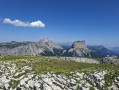
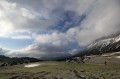
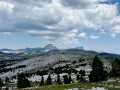
A very enjoyable route on the wild high plateau of southern Vercors. Solitude is guaranteed, except for ibex, marmots and vultures.

There are no marked trails on this hike, only a few topographical landmarks to help you navigate the nearly 16 km. However, orientation is easy, as the view is generally very clear. This hike is excellent practice for off-trail hiking.

See the practical information for some orientation tips.

Details

1296186
Creation:
Last update:
Last review:
  • Walking
    Activity: Walking
  • ↔
    Distance: 20.05 km
  • ◔
    Duration according to the author: 7 hrs 
  • ▲
    Difficulty: Very difficult

  • ⚐
    Back to start: Yes
  • ↗
    Ascent: + 1,183 m
  • ↘
    Descent: - 1,175 m

  • ▲
    Highest point: 1,956 m
  • ▼
    Lowest point: 1,455 m

Photos

Description of the walk

Warning: this hike takes place away from any paths or trails for more than 16km. See the practical information below for details on how to proceed. The description below is highly flexible, as each hiker will choose their own route. This description assumes that you will be setting off with a head torch and therefore chooses the most obvious route up to the plateau.

Park at the Fontaine des Prêtres car park at the end of the D515.

(S/E) From the car park, take the track that leads to the large barn in Vallon de Combau. After 700m, look for a small path on the right that descends into the valley (ignore it for now, you will use it on the way back).

(1) Continue along the track to the Vallon de Combau barn.

(2) At the barn, do not turn right onto the marked paths, but continue in the same north-westerly direction at the bottom of the valley, initially on the right bank of the valley (path). Below the Col du Creuson, the valley rises and a slightly steeper path branches off on the left bank of the valley. Take this path to the pass and temporarily join the main path leading to the Bergerie de Chamousset (east-northeast).

(3) From the unnamed pass separating Drôme from Isère, turn right heading due north to follow the ridge line. A small scree slope on sharp limestone pavement is a nearby alternative route to get there. Follow the ridge generally northwards (traces) until you reach the slopes of Les Fraches. Turn left, still following the ridge, to reach Tête Chevalière due west.

(4) From the summit, continue along the ridge towards a clearly visible group of several cairns (there are four in total, plus a small stone bench in the pine trees). From this secondary summit (1,924 m), locate a cairn to the south on a less grassy summit (sharp limestone pavement).

(5) Follow the peaks of the ridges heading south-southeast towards this cairn. If necessary, climb over any sheep park fences (when there are no flocks, of course).

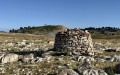
(6) At the cairn on the sharp limestone pavement, descend south towards the Chamousset sheepfold. It is not visible, but a water reservoir can be seen in the same direction, on the opposite side of the valley. Pass the sheepfold and climb up the opposite side of the valley, still heading south, towards a stone shelter and a cairn. Pass the stone shelter (where shepherds store salt for their flocks) and climb up to the hilltop at 1,874 metres.

(7) Two large cairns mark the summit. Locate the first nearby summit to the west, the Tête des Chanaux. Also locate a few intermediate points before following mainly the ridges of the shoulders to head towards this summit.

(8) At the Tête des Chanaux, take note of your bearings and determine the precise direction of south (sun + watch or compass). To avoid getting lost, you must now head due south, or failing that, south-southeast, to be sure to come across the Jardin du Roi sheepfold or the vaguely passable path leading to it. Head south through a maze of sharp limestone pavement and sparse forests of mountain pines (see practical information).

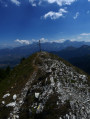
(9) Once you reach the Jardin du Roi sheepfold, turn left, heading due east, to follow the bottom of the valley. Stay in this direction, heading due east, and leave the bottom of the valley as soon as it turns south. Climb up the eastern slope to head towards the peaks in your line of sight. Below the highest peak, the Croix du Lautaret, turn left, heading north, to reach the cross.

(10) At the Croix du Lautaret, look for a rounded grassy dome, dotted with numerous mountain pines, to the east-south-east. Follow the obvious lines of the terrain to climb this small dome overlooking the magnificent Marichaume.

(11) From the summit, locate the gently sloping pass of the Plaine du Tisserand (northeast) and descend towards it.

(12) At the pass, look for the tracks that climb eastwards through the scree below the summit of Ranconnet. Follow these tracks to reach the ridge south-east of the summit. Then turn left, north-west, to reach the summit.

(13) From Ranconnet, follow the ridge to the north-west to "climb" the highest point of the hike, the summit of Montagnette.

(14) From the summit, follow the cairns to the west to descend, and when the slope becomes too steep, veer southwest to find a short passage descending westwards to a well-marked path (cairns). Follow this path north then north-east to go around the shoulder of Montagnette and descend towards Vallon de Combau (alternatively, go via Pas de la Coche a little further down, where the slopes are less steep).

(2) Once at the bottom of the valley, go back through the large barn and follow the carriage road (south-east) until you come to a path leading into a valley to the east.

(1) Descend into this valley, which is a small dry stream leading to the starting point (S/E).

Waypoints

  1. S/E : km 0 - alt. 1,455 m - Parking at the - Fontaine des Prêtres (Treschenu-Creyers)
  2. 1 : km 0.81 - alt. 1,555 m - Trailhead - Carrefour de la circular
  3. 2 : km 1.4 - alt. 1,605 m - Large barn in the Combau Valley
  4. 3 : km 3.38 - alt. 1,801 m - Unnamed pass between Drôme and Isère
  5. 4 : km 5.46 - alt. 1,947 m - Tête Chevalière (1951m)
  6. 5 : km 5.89 - alt. 1,918 m - End of the ridge with 4 cairns and 1 bench
  7. 6 : km 6.58 - alt. 1,890 m - Summit and cairn on sharp limestone pavement
  8. 7 : km 7.58 - alt. 1,871 m - Double cairns above Pré Mouret
  9. 8 : km 9.01 - alt. 1,883 m - Tête des Chanaux (1889m)
  10. 9 : km 11.96 - alt. 1,729 m - Sheepfold in the King's Garden
  11. 10 : km 13.67 - alt. 1,950 m - La Croix du Lautaret (1951m)
  12. 11 : km 14.38 - alt. 1,947 m - Summit overlooking Marichaume
  13. 12 : km 15.12 - alt. 1,862 m - Col de la Plaine du Tisserand (1863m)
  14. 13 : km 16.09 - alt. 1,939 m - Sommet de Ranconnet (1961m)
  15. 14 : km 16.68 - alt. 1,941 m - Sommet de la Montagnette (1972m)
  16. S/E : km 20.05 - alt. 1,456 m - Fontaine des Prêtres car park

Notes

Difficulty: the only difficulty on this hike is finding your way. The terrain is generally easy to moderate (but be careful of sharp limestone pavement, as it is easy to get your leg stuck and break it).

Be careful never to set out in variable weather conditions; fog is absolutely to be avoided.

Orientation: as with any off-trail hike, it is essential to study the map beforehand in order to identify the crossing points. If you have a GPS or the Visorando app, you can store the crossing points or the route.

The art of off-trail hiking lies in identifying these waypoints, visually if possible, or directionally if the terrain is an obstacle. As progress on the terrain may cause you to lose sight of your target points, you should also identify intermediate points from which you are likely to be able to see part of the rest of the route.

Then, simply aim for these points. To make progress easier, the simplest thing to do is to always stay on the ridges (or crests) in order to have the clearest view possible, even if it means climbing a little more.

The most difficult part of this hike is the north-south section connecting Tête des Chanaux to Bergerie du Jardin du Roi. The forest obstructs the view and the slopes naturally cause you to veer too far west. However, the map shows that the main direction of the sharp limestone pavement valleys is downhill from east to west and then south-west. You therefore need to regularly cross a ridge to reach a valley further east.
A few clearings can also be seen from a distance between the pine trees, allowing you to aim correctly towards the south (find a distinctive tree or rock and head towards it). The sun (rather than your watch) is also a good way to find your bearings, as you can feel its warmth on your skin and therefore navigate without constantly having to refer to a map or landmarks.

If you encounter difficulties, do not hesitate to head due east towards the high plateau, where you are sure to have good visibility.

Apart from this more difficult section, the summit of Montagnette is visible from almost anywhere on the plateau, making it easy to find your way using a map.

And of course, you can also rely on technology and the Visorando app to follow this route.

Equipment: no special equipment is required, but walking poles are always useful, especially on sharp limestone pavement.

Water: there are no water sources on this route, apart from the Bergerie du Chamousset spring (but I haven't tested the water).

Dogs: dogs are not allowed on the high plateaus, but as there are many herds in summer, you are likely to encounter patous (shepherd dogs). Never look these dogs in the eye, move away calmly and ignore their barking. In general, keep a good distance (at least 100m) from the herds so as not to disturb the farmers.

This route passes through a protected area, which may be subject to special regulations:

Worth a visit

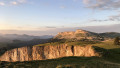
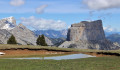
Things to see: wildlife is abundant, especially early in the morning. On my first hike, I saw ibexes fighting at dawn on a vertiginous ridge! Griffon vultures are numerous as soon as the air warms up and facilitates their ascent. Sunrise on Mont-Aiguille is a unique experience, so set off an hour before dawn to enjoy it.

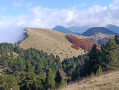
Variations: the time indicated is a little excessive (7 hours should be enough), and if you set off early, a descent into the Marichaume (see photo) is a must. To do this, do not climb back up the slope between (9) and (10), but continue straight on until you reach the pass leading down to this plateau. The exit is opposite, allowing you to climb back up to (12) without difficulty (see map).

From Tête Chevalière (4), it is also easy to take a detour to the beautiful Chevalière mountain pasture, see the Vallée de Combau - Tête Chevalière hike, which only adds 3km to the distance and 100m to the elevation gain (about an hour).

Reviews and comments

4.4 / 5
Based on 3 reviews

Reliability of the description
4.3 / 5
Ease of following the route
4 / 5
Route interest
5 / 5
greggy26
greggy26

Overall rating : 4 / 5

Date of your route : Jul 30, 2022
Reliability of the description : ★★★★☆ Good
Ease of following the route : ★★★☆☆ Average
Route interest : ★★★★★ Very good
Very busy route : No

Quite a long hike in terms of distance, but the gradients are reasonable. Make sure you have a GPS track or a map, as it's not easy to find your way around the plateau.
Very few trails are used, but those that are are well worth it for the beauty of this walk.
There are quite a few marmots and the 360° view from the top of the hill is magnificent (Ecrins, Dévoluy, Grenoble, Grand Veymont, Glandasse, Mont Ventoux).

Machine-translated

relaischichilianne
relaischichilianne
• Edited:

Hello,
Regarding the description: it is not appropriate to suggest climbing over the fences of the sheep pens – care pens or night pens – in Chamousset. It is very easy to bypass the area where the sheepfold, infirmary and pens are located. The pastoral group has been renting the premises for 40 years and is also keen to ensure that shepherds can work in peace when they need to intervene in the pens. The old path ran right past the sheepfold, but it is now advisable to go around it. ***What is marked as a spring in Chamousset has never been used as such, and even herding and guard dogs do not drink from it; this has been the case for ages. (This is somewhat similar to the case of the poisonous fountain.) It is therefore a good idea to remove the mention of the spring so that walkers who are surprised or disappointed by the water hole do not go and ask the shepherds, if they happen to be at the sheepfold. (I frequent the mountain pasture with farmers/shepherds and their neighbours.) Thank you! The same applies to the detour around the Jardin sheepfold (rented by the same farmer from Vaucluse who keeps two flocks).

Machine-translated

SebLau26
SebLau26

Overall rating : 4.3 / 5

Date of your route : Jul 24, 2022
Reliability of the description : ★★★★☆ Good
Ease of following the route : ★★★★☆ Good
Route interest : ★★★★★ Very good
Very busy route : No

A beautiful hike to discover the Combeau valley and the Haut Plateau du Sud... When the panorama unfolds onto Mont Aiguille, the entire Alpine range to the east, and Grand Veymont from a less distinctive side than the west face, it is magnificent!
The orientation can be tricky, but if you follow the trail on the app, apart from a few zigzags, you're unlikely to get lost. Much of the route is off-trail, allowing you to encounter some very friendly wildlife. And don't forget to leave a note in the logbook at the Croix du Lautaret.

Machine-translated

BRUN Mireille
BRUN Mireille

Overall rating : 5 / 5

Date of your route : Jun 18, 2021
Reliability of the description : ★★★★★ Very good
Ease of following the route : ★★★★★ Very good
Route interest : ★★★★★ Very good
Very busy route : No

Ask for directions
The map is useful
Beautiful day. Very rich flora

Machine-translated

Other walks in the area

For more walks, use our search engine .

The GPS track and description are the property of this route's author. Please do not copy them without permission.