Country:

 City:
City:


Start: Pompas church.
(S/E) Walk up through the village of Pompas along Rue du Mès and turn left onto Rue de Sarre. At the end of this street are farmhouses, some of which have retained their original features. The area is a fine example of what the villages of the Brion region must have looked like at the start of the last century.
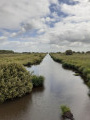
The long path leading up towards Boyac runs alongside a marsh known as the Étang de Sarre, an extension of the Mès marsh which, as its name suggests, was once open water.
(1) At the end of the path, turn left towards Boyac, which you cross straight through. Turn right towards Beausoleil, then left towards Kercrusson.
(2) In the hamlet of Trément, you can see the small fountain preserved ‘in its original state’, after turning right at the crossroads. Then cross the RD33 (take care) and head down the country lane leading to Landieul.
(3) When you reach the junction with the road, take the time to visit the village on your left (see comment below). Then return to the path that branches off to the left after the pond (Chemin du Nescoeur) to reach the Kergoche cross.
(4) Turn right and continue along the track to the Bois de l’Épine. You will then come out onto theGR®39(red and white markings).
(5) Turn right. Continue along thisGR® path to reach the RD33 at La Cour aux Loups.
(6) Once you have crossed the RD33 again (take care), continue straight ahead and turn left onto the Chemin de la Gassun, which will take you to the Vergers du Littoral. Ignore all side paths.
(7) Cross the RD774, then the orchards (private land) following the signposts. Leave the orchard by taking the path that runs alongside the pond.
(8) Go down the steps on the pond’s embankment and reach an ancient Roman road, of which unfortunately no traces remain. A path through a copse takes you to the vicinity of La Baronnerie, leaving theGR®39to your left. At La Baronnerie, turn right towards L’Auvergnac.
(9) Cross the Auvergnac then turn left before Kercouret. Walk alongside the irrigation ponds. For the past 25 years, the water treated by the dairy’s wastewater treatment plant, which you passed earlier, has been used for agricultural irrigation.
(10) Turn right to head back towards Pompas, passing through the wooded moorlands of Belle Vue and La Grée de Poulgan, before passing through the villages of Kerverte de Pompas and Kerhébé.
(11) Once past this last village and a final right-hand bend, you would have the bell tower of Pompas church in your sights, were it to have one. To your left, you once again look out over the Pompas and Mès marshes, the extent of which can be better appreciated in winter, when the trees are bare.
Continue straight on to return to the starting point (S/E).


 Visorando Member
 Easy
Easy 
 Tourist office