Country:

 City:
City:


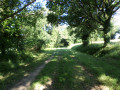
(S/E) With your back to the castle car park, take the path in front of you. After 600 metres, and just before the first bend, take the path that leads off to the left, through the trees and then the Crôlières marsh. This marsh consists of long, narrow plots running parallel to each other, all leading to the central canal and the service road. Although the woods are gradually encroaching on the former pastures, these areas were mowed every year to provide the necessary bedding for the animals of the many farms that shared the marsh. Beyond the canal, these land divisions are repeated.
(1) The path follows two of these plots, which are connected by a footbridge over the canal that drains water towards Brière. After walking for nearly a kilometre through the marsh, you reach the Butte de Guélan, a sort of peninsula between marshes, since on the other side lie the 7,000 hectares of the Grande Brière Mottière, France's second largest freshwater marsh.
(2) At the path, turn right and follow the large curve. At the next crossroads, turn right and continue straight on until you reach the road.
(3) Turn left towards the Kerougas farm, then follow the RD51 for 450 metres until you reach the Fossés Blancs. Traffic can be heavy, but the wide verges allow you to walk safely along this road (provided the grass has been cut, which is done later and later in the season).
(4) When you reach the marsh, cross the road and take the path that runs alongside the road in the opposite direction, then winds its way through woods and reeds. You will come to a section of marsh, where a footbridge allows you to cross the ditch. Continue along the path to a place called "La Tranchée", which marks the northern end of the Canal du Nord. This canal was dug from north to south of La Brière in 1936 to facilitate travel and the exploitation of the marsh. Local peculiarity: the area you are walking through does not have a single owner, as it belongs to the inhabitants of the 21 surrounding municipalities. This undivided property dates back to the 15th century, when the Duke of Brittany (François II, Anne's father) gave it to the people of Brière. This is where the motto "Briéron, maître chez lui" (Briéron, master of his own house) comes from, and you'd be wise not to challenge it!
(5) Retrace your steps for about 300 metres to take the more or less passable path that leads to the port of Mintré. Turn left at the second path to reach the port.
(6) The port of Mintré lines up its barges (flat-bottomed boats typical of the marshes) under its rows of trees. It is a beautiful place to stop, even if the marsh is less visible here than at La Tranchée.
Retrace your steps to pass in front of the Jardins du Marais (worth visiting if you have a little time) and reach Hoscas via the gravel road.
(7) At the road (RD 51), turn left for 200 metres, then right to enter Le Bignon d'Hoscas. This village has a few beautiful thatched cottages and has retained its village structure despite some recent construction. One of these buildings was used as a stopover lodge for a long time, but has now become a private residence.
(8) Go around the last ruined thatched cottage at the far right of the village and take the path on the left, which runs along the edge of the plot. It follows a hedge and leads you to the Bois de l'Abeille. Continue through the woods and turn right onto the path. After 300 metres, you will reach the Hoscas road, which you will follow to the left for about 700 metres. Then turn right onto the road leading to Kerjarno.
(9) At the hamlet, turn left in front of the first house and continue along the rural path that branches off to the left. A passage through the copses, 500 metres after the bend, will take you to the Crolières marsh. Cross the stream on the footbridge and turn right after the meadow. Be careful, as you may encounter animals.
(10) At the path, you will reach the Bois de Mirebelle, which you will go around by turning right before returning to the straight path that will take you back to the Château de Ranrouët (S/E).


 Visorando Member
 Easy
Easy