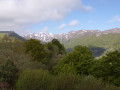
The Cascade de la Biche in the Chaudefour Valley

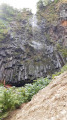
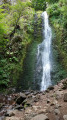
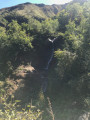
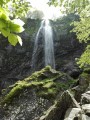
An easy, family-friendly round-trip hike to admire the Cascade de la Biche, some thirty metres high, which flows over a volcanic rock formation formed by the solidification of a lava flow. In a wild and spectacular setting, the water cascades down superb basalt columns.

Starting from the Maison de la Réserve, the route climbs gently up the bottom of the Chaudefour Valley before ascending through the woodland towards the waterfall. This secret and magnificent valley is a listed natural site, enclosed by the steep slopes of a glacial cirque. The path is shaded, sometimes muddy, with a few small streams to cross. To reach the foot of the waterfall, the final section becomes steeper and rockier.

Details

80401439
Creation:
Last update:
Last review:
  • Walking
    Activity: Walking
  • ↔
    Distance: 5.79 km
  • ◔
    Average duration: 2h 20 
  • ▲
    Difficulty: Easy

  • ⚐
    Back to start: Yes
  • ↗
    Ascent: + 245 m
  • ↘
    Descent: - 246 m

  • ▲
    Highest point: 1,385 m
  • ▼
    Lowest point: 1,139 m

Photos

Description of the walk

Above Chambon-sur-Lac, take the Route de la Croix Saint-Robert (D36), between Monneaux and Courbanges. Park in the car park at the Maison de la Réserve Naturelle Nationale de la Vallée de Chaudefour.

(S/E) Follow the nature trail starting from the Nature Reserve Centre, heading south-west, ignoring the paths and tracks branching off to the left or right. Briefly leave the path to take a small track on the left leading to the Cascade de Pérouse (signs on site).

(1) Return to the nature trail and continue left, heading north-west, towards the Chalet Sainte-Anne (a former spa resort project).

(2) Take a short detour to the Source Saint-Anne. Do try the iron-rich, naturally sparkling water. Then cross the Pont Sainte-Anne and reach a junction.

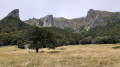
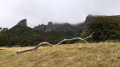
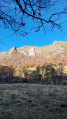
(3) Keep left on the main path, heading south-west for about 600 m until the next junction. You’ll reach the bottom of the valley. You can make out the Dent de la Rancune, the Crète du Coq and the famous Cascade de la Biche (on the left at the first viewpoint).

(4) Take the Sentier de Rondaire - Cascade de la Biche (blue route), heading south, ignoring the paths branching off to the right. Cross the Ruisseau de la Biche via a footbridge, then enter the woodland. Walk to the first hairpin bend.

(5) Continue along the path opposite, still heading south, to climb up towards the waterfall.
Make your way through the forest, crossing the streams and then following the Ruisseau de la Biche. Climb until you can see the waterfall.
You can stop just before the final section of the path (below the waterfall), which is steeper and more rugged!

(6) Climb the steep path, which involves scrambling over a few rocks (some of which may be wet and slippery). Get very close to the waterfall to experience the sensation of being under the water!

Turn back and return via the same route to the car park (S/E).

Waypoints

  1. S/E : km 0 - alt. 1,140 m - Maison de la réserve de la vallée du Chaudefour
  2. 1 : km 0.92 - alt. 1,199 m - Cascade de Pérouse
  3. 2 : km 1.43 - alt. 1,196 m - Source Sainte-Anne
  4. 3 : km 1.56 - alt. 1,204 m - Trail junction - Couze Chambon (rivière) - Affluent de l'Allier
  5. 4 : km 1.97 - alt. 1,233 m - Crossroads in the heart of the valley
  6. 5 : km 2.25 - alt. 1,243 m - Crossroads at the hairpin bend
  7. 6 : km 3 - alt. 1,385 m - Cascade de la Biche
  8. S/E : km 5.79 - alt. 1,139 m - Maison de la réserve de la vallée du Chaudefour

Notes

Caution: the final section of the path beneath the waterfall is very steep! Good physical fitness and sturdy footwear are essential. You can get very close to the fall (it feels as though you’re under the water), but absolute caution is required for beginners or young children. It is also possible to admire the waterfall from just before it.

The car park is subject to a charge from1 May to 30 September. The Chaudefour Valley is a protected area: mountain biking, foraging and camping are prohibited. Dogs are not permitted, even on a lead. Please stay on the marked paths.

There are no drinking water points along the route, other than the Source Sainte-Anne (iron-rich water, not recommended in large quantities). Toilets are available at the Maison de la Réserve and there is a picnic table near the car park.
Restaurants, cafés and accommodation (lodges, hotels and campsites) in Chambon-sur-Lac and Le Mont-Dore.


Option to continue on to the Cascade du Moine via the “valley floor” path (marked in purple) from the “4 ” trail junction.

This route passes through a protected area, which may be subject to special regulations:

Worth a visit

The Pérouse waterfall is small compared to the Biche waterfall, but has a greater flow. It is quite remarkable in winter when it freezes.

The Source Sainte-Anne, whose springs emerge just before the bridge overlooking the glacial cirque of the Chaudefour Valley, is a “cold, tangy and ferruginous spring, with water that is sharp, astringent and fizzy”, as Dr Borieux noted in 1884. In the early 20th century, there was an attempt to develop it as a spa. It was recommended for treating stomach ailments and for breaking the hold of certain evil spells. Work began on several buildings: hotels, villas, a bridge over the Couze... This project was halted in 1914. It is possible to drink this water, but in moderation! Its composition can cause stomach upset. A sparkling water with a slightly salty taste, it is rich in carbon dioxide and sulphates. Its average annual surface temperature is 7°C.

The Couze de Chaudefour rises at the Puy de Sancy (on the ridges overlooking the Chaudefour valley) and flows into the Allier near the village of Coudes. Downstream of Lake Chambon, it is known as the Couze Chambon. The latter offers numerous waterfalls to hikers following its course. Its main tributary is the Couze du Moulin. It is worth noting that “Couze” is the local pre-Celtic generic term generally used to refer to mountain streams.

The Chaudefour Glacial Cirque: The volcanic massif of the Monts Dore rests on a granite base that collapsed some 2.5 million years ago. Around this gigantic, almost circular “collapsed basin”, known as a caldera, ejecta accumulated: the first was volcanic ash (cinérites), followed by trachyandesitic flows, all of which formed a stratovolcano, the Sancy. Later, glaciers dismantled this vast structure, carving out the Chaudefour valley.
Its history is written in its landscape: the ancient dome-shaped volcanoes composed of trachyandesite form the rounded hills. The cliffs correspond to the edges of the flows, such as the cliffs beneath the Pic de Cacadogne and the Cascade de la Biche. The igneous rocks, stripped of volcanic ash by erosion, stand as jagged lava pyramids like bell towers, lending a wild aspect to the landscape.
The valley covers a total of 820 hectares, of which the glacial cirque—classified as a nature reserve—covers more than a quarter of this area managed by the ONF.

Standing 90 m high, the Dent de la Rancune dominates the heart of the Chaudefour Valley, alongside the Crête de Coq and the Cornes du Diable (between the two). This giant’s ‘tooth’ rises to an altitude of 1,493 m. It is an iconic and extremely challenging climbing site. The Crête de Coq is easier to access for those wishing to experience the first joys of climbing. Of volcanic origin, these lava veins, known as dykes, were exposed by glacial erosion 330,000 years ago. These ancient lava flows are composed of very hard igneous rock. Glacial erosion cleared away the looser rock, creating an inverted relief.

The Cascade de la Biche is around thirty metres high, rivalling the Grande Cascade at Mont-Dore. It flows over a volcanic base formed by the solidification of a lava flow. The black rock, dorite, formed columnar joints as it cooled. At the base of the waterfall, another layer of rock, cinerite, is composed of accumulated volcanic ash. Water erosion of this softer rock has created a hollow at the base of the waterfall.

At the entrance to the site, the Maison de la Réserve displays models and images of animals and plants, and traces the history of the exploitation of the Sainte-Anne spring. It also offers guided walks to discover, with a guide, the unique features of this iconic site in the Sancy. Open from May to August.

The Cascade du Moine is situated below and to the left of the path. As its name suggests, it is located near the Couloir du Moine. This waterfall does not drop from a great height. Closely linked to the melting of snow and snowfields, it is characterised by a low flow, generally from June onwards.

Other walks in the area

For more walks, use our search engine .

The GPS track and description are the property of this route's author. Please do not copy them without permission.