Country:
 City:
City:


Park in the car park at the entrance to the town. Unfortunately, like many car parks in Honfleur, this one is pay-and-display. It is located on the site of a former basin.
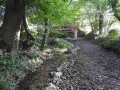
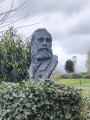
(S/E) Cross the roundabout and enter the park near the wash house. Walk up to the top of the park, passing the statue.
(1) Near the second wash house, you will arrive at Place Saint Léonard with its 17th-century church. The interior is magnificent.
Go back down the street opposite the bell tower, Rue Cachin, which leads to Rue de la République. Turn left. Take the street just before the Carrefour Market, Chemin du Grand Bouloir, which leads to Rue Saint-Nicol. Turn right.
This street changes name and becomes Rue de la Bavole. It crosses Rue Eugène Boudin. Take Rue Eugène Boudin to the left (uphill). This street leads to a triangular square with an old well on the right. Continue uphill, keeping to the left.
Then take the Mont-Joli ramp, which starts on the right about a hundred metres further on. This climb is quite steep but very passable.
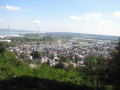
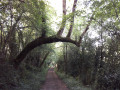
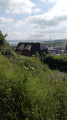
(2) When you reach Mont Joli, you will have an impressive view of the town. Then take the tree-lined road to the Notre-Dame de Grâce chapel.
(3) Opposite the chapel, under the trees, is another small open-air chapel, the remains of an older chapel. The grassy area near the chapels offers a magnificent view of the Seine estuary.
Head back down towards the town via Rue Charrière de Grâce, then Rue Lucie Delarue Madrus. At the Hotel La Maison de Lucie, turn left onto Rue Albert 1er, which leads to Rue de l'Homme de Bois, near the Eugène Boudin Museum, where you can see some magnificent paintings by this Honfleur artist.
(4) Take Rue de l'Homme de Bois to the left, then the next street to the right, Rue du Trou Miard, which slopes downwards. At the roundabout, turn left to reach the old Honfleur lighthouse. At the beginning of the 20th century, the sea used to lap against its walls.
Opposite the lighthouse, take the path towards Naturospace, which you will go around on the left. At the end of the car park, take the footpath that leads to the Jardin des Personnalités. Cross the garden to reach the pier.
(5) Turn right onto the dyke to admire the estuary, then the lock that regulates the entrance to the port.
The pier arrives in town via the passenger quay, which was the embarkation point for Le Havre before the Tancarville Bridge was built.
Do not head towards the Lieutenance, but turn right onto Place Hamelin. On the right-hand side of this square, you will see the house where Alphonse Allais was born.
At the end of this square, a street continues straight ahead, Rue Haute, which was the lowest street in the town, and, on the left, Rue de l'Homme de Bois. Take this street.
At the crossroads with the next street on the left, take this street, Rue des Lingots. You will arrive at Place Sainte-Catherine with its characteristic wooden church.
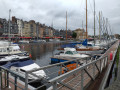
(6) Then cross the square and turn right onto Place Pierre Berthelot to go down Rue du Dauphin. Take the first left to reach the bottom of Rue de la République. You will have a complete view of the Vieux Bassin.
Walk along the Vieux Bassin on the left until you reach the Lieutenance (remains of the old city walls). It was from here that Samuel de Champlain left France to found Quebec City.
(7) On the right, take the bridge over the entrance to the Vieux Bassin and continue along the quays. Take the second street on the right after the town hall, Rue de la Ville.
On the right side of the square is the Grenier à Sel. Return to the back of the square, towards the Vieux Bassin. Once you reach it, turn left.
You will pass in front of the Church of Saint-Étienne, which has been converted into the Maritime Museum. This church is bordered by Rue de la Prison, which has retained its old-world charm.
Once you reach Cours Montpensier, turn left to return to the car park (S/E).


 Visorando Member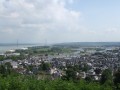
 Easy
Easy