Country:

 City:
City:


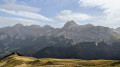
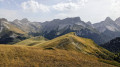
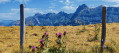
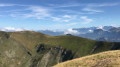
On the road from Mas Bourget to Les Amayères, park after the second right-hand bend and before you reach Les Amayères, on a lay-by on the left-hand side of the road (see also § Practical information).
(S/E) Continue along the road towards Les Amayères, then take the path on the right-hand side of the hillside, which descends gently through the fields of Mas Bourget before reaching the first house in this hamlet.
At this point, stay away from the houses on your right and gently climb up the path heading east towards the Combe de Vallauris. Continue for about 400 metres (1,118 metres).
(1) At the end of a meadow, when the path forks, take the left branch, which turns into a trail and overlooks the Torrent du Merdari, along the Gorges de Vallauris. At the entrance to the gorges, note a cave on the left.
Keep going in the same direction. Although the path was laid out by our ancestors, with a beautiful foundation of earthworks and retaining walls, it tends to become overgrown, which sometimes makes it a little difficult to see. Given the terrain, there is very little chance of straying from it.
Further on, walk along the wire fence of a small field overlooking a forest track below, on your right.
(2) Just before reaching it, turn sharply left onto the path that enters the national forest. Follow the marked path through the pine trees. We have taken care to map the twists and turns in this area to make it easier for hikers to recognise the route.
Climb 400 metres towards the track, which you will reach at an altitude of 1,350 metres. Follow this track to the left. At an altitude of 1,400 metres, rejoin the winding path.
At the top, it joins an almost horizontal patrol path, which you should follow westwards.
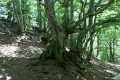
(3) At the pass, the trail heads north into a dark, dense spruce forest, in stark contrast to the light forest on the way up. Pass a second pass.
(4) Continue along the trail that leads to the open Col de Chausseiras, which marks the entrance to the mountain pastures.
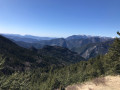
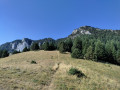
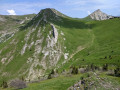
(5) The climb to Pointe de Feuillette follows the ridge that separates the Vallauris ravine on the right from the Amayères ravine on the left. As is often the case in such situations, it is advisable to zigzag up the grassy slope rather than taking the steepest route. Make sure you always stay on the Amayères ravine side to reach the summit in about an hour.
(6) Feuillette summit. First head in a north-easterly direction. After about 300 metres, you will reach a second small summit at an altitude of 1,855 metres on the Crête de la Montagne de France, which marks the boundary between the northern Alps on the Drac-Isère side and the southern Alps on the Buech-Durance side.
Turn left, then follow the fence, first on the Isère side, then on the Drôme side, until you reach the Col de Jajène after a steep descent.
(The fence separating the sheep pastures on the south-facing slope from the cattle pastures on the north-facing slope must be respected by using the small passages provided for this purpose)
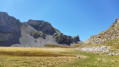
(7) Col de Jajène. Leave the ridge line and descend to the left, sometimes on the right bank, sometimes on the left bank of the Jajène ravine. Following the existing markings, the path naturally leads you to a beautiful alpine landscape at the Ruisseau de Tranchemule
(8) Descend the path that branches off to the left and follow the stream, where a series of dams indicate that violent torrential episodes can occur.
At the confluence with the Feuillette stream, the path joins a good forest track, which now runs alongside the Amayères stream (in hot weather, there are sheltered spots where you can dip your feet in the cold, clear water). The stream accompanies walkers to the hamlet of Les Amayères; the initially open landscape gradually narrows to form gorges. The hamlet, with its mountain houses, is crossed between two tall boxwood hedges, quickly reaching the starting point of the hike (S/E).




 Visorando Member
 Moderate
 Association / Club / Walk leader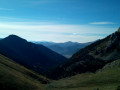
 Easy
Easy