Country:
 City:
City:


Car park near the Tréboul functional rehabilitation centre, where the railway station used to be.
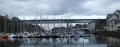
(S/E) With your back to the car park, walk along the esplanade beside the building until you reach a roundabout. Turn left towards the Grand Pont bridge. Don't hesitate to walk a few steps forward (without crossing the bridge) to get a better view.
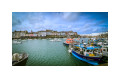
Take the stairs on the left down to the ria, continue along the street and then follow the path along Port Rhu to the Jean Marin footbridge.
PR® yellow markings (not very visible)
(1) Cross the footbridge and turn right at the end to walk along the harbour museum's wet dock and the marina. Pass the Place de l'Enfer on your left, where the museum is located, go under the Grand Pont and continue along the promenade along Boulevard du Général De Gaulle. When you reach a street, continue straight ahead, keeping to the right, and pass a petrol station just before a roundabout.
MarkingsGR®®34G (white and red).
(2) Take the small staircase down to the Yves Caroff skate park, named after the first mayor of Greater Douarnenez (sign at the exit), and you will come out onto Rue Étienne Kernous, which you take to the left for a few metres.
No markings
(3) Cross this street at the two-stage pedestrian crossing and take Rue Saint-Jacques uphill. Ignore the streets on the right and left to reach a three-way junction near a glass container. Turn right into Rue de Gradlon and follow it straight ahead until you reach a dead end sign.
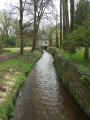
(4) Continue along a wide tree-lined path. Pass a beautiful house on the left and continue along the path, which eventually joins the Ty an Taro stream that used to power the old Kerguesten mill hidden at the bottom of the valley. You will come to a bridge.
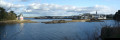
(5) Cross the stream and the leat of the old mill, go around it on the right and continue along an uphill grassy path. Pass a house on your left and go straight up a wide, unpaved road lined with oak trees. This is the access road to this house. You will come to a water catchment on your right, with a beautiful view of Douarnenez.
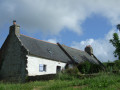
(6) Turn left, then right at the first street you come to. Walk up this street, which offers glimpses of the town of Douarnenez between the houses. Notice, almost at the top of the street, an old windmill on your left, which has been converted into a house. Join Rue Guillaume Le Brun, which ends at a stop sign on the D143.
(7) Cross this relatively busy road with caution and turn left onto Route de Pont Toullec. At the first crossroads, turn right onto Route Cloarec and follow this road to the next fork.
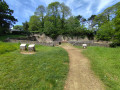
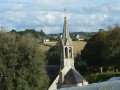
(8) Turn right onto the uphill Chemin de Kerem, ignore a dead end on the left and note a small calvary on the edge of a grove of fir trees. Continue along the sunken lane which descends and runs alongside a primary school on your right. You will come out onto Rue Pierre Belbéoch, named after the first mayor of Pouldavid-sur-Mer in 1919. Follow it to the left, walk past the cemetery and arrive at the esplanade where the Church of Saint-Jacques is located (small garden with picnic table on the left).
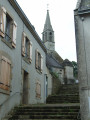
(9) Walk around the small church (view of the street below), take the wide stone staircase on the right to reach Rue Eugène Lucas, which you take on the left. At the three-way junction where the Kreisker bar (town centre in Breton) is located, turn left into Rue Jean Moreau.
(10) Look carefully between the houses on the left for Rue de la Liberté, which begins with a staircase followed by a narrow alley before becoming a street. Start this beautiful climb, which once again offers beautiful views of Douarnenez and the Pouldavid district. At the bottom of the same street, turn left onto Rue Bernard Ansquer and you will arrive at Rue de la République (D765).
Cross this relatively busy road with caution and take the street opposite (signposted "No coaches or lorries" 100 m ahead).
(11) At letterbox no. 6, look for a wooden gate on the right to take a pedestrian passageway. Ignore the first street and take the next one, Rue de Pont Dinou, which crosses the industrial estate.
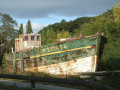
(12) Cross Boulevard Jean Moulin at the pedestrian crossing and take the small staircase that leads to the edge of the ria. Go around an old Camaret lobster boat (registered CM for the name of the maritime district) and follow the path on the left that runs along the ria to reach the Voie Verte. Climb a small hill and take the path on the left.
Follow it to the street, which you cross at the pedestrian crossing, and continue to the right, following the signs for Tréboul Voie Verte.
(13) Before the roundabout, turn left to go behind the Tréboul functional rehabilitation centre. Note the old water tank that was used to supply steam locomotives. At the end of the building, you will find the car park on the right (S/E).

 Visorando Member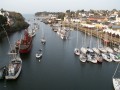

 Moderate