Country:

 City:
City:


Park in Rue de Penlys, opposite Crédit Mutuel, at La Chapelle des Marais.
(S/E) Cross Boulevard de la Gare and turn right into Rue des Écluses. Continue to Rue de la Brière and turn left until you reach the roundabout. Go round it to reach Route de Saint-Joachim, then turn right to access the sports grounds.
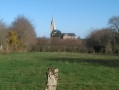
(1) Enter the grounds on the right through the gate, walk alongside the buildings, then turn left until you reach the centre line. Follow the path to the right as it enters the woods, then turn left onto the path leading into the first marsh. Head towards La Gagnerie de Ros (pronounced ‘rô’). At the crossroads, continue left along the lovely tree-lined path that skirts the farmland. The mill tower still stands proudly amidst the crops. You’ll reach the D51 road.
(2) Turn left, then, on the same side, take the path that also heads left. Follow the path to the next crossroads, and turn right to return to the RD51. Cross it and enter the village of Mayun. At the next crossroads, turn left onto Rue du Fossé Blanc and rejoin the departmental road. Walk a few metres to the right.
(3) Turn right onto the path that goes round the Gagnerie de Lèse-Mayen. Follow the outline of the island, dominated by the silhouette of the mill. Return to the village and turn left onto Rue de la D’bas, then onto Rue de Colly, which continues on to the RD33.
(4) Cross over to take the path slightly to the left on the other side. It winds around the Gagnerie de Colly, on the boundary between marshland and fields. Three-quarters of the way round the island, turn left, then left again, heading into the marsh. This section was consolidated in the early 1970s. The layout is more regular and the paths are straight. However, the route retains its timeless feel and the landscape offers quite sweeping views where the tree cover is sparse.
(5) At the crossroads, turn right to head back towards the village of La Chapelle-des-Marais. At the footbridge, turn right, then left as you reach the houses. You’ll come out onto the street next to the ‘Les Fifendes’ school. This name refers to the common reed, a plant found throughout the area you’re passing through. Turn left, then right.
(6) At the bend, turn left onto the old path which leads into a recently developed residential area. Le Clos du Moulin is an example of recent urban development that has successfully made use of the natural heritage (paths, large trees) and built heritage (mill) whilst significantly increasing housing density.
At the crossroads, turn left onto Chemin du Clos du Moulin. When this path turns sharply right, continue straight on along Chemin de la Vaie Anne. This wide track leads deep into the heart of the marsh. Taking two right turns, you reach the rear of the houses on Rue du Gué, to the sound of the quacking ducks and geese that inhabit the gardens.
(7) Turn right onto Rue du Gué, then take the first small road on the left, which continues as a path, until you reach La Surbinais. Follow this road for two hundred metres, then turn right onto Rue des Ecobuts. A path lies opposite on the other side of the road you’ve just crossed: follow it and turn left at the first houses, after passing the leather workshop overseen by the Galvandais mill.
(8) At the junction of two paths, turn right and continue to Rue de la Saulzaie (RD50). At the crossroads, head back towards the village and take the path leading left towards Trélan. The woodland through which it winds borders the Gagnerie de la Jô. This, in turn, borders the marsh separating the Chapelle des Marais from Sainte-Reine de Bretagne.
(9) To return, turn right onto Rue de Trélan, then left onto Rue des Trélonnées. Continue to the Penlys cross, opposite the care home. Turn right to return to the starting point, the car park on Rue de Penlys (S/E).

 Visorando Member
 Easy
Easy