(S/E) Place Gutenberg
Area of approximately 7,400 m². The square is situated on the site of a former fortification: Lunette 5. This had an underground passageway connecting it to Fort Montessuy and another access point via a drawbridge located within the defensive quarter.
Around 1954, all the military land within the fortified complex was sold off and became Place Gutenberg.
- Redeveloped by the City as a square and garden, and inaugurated in 2013.
- A finalist in the ‘Victoires du Paysage 2016’ awards in the urban public space category and winner of the ‘Paysages en Projet Rhône et Métropole de Lyon’ prize in the urban development category.
- The ‘Turba Choux’ lane is named after two local children, Jean Turba and Bernadette Choux, who were murdered by the Germans in 1944.
Affordable Housing
The HBM (low-cost housing), built between 1934 and 1942, comprised around 290 flats considered modern for the time, although they were not fitted with en-suite bathrooms – though a notable improvement was that each flat had a toilet. It was not uncommon to find that some flats were occupied by six or eight people, including four to six children.
Although originally reserved for civil servants, the HBM flats also housed other working-class families. This green space, built on the edge of a vast military site, was a real breath of fresh air for everyone, compared to other housing estates in the suburbs of Lyon.
Shopkeepers gradually set up shop there. The various social classes lived in harmony (the bourgeoisie, horticulturalists and market gardeners, craftsmen, the middle classes, workers and civil servants…).
The East Block
The urban regeneration project, which aims to increase the supply of housing and retail outlets, is continuing with the East Block. The buildings were demolished following a lengthy period of clearance and asbestos removal.
- was designed in the spirit of a ‘garden city’, with a pedestrian link of approximately 600 m² between Rue du Professeur Roux and Rue Paul Painlevé.
(1) The Casemate
The Montessuy Casemate forms part of the defensive belt built to protect Lyon in the19th century. It linked the forts of Caluire and Montessuy.
After falling into disuse, it served successively as an air-raid shelter during theSecond World War and then as a mushroom farm in the 1960s.
Under an agreement, the city has entrusted the Ocra (“Organisation for the Knowledge and Restoration of Underground Structures”), run by enthusiasts, with organising visits and showcasing these tunnels. (This same association also manages Fort de Vaise.) It can be visited, but only in small groups and by booking in advance on set dates, such as during Heritage Days.
The West Block, inaugurated on 24 September 2021
- welcomes residents to 220 homes built within a natural setting.
- allows the residents of Calais-sur-Marne to enjoy over 4,500 m² of green spaces and walkways. Nearly 550 homes, available for rent or purchase, along with new services and shops, make up this new-generation garden city.
- A tree-lined terrace along the former Rue Branly, with views of the horizon, encourages cycling and walking; it has been named the Esplanade Jaques Chirac. The buildings themselves are flanked by flower-filled gardens and wooded edges. This is complemented by the remarkable enhancement of the Fonton de la Casemate.
(2) Fort de Montessuy
Built between 1831 and 1836 to protect the population against potential invasions.
(-> Trivia: In Caluire, two defence zones were established, one known as the ‘enceinte de la Croix Rousse’, on which Fort de Caluire was built between 1831 and 1843 (now demolished to make way for the Stade Henri Cochet), the other known as the “Montessuy curtain wall”, where Fort de Montessuy was built between 1831 and 1836).
Its underground tunnels were designed for defensive purposes but were ultimately never used as such; as warfare techniques had evolved, the fortifications were no longer adequate to protect Lyon from distant bombardments. This is why, after theSecond World War, the Caluire-Montessuy defence zone served no further purpose, except as a manoeuvres ground, whilst the buildings were used as barracks.
- Fortifications built of exposed cut stone bonded with lime mortar + vaulted ceiling.
- Acquired by the local council in 1972.
- Includes a shooting range (reserved for training exercises for municipal and national police officers and ASCTIR members).
- The area outside the fort is used by boules players.
A call for proposals centred on a programme promoting social interaction, culture and leisure was launched by the town in July 2022, with the aim of offering tailored and innovative solutions and raising the profile of Fort de Montessuy. It is currently undergoing renovation and will feature a restaurant, an open-air café and a programme of cultural events.
The Market
Allée du Parc de la Jeunesse, Thursdays and Saturdays from 8.00 am to 12.30 pm on market days. Around thirty traders and producers offer a varied range of quality produce. Events take place throughout the year, such as the quarterly sessions held on the Sunday before the change of season, organised by staff from the Parks and Gardens Department. They offer advice and answer questions from residents who enjoy gardening. The next session is on 18 March.
The municipal allotment gardens: a breathtaking view
The allotment gardens in the Montessuy neighbourhood, established in 1930.
There are 22 allotments covering an area of 6,000 m². Due to the steep slope, the allotments are laid out in terraces. The average size of an allotment is around 200 m². The association’s rules stipulate that each allotment holder must undertake to maintain their plot to a high standard, failing which they risk having it withdrawn.
Collective work takes place in spring and autumn to maintain the communal areas.
The land is council-owned. It is situated on the upper slopes overlooking the Saint-Clair neighbourhood, with breathtaking views of Lyon and the Parc de la Tête d’Or. On a clear day, you can just make out the Alps in the distance.
(3) The Belvédère
Place Laurent Bonnevay.
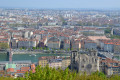
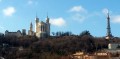
Hidden away, unexpected, little-known… and yet Place Laurent Bonnevay is well worth a visit! It offers one of the city’s most beautiful panoramic views, with a 180° vista over the rooftops, the treasures and the beauty of Lyon.
In the past, allotments stretched all the way to this square.
The René Gagès housing estate
The Montessuy housing estate, predominantly residential, is characterised by a strong sense of uniformity -> designed by the Atelier René Gagès from 1967 onwards. It constitutes a highly distinctive housing development, marked by the creation of tiered belvederes, the preservation of views, pedestrian walkways, and the interplay between the buildings and the greenery.
Completed in 1972, the housing estate was, at the time, the most modern residential neighbourhood in Caluire-et-Cuire and one of the most remarkable in the Lyon metropolitan area.
- René Gagès (1921–2008), an architect who designed several infrastructure projects in Lyon between the 1950s and 1980s, such as the Perrache transport interchange.
The Swimming Pool
- The swimming pool was fully restored in 2008. The complex project was spearheaded by Isabelle Jouffroy-Genety, Deputy Councillor for Sport, who passed away just a few days before the opening ceremony. In her honour, the town council decided to name the swimming pool after her.
- Approximately 180,000 visitors.
- Open 7 days a week, 334 days a year -> i.e. 3,750 hours a year.
- 42 supervised sports sessions (aqua aerobics, aqua cycling, aquaphobia, baby splash, water play area, diving, themed evenings, etc.)
- 1 sports pool, 1 leisure pool, 1 paddling pool, 1 water slide, 2 saunas, 1 hammam + a café area
A complex set of technical installations, unknown to the public (which were the subject of a unique tour organised by the City in 2019), ensures the centre runs smoothly
- Over the past 10 years, water consumption has been reduced by a factor of 3.5 – from 27,000 m³ to 7,500 m³ – thanks to the reorganisation and optimisation of maintenance operations (filters, the addition of a decoloriser, automatic chlorine level control, etc.)
- a green roof weighing 289 tonnes
- a 63 m³ tank for rainwater harvesting (for watering lawns)
- an energy-recovery wheel to recover part of the heated air
- 70 m² of photovoltaic panels for electricity generation
- 200 m² of solar panels for producing hot water for sanitary facilities and swimming pools
- a unique filtration system (5 sand filters)
- The connection of the municipal swimming pool to the district heating network (RCU) in 2022 will help to reduce energy bills and maintain the water temperature in the pools.
(4) The Rose Garden
An integral part of the René Gagès complex, the rose garden features around a hundred varieties of roses.
Together with the Saint-Clair rose garden, they remain key assets in retaining the four flowers of the ‘Villages et Villes Fleuris’ award.
Fun fact: when it was built in the early 1970s, local residents protested against this eyesore. They gathered to express their anger, armed with tools to tear it down.
The demolition team that arrived on site realised their mistake when they saw the climbing roses clinging to the structure and in full bloom.
The team turned back, and the Rose Garden is still thriving.”
It was completely renovated and repainted in 2018 by the Parks and Gardens Department, which also replanted 104 rose bushes.
(5) Le Carré Montessuy
The City Council has decided to plan ahead for the retirement of certain healthcare professionals within its area. Whilst the majority of young GPs (61 per cent at the start of 2019) choose to set up practice in shared premises, to pool the costs of premises, administration and management, the council intends to encourage the establishment of medical centres in the various neighbourhoods of Caluire and Cuire.
At Carré Montessuy, the medical centre is home to eight healthcare professionals, spread across the various practices: four general practitioners, one osteopath, one chiropodist, one dietitian and one hypnotherapist.
With a view to expanding its healthcare provision, the town has entered into negotiations with developers to plan for medical centres on the ground floors of other buildings.



 Country:
 City:


 Visorando Member
 Moderate

 Local authority