Discover the battlefield of Woerth-Froeschwiller

A route to discover the battlefield of Woerth-Froeschwiller from 6-8 August 1870, punctuated by monuments erected in memory of the combatants, but also by viewpoints.
It crosses fields, orchards and forests, as well as Froeschwiller, Elsasshaussen and Woerth.

Details

4250727
Creation:
Last update:
Last review:
  • Walking
    Activity: Walking
  • ↔
    Distance: 9.19 km
  • ◔
    Average duration: 2h 55 
  • ▲
    Difficulty: Easy

  • ⚐
    Back to start: Yes
  • ↗
    Ascent: + 98 m
  • ↘
    Descent: - 98 m

  • ▲
    Highest point: 256 m
  • ▼
    Lowest point: 165 m
  • ⚐ Country: France
  • ⚐ District: Wœrth (67360)
  • ⚑
    Start/End: N 48.935233° / E 7.745868°
  • ❏
    IGN map(s): Ref. 3814ET
  • Hour-by-hour weather

Photos

Description of the walk

Park in the Rue de la Gare car park near the old railway station. Coming from Morsbronn-les-Bains (D27 road), at the roundabout at the entrance to the town, continue straight ahead and take the first street on the right.

(S/E) Head towards the town by turning right along the cycle path next to the car park. The path leaves the car park and continues towards the houses and vegetable gardens on your right. When you reach the houses, continue to the right along the cycle path that leads to the bridge over the Sauer river. Take the street opposite, with the school on your right, and you will arrive at Route de Soultz near a crucifix. Cross at the pedestrian crossing and enter through the gate to access the castle (Woerth Town Hall) by crossing the park.

(1) Take the opportunity to visit the Museum of the Battle of 6 August 1870, which presents the course of the Battle of Woerth-Froeschwiller, better known as the "Battle of Reichshoffen". Leave the castle courtyard and turn right onto Rue du Moulin. After about 50 metres, take the first street on the right to admire the rear of the castle and the old cellar on your left (10 Rue du Moulin).

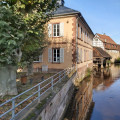
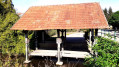
Retrace your steps and turn right again until you reach the end of the street. You will come to a small passageway on the left where you can cross the Sauer river and reach Rue de la Monnaie. Turn left to reach Grand'Rue, continue left for about 50 metres, and you will find the wash house on your left.

(2) Continue along Grand'Rue until you reach the Greco-Gallo-Roman monument on your left. Cross the road at the pedestrian crossing and turn right: before that, you can walk to the bridge to enjoy the beautiful view of the wash house.

Cross the road again at the first crossing, ignore the cul-de-sac opposite and continue along the odd-numbered side of Grand'Rue until you reach the Protestant Church. Take Rue de l'Église on the right.

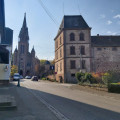
(3) Stop halfway in front of the Catholic Church on the left: it has a magnificent multicoloured roof. Continue to Grand'Rue, turn left at the junction with the D28 road and turn left again at the Bavarian monument.

(4) Cross the road at the pedestrian crossing and take a closer look at the monument. Take the pedestrian crossing in front of the monument. Leave the Calvary on your right and turn left to go around the house to access the cycle path behind it. Turn right towards Lembach along Rue des Turcos, and continue north until you reach the exit of the town at the stairs, after passing the police station and then the factory building on your left.

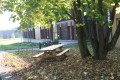
(5) Climb the steps, cross the road and take the path on the right that runs alongside the building. After the picnic tables, climb the stairs on the left that lead to the Turcos trail, named after the riflemen from Algeria, then a French colony, who took part in the fighting. You can learn more about the battle and its consequences for Alsace and Moselle along this memorial trail thanks to the information panels.

(6) Turn right, take a closer look at the two monuments in memory of the soldiers of Lower Silesia, then retrace your steps to continue along the path. Enter the forest; on your right is a monument in memory of French soldiers who died during the battle. The route then joins a forest path, which you should follow straight ahead.

(7) Pass the remains of the "Maison des Turcos" and turn left at the next intersection. Stay on the forest path until you reach Froeschwiller.
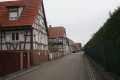
Enter Froeschwiller via Rue de Liebfrauenthal and stay on this street. Pass a crucifix on your right, continue straight ahead until you reach Rue Principale (D28) and turn left. Don't forget to admire the many half-timbered houses.

(8) Pass in front of Dürckheim Castle (private) and the Church of Peace. It houses the only organ in Alsace made by the Bavarian organ builder Steinmeier.
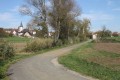
Continue along Rue Principale and, after the Town Hall, turn right onto Rue d'Elsasshausen. Follow the small tarmac road south towards Elsasshausen - Woerth; it is dotted with monuments, graves and information panels about the battle of 6 August 1870.
When you reach a crossroads (elevation 245), ignore the paths on the right, take the left turn and continue towards Woerth. Cross the hamlet of Elsasshaussen and, a few hundred metres further on, you will come to an imposing belvedere tower.

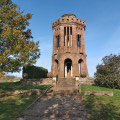
(9) Climb up to the Vosges pink sandstone belvedere and enjoy the panoramic view of the surrounding area and the battlefields of 6 August 1870.
Return to the Route de Woerth for about 200 metres, then take the first path on the right, which leads to the rear of the French monuments commemorating 6 August 1870. Take the path on your left to access the various monuments and graves, ending at the large column.

(10) Go around it and go down the steps that lead to the Route de Woerth. Turn right, enter Woerth via the Rue d'Elsasshausen and, at the left-hand bend, go down the steps on the right to reach the Rue du Cerf and then the Route de Haguenau.

Turn right and walk about 30 metres, cross at the pedestrian crossing and, a few dozen metres further on, take the passage on the left that leads to Rue de la Gare. Turn right to reach the car park (S/E).

Waypoints

  1. S/E : km 0 - alt. 168 m - Parking lot of the old railway station. Towards the bridge of the - Sauer (rivière)
  2. 1 : km 0.7 - alt. 167 m - Museum of the Battle of 6 August 1870 - Château - Musée de Wœrth et son Parc
  3. 2 : km 1.03 - alt. 166 m - Woerth wash house
  4. 3 : km 1.33 - alt. 167 m - Église Saint-Laurent (Woerth)
  5. 4 : km 1.64 - alt. 170 m - Bavarian monument
  6. 5 : km 2.51 - alt. 172 m - Stairs leading to the start of the Turcos trail
  7. 6 : km 2.84 - alt. 204 m - Memorial to the soldiers of Lower Silesia
  8. 7 : km 3.71 - alt. 220 m - Ruins of the Maison des Turcos
  9. 8 : km 5.45 - alt. 253 m - Dürckheim Castle and the Church of Peace
  10. 9 : km 7.99 - alt. 230 m - Elsashaussen viewpoint
  11. 10 : km 8.35 - alt. 221 m - Large column
  12. S/E : km 9.19 - alt. 168 m - Car park of the old railway station

Notes

Most of the route is on asphalt.

Worth a visit

This hike takes you back in time to Saturday 6 August 1870. It was here, in this small town in the Northern Vosges and the surrounding villages, that a terrible battle took place between the French and German armies.

This battle and defeat sealed the fate of Alsace and Moselle. The two departments were annexed by Germany for 48 years until the end of the First World War.

It was French cuirassier regiments, heavy cavalry, who valiantly attempted several times to dislodge enemy soldiers from the village of Morsbronn-les-Bains. Almost all of them were killed in action, trapped in the streets blocked by barricades erected by the Prussians.

The Franco-Prussian War began in July 1870 with a few minor skirmishes and battles around Saarbrücken and Wissembourg. The first major battle took place here, in the Wœrth and Frœschwiller sector.

No fewer than 50,000 French soldiers and 88,000 German soldiers (Prussians, but also Bavarians, Baden-Württembergers, Saxons, etc.) clashed. By the end of the day, 20,000 dead littered the forests, meadows and fields... Civilians requisitioned to "clean up" the area took nearly a week to bury the dead and treat the wounded.

From 1871 onwards, the battlefield of Wœrth was "sanctified": German veterans from the various battalions who had distinguished themselves on that terrible day erected various monuments in memory of their comrades. Many of these works are still there and are maintained by the German veterans' association. As for the French soldiers, there are also several graves of French officers, mass graves and monuments that are maintained today by the Souvenir Français

(2). The Museum of the Battle of 6 August 1870: the museum recounts in detail the battle that took place in Wœrth and its surroundings. Not to be missed: the impressive "diorama" (huge model) and its 4,000 lead soldiers, which give an overview of the battle. You can also see weapons, uniforms and everyday tools used by soldiers found on the battlefield.

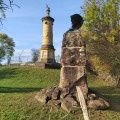
(6) Two monuments in memory of the soldiers of Lower Silesia: a tall column of yellow sandstone and a pink sandstone rock topped with an eagle.

(7) It was in this forest that the Turcos were overwhelmed by their enemies. By holding them back as long as possible, they allowed the rest of the defeated armies to retreat in good order to continue the war. To prevent it from falling into Prussian hands, the Turcos officer entrusted the French flag of his battalion to one of his sergeants. With a few comrades, the sergeant made his way to Strasbourg on foot, marching through enemy-occupied territory at night... without speaking either French or German!

"Maison des Turcos", the former home of the Wœrth rural policeman. On the evening of 6 August 1870, as the bulk of the French troops were retreating to the west, around thirty Turcos gathered around their captain, Pierre-Auguste Anglade. They were completely isolated from their comrades and surrounded by several hundred Bavarian soldiers. They were literally shot at and had no ammunition left to fight back... A Bavarian major advanced and ordered them to surrender in French. Anglade joined the major and plunged his sabre into his heart! He didn't even have time to pull it out before he was pierced with blows and his men who had followed him fell one by one in a final zigzag fight.

(8) Dürckheim Castle (private, the castle is generally only open to the public on Heritage Days or during private events and receptions)
The Eckbrecht de Durckheim family had held the village of Froeschwiller as a fief from the Bishop of Strasbourg since the 14th century. The castle, attached to the village church, consisted of a main building flanked by two towers and outbuildings accessible through a door in a passageway. At the rear was a garden and park. Around 1850, the castle was bought by Ferdinand de Durckheim, a cousin of the Durckheim-Montmartin family and then Prefect of Haut-Rhin, who had it rebuilt. It was then a large rectangular villa with a balcony supported by pillars. His son, Albert, had it transformed and enlarged again in 1890 by the architect Emanuel von Seidl, who added a large broken roof with pedimented dormers and a tower covered with a belvedere. A second residential building was erected alongside it, connected to the main building by an upper-floor passageway supported by a low arch. The outbuildings bear the coat of arms of the Durckheim family and the date 1891.

Church of Peace (It houses the only organ in Alsace made by the Bavarian organ builder Steinmeier)
The old church of Froeschwiller, dedicated to Saint Michael, became Protestant in 1552 when the Eckbrecht family of Durckheim took possession of the village. During the Simultaneum, the choir was reserved for Catholics.
In 1824, the architect Dufau undertook the reconstruction of the interior façade, then from 1841 to 1845, a new nave was built, with an entrance on the street, according to the plans of the architect Albert Haas.
During the battle of 6 August 1870, the church was destroyed, and the Germans promised to rebuild it, along with a Catholic church.
Charles Winkler, architect of historic monuments, proposed a neo-Gothic style construction project, which was accepted, allowing the new church to be built. It was inaugurated in 1876.
The reconstruction work was supervised and overseen by the Crown Prince, Frederick William, and financed by German donations.
The inauguration speech was given by Pastor Charles Klein on 30 July 1876, and the church was dedicated to Peace.

(9) The Belvedere monument: located on the heights of Wœrth, this pink sandstone tower was built about ten years after the battle by German veterans. It offers a unique panorama of the surrounding area: almost the entire battlefield, but also to the north and west, the blue line of the Vosges mountains, to the east the Hochwald massif and then the Black Forest, and finally to the south, the Haguenau forest.
The belvedere was erected in 1913 on the very site of the Prussian artillery battery brought here from Gunstetterberg to complete the French defeat. Each of the arches at the base of this monument is surmounted by the coat of arms of a German state that took part in the battle. Embedded in the pink sandstone are the barrels of German cannons used here during the conflict, symbolising "never again war". But we are already on the eve of the "Der des der". almost across the entire battlefield, but also to the north and west, on the blue line of the Vosges, to the east on the Hochwald massif, then on the Black Forest and finally to the south, on the Haguenau forest.

Reviews and comments

4.9 / 5
Based on 11 reviews

Reliability of the description
4.9 / 5
Ease of following the route
4.8 / 5
Route interest
4.8 / 5
Luttmi
Luttmi

Overall rating : 4.3 / 5

Date of your route : Mar 17, 2026
Reliability of the description : ★★★★★ Very good
Ease of following the route : ★★★★☆ Good
Route interest : ★★★★☆ Good
Very busy route : Yes

A beautiful route with views of the Black Forest. There are numerous memorials and monuments from the 1870 war, with clear explanations of the battle. I highly recommend this route; it immerses the hiker in the history of this dark period in Alsace’s past.

Machine-translated

Randoangels
Randoangels

Overall rating : 5 / 5

Date of your route : Sep 10, 2025
Reliability of the description : ★★★★★ Very good
Ease of following the route : ★★★★★ Very good
Route interest : ★★★★★ Very good
Very busy route : No

A very pleasant route... no major difficulties... beautiful panoramic views... very well maintained and passing through two magnificent Alsatian villages... numerous information panels... memorial stones... tombs... the battle of 6 August 1870 must have been terrible... I highly recommend this route!

Machine-translated

Ramon5791
Ramon5791

Overall rating : 4 / 5

Date of your route : Apr 28, 2025
Reliability of the description : ★★★★☆ Good
Ease of following the route : ★★★★☆ Good
Route interest : ★★★★☆ Good
Very busy route : No

A lovely historical walk

Machine-translated

Clamence
Clamence

Overall rating : 5 / 5

Date of your route : Jan 29, 2024
Reliability of the description : ★★★★★ Very good
Ease of following the route : ★★★★★ Very good
Route interest : ★★★★★ Very good
Very busy route : Yes

A pleasant route with beautiful views, and very informative.

Machine-translated

jijijcj
jijijcj

Overall rating : 5 / 5

Date of your route : Jan 11, 2024
Reliability of the description : ★★★★★ Very good
Ease of following the route : ★★★★★ Very good
Route interest : ★★★★★ Very good
Very busy route : No

Very beautiful route
I knew the Elsasshausen area but not the part in the forest above Woerth
Highly recommended

Machine-translated

Thecla
Thecla

Overall rating : 5 / 5

Date of your route : Feb 23, 2023
Reliability of the description : ★★★★★ Very good
Ease of following the route : ★★★★★ Very good
Route interest : ★★★★★ Very good
Very busy route : No

Hike already completed on 10/02/2023, then repeated today with a group. Very interesting and informative about part of Alsatian history. The route is very pleasant and there are also some beautiful views.
Thank you to the author of this route for sharing it and for all the explanations provided!

Machine-translated

Christian Sanry
Christian Sanry

Overall rating : 5 / 5

Date of your route : Apr 22, 2022
Reliability of the description : ★★★★★ Very good
Ease of following the route : ★★★★★ Very good
Route interest : ★★★★★ Very good
Very busy route : No

This route is of great interest to anyone interested in history. It begins with a pleasant visit to Woerth and continues with a tour of the battlefield of the famous 6 August 1870. The route to Froeschwiller is marked with well-designed information panels. The path is in the woods and is therefore ideal for a mid-season hike. The rest of the route is open and can be difficult in hot sunshine: remember to wear a hat and take water with you.
The route description is very precise and well done: well done to sylviadaniel for their work!
Two small comments to make the description perfect: at (3), you cannot see the multicoloured roof of the church because you are right next to the building; at (10), the stairs have been replaced by a ramp.

Machine-translated

Laurence68
Laurence68

Overall rating : 5 / 5

Date of your route : Sep 26, 2021
Reliability of the description : ★★★★★ Very good
Ease of following the route : ★★★★★ Very good
Route interest : ★★★★★ Very good
Very busy route : No

Great hike to do with the family.
Thank you for all the explanations.

Machine-translated

laroquette
laroquette

Overall rating : 5 / 5

Date of your route : Sep 21, 2021
Reliability of the description : ★★★★★ Very good
Ease of following the route : ★★★★★ Very good
Route interest : ★★★★★ Very good
Very busy route : No

A lovely walk in the sunshine before our return to the south.
Very interesting from a historical point of view.
Thank you for the very detailed description.

Machine-translated

tchequemat
tchequemat

Overall rating : 5 / 5

Date of your route : Feb 21, 2021
Reliability of the description : ★★★★★ Very good
Ease of following the route : ★★★★★ Very good
Route interest : ★★★★★ Very good
Very busy route : Yes

Hello,
A very beautiful hike on this first sunny Sunday.
The route was very well explained.
Thank you to the author.

Machine-translated

SM BISCHE
SM BISCHE

Overall rating : 5 / 5

Date of your route : Jan 26, 2021
Reliability of the description : ★★★★★ Very good
Ease of following the route : ★★★★★ Very good
Route interest : ★★★★★ Very good
Very busy route : No

An interesting and fairly short walk in and around WOERTH. Most of the route is on small tarmac roads. As this is a "battlefield discovery route", there is plenty to see: several information panels, monuments, memorials, churches and some beautiful views.
The Church of Peace in FROESCHWILLER has been closed since 7 January 2021 for an indefinite period, following a decision by the prefecture (safety work is reportedly needed).

Machine-translated

Other walks in the area

For more walks, use our search engine .

The GPS track and description are the property of this route's author. Please do not copy them without permission.