Discovering Besse for campers

What a pleasure it is to leave "home" on foot, taking a path through the woods along a beautiful stream to discover one of the most beautiful medieval villages in Auvergne!

Details

1261566
Creation:
Last update:
Last review:
  • Walking
    Activity: Walking
  • ↔
    Distance: 3.36 km
  • ◔
    Average duration: 1h 10 
  • ▲
    Difficulty: Easy

  • ⚐
    Back to start: Yes
  • ↗
    Ascent: + 60 m
  • ↘
    Descent: - 60 m

  • ▲
    Highest point: 1,042 m
  • ▼
    Lowest point: 981 m

Description of the walk

The starting point for this hike is the Bois de Gravière de Besse campsite, on the Route de Murol (D5) in Besse-en-Chandesse.

(S/E) Leave the campsite, cross the D5 and, opposite, slightly to the left, take the path to the right of the wooden huts, ignoring the small tarmac road on the left. The path runs alongside the Couze Pavin and, after the huts, you will see a restoration site for old mills on the left. You will come to an intersection with yellow directional signs.

(1) Continue straight ahead (towards the wash house, although this is actually on the left!), with the stream still on your left. Shortly afterwards, you will see more yellow signs. Follow them straight ahead towards Leylavaux. You will come to a road, the D36. Follow it to the left and cross the Couze Pavin. At the junction with Rue de la Résistance, continue straight ahead onto Rue des Anciens Combattants d'Afrique du Nord. Ignore a street on the right, pass the fire station, along the Pré Chadrat car park and note a large sign for the medieval village, then cross a street and continue straight ahead (30 km/h zone sign) to enter the village and continue until you reach Place Alfred Pinet, with a fountain.

(2) Notice the "Maison des Consuls" sign on the right. Turn right and notice the Maison de la Reine Margot on the left and the corresponding information sign on the right. Continue along the street on the far right, passing the shop that sells hides, to arrive immediately at Place de la Pairie.

Follow Rue de la Tour Chabrit on the right for a few metres until you reach a beautiful medieval house with a small watchtower at the top of the wall, then return to Place de la Pairie and take the first street on the right to arrive at Place de la Gayme. Continue a little further and turn right at the corner of Bar les Gentianes, towards the Belfry. Walk underneath to admire the beautiful gate on the other side, and note the fountain.

(3) Return to Place de la Gayme, head towards the fountain and take the second street on the right, Rue du Marché, on the left of the restaurant at no. 1. Shortly afterwards, on the small square, walk past "L'Cav à Bo" and turn into the passage on the right of this shop, at the "Rue du Marché" sign.

You will come to Rue Notre-Dame and follow it to the right. Shortly afterwards, at No. 13, go through the door of the media library, which also leads to the Tourist Office and a small park. Exit Rue Notre-Dame and continue to the right. Ignore a small street on the right and you will come to a fork in front of the Ancien Hôpital de Broglie (information panel).. Take Rue des Boucheries on the left to discover some beautiful medieval houses, including the Maison des Bouchers (information panel) on the corner of the first street on the right. Take this street on the right to reach Place Alfred Pinet and you will find a second Tourist Office opposite you, housed in a beautiful building.

Turn right, then right again in front of the town hall, then continue straight ahead, turning quickly left onto Rue aux Œufs. At the fountain on your right, turn left onto Rue Saint-André to find yourself in front of Saint-André Church. Look for an information panel and visit the church if you feel like it.

(4) Otherwise, turn right towards the back of the town hall, where you will see a large information panel about the town of Besse.

Walk along the left side of the town hall to return to Place Alfred Pinet, passing in front of the Tourist Office again. Turn right onto Rue Quartier Saint-Jean, but not before noticing the information panel about the Rôle des Places opposite you and a pretty shop, the Atelier du Monty, and its courtyard, just to the right of point 2. Further on, still on Rue Quartier Saint-Jean, you will see a fountain on the left and then arrive at a crossroads.

Continue straight ahead on Rue du Quartier de la Bessou. Ignore the two streets on the left to reach Rue de la Résistance and follow it to the left for about 20 metres. Turn right onto Rue du Lavoir, arrive opposite the Station Biologique building, turn right to pass in front of it, then turn left to cross the Couze Pavin. You will arrive at the crossroads marked with yellow signs that you took on the way there.

(1) Turn right to return to the campsite (S/E) via the same route as on the way there.

Waypoints

  1. S/E : km 0 - alt. 982 m - Bois de Gravière Campsite - Couze Pavin (rivière) à finaliser
  2. 1 : km 0.59 - alt. 1,006 m - Crossroads of the circular loop
  3. 2 : km 1.38 - alt. 1,036 m - Place Alfred Pinet
  4. 3 : km 1.58 - alt. 1,042 m - Belfry
  5. 4 : km 2.11 - alt. 1,030 m - Saint-André Church
  6. S/E : km 3.36 - alt. 982 m - Bois de Gravière Campsite

Notes

Hike difficulty: Very Easy, hiking boots recommended for the riverside section

Visorando is a wonderful tool, but for hikers who are not members of the Club, the IGN or OSM maps associated with the descriptions are too small to be really useful in towns and villages. I recommend doing what I do: enlarge the map on the website and take a screenshot to print out to accompany the PDF map.

This is not an advertisement for the Bois de Gravière campsite, as it is the only campsite in Besse. It may deserve its 4 stars for mobile home rentals, but this is not the case for the camping pitches. There are relatively few bare pitches, and most of these have been designed for motorhomes, with gravel and a grassy area rutted with wheel tracks. Only the pitches at the entrance to the campsite are nicer, but unfortunately they are not shaded and are far from the only toilet block (which is not very big). However, out of season, this should be fine.
Be sure to bring earplugs for:
1 - the roads surrounding the campsite, which are popular with motorcyclists (day and night),
2 - the showers, where the radio is constantly on and very loud.
In addition, the water pressure is so strong that it is difficult to wash the dishes without taking a shower at the same time, and the water is boiling hot. Despite this, the campsite is well located for exploring the pretty village of Besse on foot, without having to worry about finding a parking space. And the campsite is open all year round.

Worth a visit

Discover more hikes in this area with a description or the Visorando app here and more generally in the Puy-de-Dôme here

The name Besse comes from the Occitan word 'bessaou', which means 'birch'. The town developed economically in the Middle Ages as it was a trading post between the Limagne plain and the mountains. The farmers from the plain traded wine and cereals for meat and cheese from the mountain dwellers.
The town was long owned by the lords of La Tour d'Auvergne and was annexed to the Kingdom of France by Catherine de Medici in 1547. In the 13th century, it was inhabited by merchants, scholars and lawyers.
In the 15th and 16th centuries, the town's bourgeoisie rebuilt their houses using locally quarried trachyandesite stone. However, in the 19th century, the town's economic activities declined. With no railway connection, it suffered from rural depopulation. Besse then focused on its living environment and its architectural and natural heritage to become a holiday resort, attracting tourists in both summer and winter thanks to the development of winter sports from 1902 onwards.
The creation of Super-Besse in 1961 created jobs, but unfortunately at the expense of nature: a beautiful old beech forest was destroyed to create the ski slopes.

Besse-en-Chandesse or Besse-et-Saint-Anastaise? Originally, Besse and the hamlet of Chandèze were two parishes located four kilometres apart. As the church in Chandèze was completely destroyed during the Hundred Years' War, the priests of Chandèze took to officiating in Besse until the Revolution. In 1790, when the republican communes were created, the two municipalities were naturally merged under the name of Besse-en-Chandesse. In 1973, the commune merged with that of Saint-Anastaise and became Besse-et-Saint-Anastaise.

The House of Consuls. On either side of the street, the two houses were connected by a porch housing the consular hall. Two consuls were appointed by the inhabitants on the first of January each year. Their role was to organise the political and economic life of the town, with judicial functions being the responsibility of the Bailiff, the representative of the lords of the Tour d'Auvergne, then the lords of Broglie.

The House known as Queen Margot's House. Legend has it that, to escape her brother Henri III, Marguerite de Valois passed not far from Besse before taking up residence in Usson. This house was one of the most luxurious in the town, as evidenced by its architecture, which earned it the reputation of having housed Margot.

Place de la Pairie. The name of this square indicates that it was the place where taxes were paid in the Middle Ages. On the left, the house set back from the square has an interesting architectural style, combining Gothic and classical elements. Neither nobles nor clergy lived in Besse, only bourgeoisie who worked as merchants, lawyers and scholars. The houses often have an ogival tympanum door leading to a stair tower topped with a pepperpot roof. On the right, going up Rue de la Tour Chabrit, another door, decorated with figures wearing ruffs, recalls the fashion of the time of Henry IV.

Since the 15th century, Besse has had two squares dedicated to trade. The central square, or Place Alfred Pipet (2), was dedicated to the trade of wheat imported from Limagne, Champeix, Issoire, etc. The Town Hall is the former grain market built in the 1860s. Place de la Gayme was reserved for the trade of Saint-Nectaire cheese and was formerly called Place au Blanc, Blanc being the name of the delicious cheese during the first stage of its production. In Besse, you will find many shops where you can buy Saint-Nectaire and other Auvergne cheeses (Cantal, Salers, blue cheeses) as well as gentian liqueur.

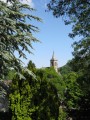
The Beffroi is the only gate built into the ramparts that is still intact. It is a fine example of military architecture, with its barbican and chicane, which slowed down the progress of attackers. This tower, a symbol of communal freedom from the clergy and nobility, marked the rhythm of civilian life (work, fires, alerts).

The former Broglie Hospital. This shop, built in the 15th century, was converted two centuries later into a charity house on the initiative of Marie de Broglie, who received authorisation from Louis XIV to transform it into a hospital for the poor in 1715. In the 18th century, it was common for the nobility to establish hospitals, but for the Broglie family, who had been the new lords of Besse since 1668, it was also a way of establishing their legitimacy.

The Maison des Bouchers was built in the 15th century and is part of a commercial block that reflects the importance of the local clientele. This house housed a butcher's shop from the time it was built until 1984. Note that Rue des Boucherie has a significant slope to facilitate the removal of organic waste, as animals were slaughtered in the street! This house is built of Besse lava stone, trachyandesite.

The Church of Saint-André is the oldest known building in Besse. It was built in the 12th century in the Romanesque style, but has been extensively remodelled since then and therefore features multiple architectural styles. It is built on a lava flow, which was the primary material used in the construction of the town. Inside, note the beautiful carved capitals and stalls. Every year, on the morning of 2 July, to commemorate Mary's visit to her cousin Elizabeth living in the Judean Mountains, the Black Madonna of the church is carried on the backs of men to the Chapel of La Vassivière, at an altitude of 1,300 metres and 8 kilometres from Besse. This is the Fête de la Montée (Feast of the Ascent). The return journey to Besse takes place on the Sunday after 21 September, and is marked by the night-time Festival of the Descent.

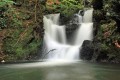
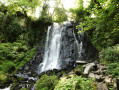
The Couze Pavin river rises at an altitude of around 1,580 metres in the Monts Dore, on the south-south-west slopes of the Puy de la Perdrix, on the border between the municipalities of Besse-et-Saint-Anastaise and Chambon-sur-Lac. It flows into the Allier river at Issoire. In Besse, it is a beautiful stream with fast-flowing waters that feeds the Chiloza Waterfalls, not far from the campsite.

Since 1901 (the date of its creation), the Besse Biological Station has welcomed scientists: botanists, limnologists, geochemists... whose work focuses on mountain flora, water and its composition in this volcanic environment... The building that houses the researchers is a former mill whose wheel was used until the 1970s to drive a turbine that supplied electricity to the station.
In 1935, the biological station welcomed the Bourbaki group of mathematicians, who created their imaginary mathematician Nicolas Bourbaki here. Under this name, the mathematicians wrote serious scientific publications, but also some humorous texts, such as this wedding announcement:

"Mr Nicolas Bourbaki, canonical member of the Royal Academy of Poldévie, Grand Master of the Order of Compacts, Curator of Uniforms, Lord Protector of Filters, and Madame, née Biunivoque, have the honour of announcing the marriage of their daughter Betti to Monsieur Hector Pétard, managing director of the Society of Induced Structures, graduate member of the Institute of Class Field Archaeologists, secretary of the Oeuvre du Sou du Lyon.
Mr Ersatz Stanislasz Pondiczery, retired first class recovery complex, president of the Hom de rééducation des faiblement convergents, knight of the four U's, grand operator of the hyperbolic group, knight of the total order of the golden mean, L.U.B., C.C., H.L.C., and Mrs. Pondiczery, née Compactensoi, are pleased to announce the marriage of their son Hector Pétard to Miss Betti Bourbaki, former pupil of the Bien Ordonnés de Besse.
Read more at this link.

Reviews and comments

grandin
grandin ★

Simple message to follow up on this hike.

Machine-translated

Other walks in the area

For more walks, use our search engine .

The GPS track and description are the property of this route's author. Please do not copy them without permission.