From the Sèvre Nantaise to the Moine

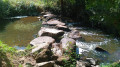
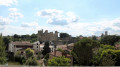
Between the tame and tranquil Sèvre Nantaise and the wild and secretive Moine, this life-size trail is sure to appeal to many hikers. Footbridges over the rivers make it easier to get around and allow you to better enjoy the steep-sided valleys.

Please note: due to the Hellfest festival in Clisson, the Sèvre Nantaise to Moine route is not accessible during the second half of June (dates to be checked each year).

Details

23379474
Creation:
Last update:
Last review:
  • Walking
    Activity: Walking
  • ↔
    Distance: 13.58 km
  • ◔
    Average duration: 4h 10 
  • ▲
    Difficulty: Moderate

  • ⚐
    Back to start: Yes
  • ↗
    Ascent: + 109 m
  • ↘
    Descent: - 118 m

  • ▲
    Highest point: 64 m
  • ▼
    Lowest point: 12 m
  • ⚐ Country: France
  • ⚐ District: Clisson (44190)
  • ⚑
    Start/End: N 47.085884° / W 1.282134°
  • ❏
    IGN map(s): Ref. 1324SB
  • Hour-by-hour weather

Description of the walk

(S/E) Head east, leaving the castle on your left. Go down the steps into the moat and turn right to join Rue de la Montée de l'Éperon.

(1) When you arrive, turn right and follow the road for about 20 metres before taking the path between two low walls at the Éperon playground. Then turn left to go down into Parc Henri IV and follow the Sèvre Nantaise stream. The path joins the tarmac road known as Chemin de Plessard at a place called La Feuillée, where you will find the Moulin de Plessard, home to the Clisson Canoe and Kayak Club (see section "During the hike"). When you reach Chemin de Plessard, turn left and, at the end of the tarmac road, continue along the path that follows it and runs alongside the Sèvre. The path leaves the river at an old factory and joins the Feuillée road on the banks of the Sèvre Nantaise to the east of the factory. Follow it to the Passerelle de l'Arsenal footbridge.

(2) Cross the Sèvre Nantaise via the footbridge and take the left-hand lane towards the Arsenal. Continue along the uphill path to Avenue Xavier Rineau, at the roundabout. Keep to the right of the roundabout to cross the road at the pedestrian crossing and take the footpath that continues along it. After ten metres, take the left-hand path which crosses the road serving a shopping area and runs alongside Avenue Xavier Rineau on the left. The path leads to Promenade Jeanne Favreau.
Take a detour to the left to see the Notre-Dame de Toutes Joies Chapel (see "During the hike" section).

(3) Walk along Promenade Jeanne Favreau towards the north-east. Cross the D149 road via the Pass Nantais bridge. Continue straight ahead along Chemin du Pass Nantais, which follows the road after the bridge. Walk to the entrance to La Monnerie.

(4) When you get there, turn right onto the road and follow it carefully for about 300 metres before turning left onto the path that heads east. When you reach La Coussaie, cross the road and continue straight ahead on the road, which is flat at first and then slopes slightly upwards. Further on, it passes under a high-voltage power line and arrives at the crossroads with the road leading to Le Tail on the left.

(5) Turn left towards Le Tail, cross the hamlet and, at the farm, continue along the path that follows the road. The path descends quite steeply towards La Moine. Cross the river via a footbridge.

(6) Turn left immediately after the footbridge to follow the course of the Moine on your left.
About 900 metres further on, at a fence, turn right onto the path leading up to the plateau and continue to the Saint-Crespin road. The path runs alongside a vineyard on the right-hand side as you arrive.

(7) Turn left and follow the road carefully for about sixty metres before turning right onto a path that heads north-east. The path passes several vineyards on the right. Shortly after the path on the right, turn left onto the path that leads to La Suardière, crossing an intermittent stream. When you reach the first houses, the path becomes a road. At the crossroads in the centre of La Suardière, where there is a calvary, turn left onto Rue des Meuniers, which heads westwards on a very slight downhill slope towards the village of La Sauzay. Near La Sauzay, stay on the road that turns left and heads south towards the village of Bournigal. The entrance to Bournigal is via Rue des Granits. This road leads to the crossroads with Route de Saint-Crespin.

(8) Cross the Saint-Crespin road carefully and follow Chemin des Sauts, which is slightly to the left. The path descends towards La Moine and runs alongside it after turning right. This is the Chauffardières area. Further on, the path climbs back up into a small wood. When you leave the wood, walk alongside the vineyards on your right. After a right-angle turn to the right, take the path on the left which runs alongside a plot of vines on your right. Follow this path which descends towards the D149 road after making a sharp turn.

(9) Pass under the viaduct that supports the D149 road and join the banks of the River Moine. The path runs alongside the River Moine towards the west. The path then climbs back up the hillside and joins Rue de Bournigal. Turn left about 20 metres after the first house on the left and follow the edge of the hillside south of the properties until you reach Rue Saint-Nicolas. Turn left into Rue Saint Nicolas. Just before the Trinity Church in Clisson, enter the Parc de la Garenne Valentin (see section "During the hike"). Turn left to pass in front of the Pavillon des Rochers and descend towards the Moine below the hillside. Follow the Moine river towards the south-west.

(10) Follow the path that passes under the Clisson viaduct supporting Rue de la Trinité and join Ruelle de la Moine. Follow it, then turn right into Rue Saint-Antoine. Then turn left into Rue de la Vallée and take the bridge over the Sèvre Nantaise. Immediately after the bridge, turn left into Rue de la Collégiale and follow it uphill to the intersection you passed on the way there.

(1) Turn right and, as at the start of the walk, pass by the castle moat and the stairs to return to the car park (S/E).

Waypoints

  1. S/E : km 0 - alt. 38 m - Car park - Château de Clisson
  2. 1 : km 0.22 - alt. 17 m - Common fork A/R
  3. 2 : km 1.6 - alt. 18 m - Footbridge over the - La Sèvre nantaise
  4. 3 : km 2.3 - alt. 38 m - Chapel of Our Lady of All Joys
  5. 4 : km 4.19 - alt. 35 m - Chemin x Route à la Monnerie
  6. 5 : km 5.89 - alt. 64 m - Fork in the road
  7. 6 : km 6.66 - alt. 23 m - Footbridge over the Moine
  8. 7 : km 8.02 - alt. 43 m - Route de Saint-Crespin
  9. 8 : km 9.84 - alt. 33 m - Carrefour route des Granits
  10. 9 : km 11.43 - alt. 19 m - Viaduct - Route D149
  11. 10 : km 12.97 - alt. 13 m - Passage under the Clisson viaduct
  12. S/E : km 13.57 - alt. 38 m - Car park - Château de Clisson

Notes

The parking area is located in the Château car park on Rue des Halles. Other parking options are available nearby on Avenue du Général Leclerc and Place des Douves.
Access: from Nantes, take the N249 heading south-east. At Vallet, turn right onto the D763. Follow this road to Clisson.

This hike covers varied terrain and requires suitable footwear.

This hike does not present any real difficulty in terms of orientation as it is marked in yellow and follows the route described in sheet no. 5 "From the Sèvre to the Moine" published by the Nantes Vineyard Tourist Office. It follows Promenade and Petite Randonnée (PR®) paths. In addition, it is advisable to follow the directions in the description and on the map, while paying close attention to the landscape. The waypoints (with their GPS coordinates and distance from the starting point) are helpful for hikers who are new to the route.

Additional information:
- The vineyard is a space shared between various uses (viticulture, market gardening, livestock farming, hunting, hiking). Cultivated plots may be subject to treatment. Everyone must respect the practices of others.
- Some paths are private, but the owners have granted permission to use them. Only by respecting the area can these permissions be maintained.
- Stay on the paths and do not enter the plots to pick fruit.
- Dogs must be kept on a leash.
- Remember to close gates and fences in the meadows to preserve the peace and quiet of the animals.
- During hunting season (Thursdays and Sundays from mid-September to the end of February), wear bright clothing.

Worth a visit

Clisson
Clisson was part of the Duchy of Brittany and, with its castle, was the keystone of the defence of the Marches of Brittany against Poitou and Anjou. The town is also known as Clisson l'Italienne (Italian Clisson) due to its Italianate architecture inspired by rural models from central Italy: Umbria, Lazio and Tuscany, and the town's landscape, redesigned by the great 19th-century artist François-Frédéric Lemot.

Places and monuments
The commune of Clisson has been a protected area for architectural, urban and landscape heritage since 25 April 1994.

Residences and castles
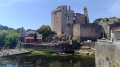
Clisson Castle
Clisson Castle has a rich history: first an impregnable fortress, then a ducal residence and finally a romantic ruin.
In the 12th century, the powerful lords of Clisson built this stone castle with highly sophisticated defensive architectural features: arrow slits, embrasures, machicolations, etc.
A strategic point protecting the border of the Duchy of Brittany in the 15th century, it was abandoned by its owners in the second half of the 17th century before being burned down by Republican troops in 1793.
But this castle also has a lesser-known history! In 1807, François-Frédéric Lemot, creator of the Domaine de la Garenne Lemot, was inspired by these ruins and bought the castle. It became a listed historical monument in 1924, before becoming the property of the Loire-Atlantique department in 1962.

The old city gate,
Built between 1592 and 1596 as part of the last major fortification works on the walled town of Clisson, undertaken by Odet d'Avaugour (1549-1598), Count of Vertus and Goëlo, Lord of Clisson.
It controlled access to the town from the south and the Vendée.
It was burned down in September 1793 during the destruction of Clisson.
In the mid-19th century, recognising the danger of crossing it, the municipality decided to move the entrance to the town to its current location on Rue des Halles.

The Garenne Lemot estate and its villa (also in the municipalities of Gétigné and Cugand)
This is an exceptional park on the banks of the Sèvre, dominated by an Italian-inspired villa.
Nothing here is as one might have imagined. In the 19th century, the sculptor François-Frédéric Lemot built a Tuscan-style house and a neoclassical villa on this former hunting ground.
In the middle of this 13-hectare park, overlooking the Sèvre and the town of Clisson, he created an idealised landscape, inspired by the great landscaped and picturesque gardens of the 18th century.
His extravagance did not stop there, as he punctuated the wooded paths with statues, a grotto, a tomb, a temple and columns.
At the heart of the estate, the Gardener's House completes the tour with an educational and entertaining display that helps visitors understand the origins of the site.

The Henri IV Park (opposite the Garenne Lemot), in which the sculptor Lemot erected a column topped with a bust of Henri IV.
In the heart of the historic centre of Clisson, on the banks of the Sèvre Nantaise stream, with picnic tables and children's games.

Places of worship
The Templar Chapel, a Romanesque church
This church, with Romanesque foundations, dates from the end of the 12th century and is the last remaining building of one of the many commanderies of the Knights Templar or Knights of the Order of the Temple, monk-soldiers who distinguished themselves particularly in Palestine. Attested in Clisson before 1213, this commandery of Mauléon owned numerous properties. The Hospitallers of St John of Jerusalem (Order of the Knights of Malta) succeeded the Knights Templar after 1312. In 1794, the commandery of La Madeleine du Temple was completely destroyed by the infernal columns of the Republican armies, except for the Templars' sanctuary. This was restored by the Compagnons du Devoir et du Tour de France in the 1970s and 1980s. The roof, in particular, was covered with Ponchâteau stone.
Today, the site hosts exhibitions and concerts.

The Church of Saint-Jacques
In the 11th century, it was a former Benedictine priory belonging to Saint-Jouin-de-Marnes, in Poitou. The Church of Saint-Jacques was built in the 12th century. It was a stopping place for pilgrims travelling on foot to Santiago de Compostela.
The remaining nave dates from the end of the 12th century and the roof structure from the mid-16th century (1583). It was in this church that the people of Clisson drew up their list of grievances in 1789.
The town of Clisson has owned St James' Chapel since 1967 and is now working to preserve it and bring it to life (cultural space with an annual programme of events). A medieval garden has also been created nearby.

Notre-Dame Church
Notre-Dame Church, built in the walled town of Clisson, may date back to the 13th-14th centuries. In his will dated 5 February 1407, Constable Olivier V, Lord of Clisson, founded a collegiate church in this church.
Burned and ransacked during the Wars of the Vendée (1793), Notre-Dame Church was restored during the Empire.
In 1887-1888, the religious building was completely restored based on plans by Nantes architect René Ménard. This new sanctuary, in the neoclassical-Romanesque style, was heavily inspired by the older church of St Giovanni e Paolo in Rome. The façade features relief sculptures.
Two frescoes, painted in 1931 and 1932 by Clisson painter Georges Lusseau, adorn the baptismal font and the back of the church's apse. The latter depicts several residents of Clisson.

The Church of the Trinity
The Trinity Church was originally a Benedictine priory with a parish, dependent on the abbeys of Saint-Martin-de-Vertou and Saint-Jouin-de-Marnes. In the 11th century, it was occupied by the canons regular of the Order of Saint Augustine. In 1645, Fontevrist nuns from La Regrippière en Vallet settled there. The convent was burned down in 1794 by the infernal columns of the Republican armies.
From the 11th century onwards, the church had a choir with an apse, side chapels and a square bell tower. In the 17th century, the Benedictine nuns replaced the Romanesque choir with an elongated choir, with a remarkable Baroque altarpiece. They demolished the southern part of the choir to build their oratory. During the Revolution, the church was returned to the parish.
Around 1867/1868, work was undertaken. The façade was rebuilt in a Neo-Romanesque style, while a Neo-Gothic style was favoured for the interior of the religious building.

The Temple of Friendship,
A listed historical monument, the Temple of Friendship was built on the St Gilles hillside between 1812 and 1824. It owes its name to the friendship between François and Pierre Cacault and the sculptor François-Frédéric Lemot, the initiators and creators of Clisson's Italianate architecture in the early 19th century. Pierre Cacault wanted to build a mausoleum in memory of his brother François, who died in Clisson on 10 October 1805, but as he did not have sufficient financial means, Lemot financed the project. Pierre died in 1810. In the end, the tombs of the two brothers were never built, as the Cacault heirs did not authorise the transfer of their ashes to the mausoleum. François-Frédéric Lemot was buried in this tomb on 18 May 1827.

The Cordeliers Convent
The Cordeliers were established in Clisson in 1410 by the daughter of Olivier de Clisson outside the walled town in the suburb of La Trinité. The monastery was burned down in 1793-94 and then used as a source of cut stone for reconstruction work in the surrounding area.All that remains is a fragment of the chapel's façade, a door with moulded jambs (from the 16th century) and a few arches of the church. The convent is located on private property but can be seen from the street. The owners allow access during certain events such as Heritage Days.

Other heritage sites
The Vallée Bridge,
Listed as a Historic Monument (1922), the Vallée Bridge was probably built in the 15th century by Duke François II to connect the suburbs of La Trinité and St-Antoine to the walled town of Clisson. This bridge has five spur points designed to divert strong currents during floods and various floating debris away from the piers. The bridge is unique in that it has six waterways, with arches of varying sizes. Originally, the structure included a drawbridge and two wooden footbridges. These wooden bridges served as passive defences and could be destroyed in the event of an attack from the suburbs. The footbridges were replaced by stone arches in the 19th century.

The Saint-Antoine Bridge over the Moine River
Listed as a Historic Monument since 18 March 1922 and dating from the 15th century, this granite bridge spanning the Moine River was probably built to replace a wooden footbridge. It owes its name to the chapel known as St-Antoine, attached to a chaplaincy, dedicated to St-Antoine and founded by a charter of Richard of Brittany, Count of Etampes, Lord of Clisson and brother of Jean V, Duke of Brittany. This original and unique structure in Brittany was, for centuries, the only passage between Clisson and Poitiers.

The market halls of Clisson
The market halls date from the 14th century (1376-1377). They occupy the town centre and extend from Rue St-Jacques to the southern end of Place Notre-Dame. Without a doubt, this location has always been the site of the market established by the local lords, close to their castle. The market halls' framework is made of three different types of wood: oak, chestnut and fir. It is one of the few buildings in Clisson to have been preserved during the Wars of the Vendée, as the site served as a shelter and camp for both Republican and Royalist troops.

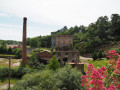
The Plessard mill (at the end of Henri IV Park)
Offers a remarkable view of the Parc de la Garenne Lemot! The mill was first mentioned in 1634. Originally a flour mill, it had many uses before becoming a power plant for Clisson in the early 20th century. It was purchased in 1821 by Baron Lemot's son to avoid noise pollution opposite the Parc de la Garenne. He enlarged it and turned it into one of the most beautiful Italian-style factories in Clisson. It now houses the Clisson canoe and kayak centre.

The Clisson viaduct
In the early 19th century, the central government was interested in opening new roads to facilitate the movement of its troops.
The Nantes-Poitiers road then passed underneath, via the small Gothic St Antoine bridge.
A law passed on 27 June 1833 decided on the construction of strategic roads in the western departments, and the construction of a viaduct spanning the Moine river, thus avoiding the need to cross Clisson, was envisaged.Designed by Jégou d'Herbeline from Nantes and completed in 1841, the viaduct is 106.80 metres long and 20 metres high, spanning the Moine with its 15 granite arches.
The originality of this structure lies in its design. The roadway is not supported by barrel vaults but by groin vaults formed by the intersection of transverse semicircular vaults with a longitudinal ogival vault.
Under the viaduct, one can imagine being in a Gothic cathedral: the perspective of the viaduct's piers resembles a ribbed vault.
On 30 August 1944, German troops blew up two arches of the viaduct. These were carefully rebuilt after the war.
From the top of the viaduct, you can enjoy one of the most beautiful panoramic views of the town of Clisson.

The remains of the city walls, notably the south gate known as the "Cabareau" or "Cahareau" gate
Listed as a Historic Monument on 21 December 1984.
Built between 1592 and 1596 as part of the last major fortification works on the walled town of Clisson, undertaken by Odet d'Avaugour (1549-1598), Count of Vertus and Goëlo, Lord of Clisson.
It controlled access to the town from the south and the Vendée.
It was burned down in September 1793 during the destruction of Clisson.
In the mid-19th century, recognising the danger of crossing it, the municipality decided to move the entrance to the town to its current location on Rue des Halles.

Clisson's heritage also includes the discovery of one of the most important French monetary deposits of the 19th century. This was unearthed at the end of 2002. It comprised 1,645 silver écus, or 45 kg of the precious metal, hidden around 1836 in an outbuilding of a former wine-growing estate. Part of this treasure is now kept at the Dobrée Museum.
Source: official website of the municipality, the Tourist Office and Wikipedia (excerpts)

Always be cautious and plan ahead when you're outdoors. Visorando and the author of this route cannot be held responsible for any accidents occurring on this route.

The GR® and PR® markings are the intellectual property of the Fédération Française de Randonnée Pédestre.

Reviews and comments

4.2 / 5
Based on 9 reviews

Reliability of the description
4.1 / 5
Ease of following the route
4.1 / 5
Route interest
4.3 / 5
GSO
GSO
• Edited:

Overall rating : 4.7 / 5

Date of your route : Mar 02, 2025
Reliability of the description : ★★★★☆ Good
Ease of following the route : ★★★★★ Very good
Route interest : ★★★★★ Very good
Very busy route : No

Please note that at point 2, after the footbridge, you cannot turn left. You must turn right and climb up towards the shopping centre above. Follow the signs for "Route between Sèvre and Moine". This will take you back to the trail after the Notre Dame de Toutes Joies chapel.
A very beautiful walk. I highly recommend it.

Machine-translated

viteetbien
viteetbien

Overall rating : 4.7 / 5

Date of your route : Sep 29, 2024
Reliability of the description : ★★★★★ Very good
Ease of following the route : ★★★★★ Very good
Route interest : ★★★★☆ Good
Very busy route : No

Despite a few sections through housing estates at the start of the walk, this is a beautiful route along the river and through the vineyards. The route is very well signposted and perfectly maintained by the local council.

Machine-translated

azerqsdf
azerqsdf

Overall rating : 4 / 5

Date of your route : Sep 11, 2024
Reliability of the description : ★★★★☆ Good
Ease of following the route : ★★★★☆ Good
Route interest : ★★★★☆ Good
Very busy route : No

Hello,
We enjoyed the section from Sèvre to the Pass(age) Nantais bridge on the D149 (except for the section before the shopping area) and along La Moine (there and back between 9 and 8, then back to the château) because when we saw the bridge and there were no signs to go straight ahead, it seemed to us that the route had changed and was going down towards La Moine, which is what we did (there is an arrow on the map, but following the route, especially with a black and white printout of the map, it didn't catch our attention).
The fact that the route seemed quiet to us may be due to the time of year (Thursday 5 September).
Kind regards,
Gwen and Véronique RUBAN

Machine-translated

Yves Peaudeau
Yves Peaudeau

Overall rating : 4 / 5

Date of your route : Sep 09, 2024
Reliability of the description : ★★★★☆ Good
Ease of following the route : ★★★★☆ Good
Route interest : ★★★★☆ Good
Very busy route : No

Good hike, which I am following on my mobile phone, easier than the description suggests.

Machine-translated

pgetrochon
pgetrochon

Hello,
The map accompanying the description is there to help you gauge distances and the time needed to cover them, which will vary depending on each individual.
Enjoy your walks!

Machine-translated

Anthocharis
Anthocharis

Overall rating : 3 / 5

Date of your route : May 13, 2024
Reliability of the description : ★★☆☆☆ Disappointing
Ease of following the route : ★★☆☆☆ Disappointing
Route interest : ★★★★★ Very good
Very busy route : Yes

The descriptions are difficult to follow, and changes in direction are not clearly explained. Fortunately, there are yellow markings. There is no distance between two changes in direction, so it can sometimes be worrying, wondering if you are still going in the right direction when you walk for 30 minutes without seeing a single yellow mark.
Frankly, it's disappointing despite the two pages. I don't feel like trying the experience again.

Machine-translated

pgetrochon
pgetrochon

Hello,

I don't know the exact dates for this year. But the Clisson Tourist Office should be able to provide you with them. In principle, it's the entire second half of June, as I indicated in the description.
Enjoy your walks!
Pgetrochon

Machine-translated

Aline7944
Aline7944

Hello,

When will the hike be available again? Considering HELLFEST?

Thank you
Aline

Machine-translated

Gilbertaron
Gilbertaron
• Edited:

Overall rating : 4.7 / 5

Date of your route : Mar 14, 2023
Reliability of the description : ★★★★★ Very good
Ease of following the route : ★★★★★ Very good
Route interest : ★★★★☆ Good
Very busy route : No

Visitor numbers: undoubtedly a seasonal issue. Not busy at this time of year. It must be busier in spring or summer. In any case, the signage in place is very easy to follow.

Machine-translated

braudjeanmarie1952
braudjeanmarie1952

Overall rating : 4 / 5

Date of your route : Nov 14, 2022
Reliability of the description : ★★★★☆ Good
Ease of following the route : ★★★★☆ Good
Route interest : ★★★★☆ Good
Very busy route : Yes

Beautiful hike, but lots of road and traffic.

Machine-translated

Padrig F
Padrig F

Overall rating : 4.7 / 5

Date of your route : Aug 08, 2022
Reliability of the description : ★★★★★ Very good
Ease of following the route : ★★★★☆ Good
Route interest : ★★★★★ Very good
Very busy route : No

A very pleasant route. Clisson is magnificent, but this hike also allows you to explore less travelled paths and leave the historic centre, which is very touristy.
The only downside is the section through the Fief du Parc area (supermarket), which isn't very pleasant (it's a bit confusing in terms of signposting, and the route on the hiking map doesn't match up).
But this area is really nice, I recommend it!

Machine-translated

MSmarcelsalmon
MSmarcelsalmon

Overall rating : 4 / 5

Date of your route : Aug 08, 2022
Reliability of the description : ★★★★☆ Good
Ease of following the route : ★★★★☆ Good
Route interest : ★★★★☆ Good
Very busy route : No

The appeal of the route is that it allows you to explore the countryside around La Moine, but I particularly appreciate the notes on the history of Clisson.
Thank you to our friend, the hiker, who can apply to be a guide for Clisson and its surroundings!

Machine-translated

Other walks in the area

For more walks, use our search engine .

The GPS track and description are the property of this route's author. Please do not copy them without permission.